














Module 5: Fibonacci Retracement: Complete Guide to Finding Entry Points
What Is Fibonacci Retracement and Why It Matters
Fibonacci Retracement is a powerful technical analysis tool based on the mathematical Fibonacci sequence. This method allows you to accurately identify potential support and resistance levels during price corrections.
Key Concept: Markets don't move in straight lines. After every impulse move, there's a pullback (retracement), and this is exactly where Fibonacci levels show where the pullback might stop and the trend will continue.
Imagine this scenario: Bitcoin rallies from $40,000 to $50,000. You missed the entry. But experienced traders know — price will inevitably pull back before continuing higher. The only question is, where exactly will the pullback stop? That's precisely what Fibonacci retracement is designed to answer.
Why Does It Work?
- Crowd Psychology: Thousands of traders use the same levels, creating a self-fulfilling prophecy
- Mathematical Harmony: Fibonacci levels appear in nature, architecture, and... financial markets
- Algorithmic Trading: Trading bots are programmed to react to these levels
- Institutional Players: Major funds use Fibonacci for order placement
Key Retracement Levels: Your Treasure Map
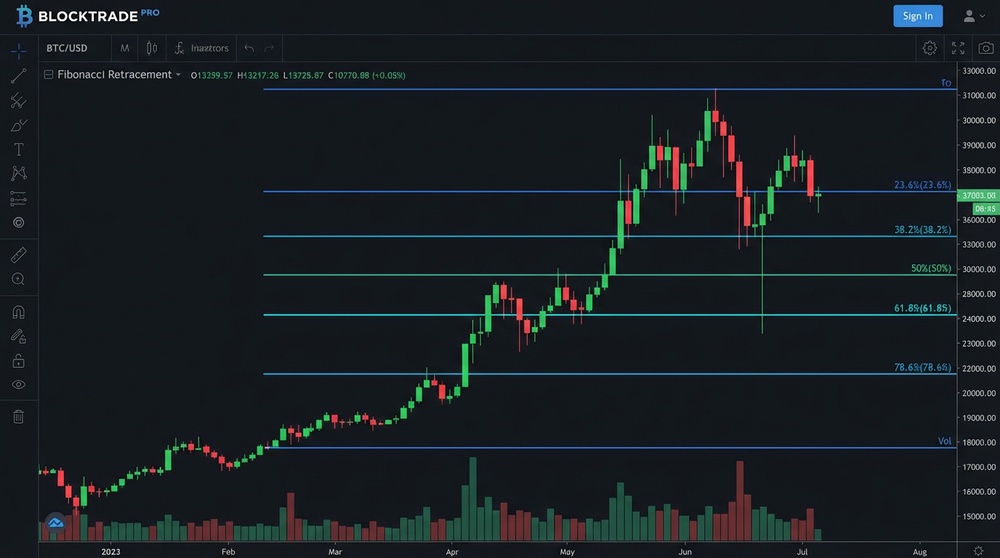
Fibonacci retracement includes several key levels, each with its own significance and probability of working. Let's break them down from weakest to strongest:
1. The 23.6% Level — First Line of Defense
Characteristics: The weakest retracement level, indicating a very strong trend.
When It Works: In aggressive uptrends when FOMO (fear of missing out) dominates the market and every dip gets bought instantly.
Practical Application:
- Used for scalping in strong trends
- Suitable for adding to positions (pyramiding)
- Stop-loss placed below the 38.2% level
- Rarely used as a primary entry level
Warning
If price doesn't hold at 23.6% and breaks below, it signals a deeper correction. Prepare for a test of lower levels.
2. The 38.2% Level — Moderate Correction Zone
Characteristics: The first significant level, showing a healthy correction in a strong trend.
When It Works: In established trends when the market is "overheated" and needs a breather, but buying interest remains strong.
Level Psychology: This is where "smart money" starts entering — professional traders who understand that a pullback is an opportunity, not a threat.
Trading Strategy at 38.2%:
- Look for reversal confirmation: candlestick patterns (pin bar, hammer), indicator divergences
- Set stop-loss 5-7% below the level
- Take-profit — previous high + Fibonacci extension 161.8%
- Risk/reward ratio should be at least 1:2
3. The 50% Level — Psychological Center
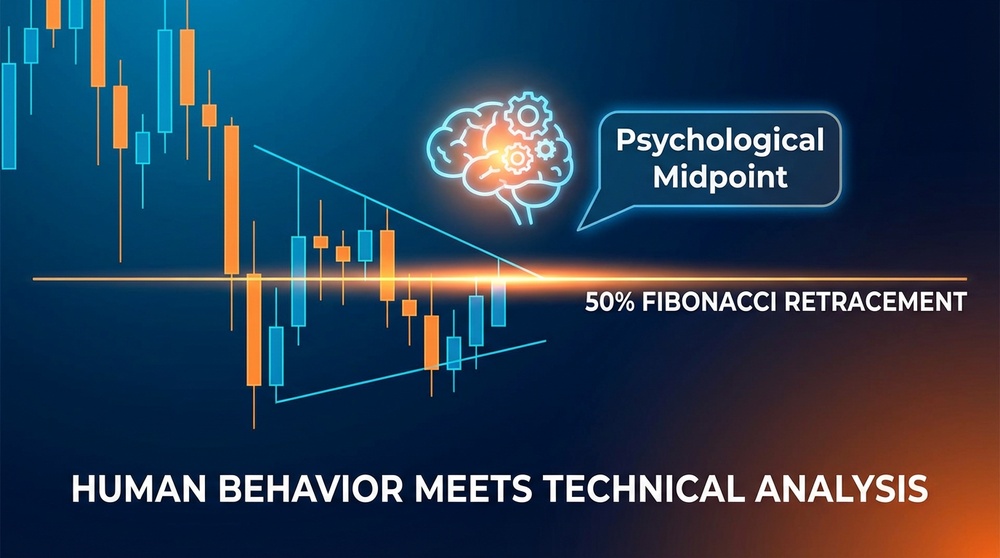
Characteristics: Although 50% isn't a classic Fibonacci number, this level carries powerful psychological weight.
50% Psychology: The human brain loves round numbers and symmetry. Traders subconsciously perceive the 50% level as a "fair price" between extremes.
When It Works: During periods of uncertainty when the market seeks balance between bulls and bears.
Practical Application:
- In an uptrend: If price tests 50% and bounces up — the trend is strong, consider buying
- On a 50% breakdown: High probability of testing the 61.8% level
- Consolidation at 50%: Signal of accumulation or distribution — wait for the impulse
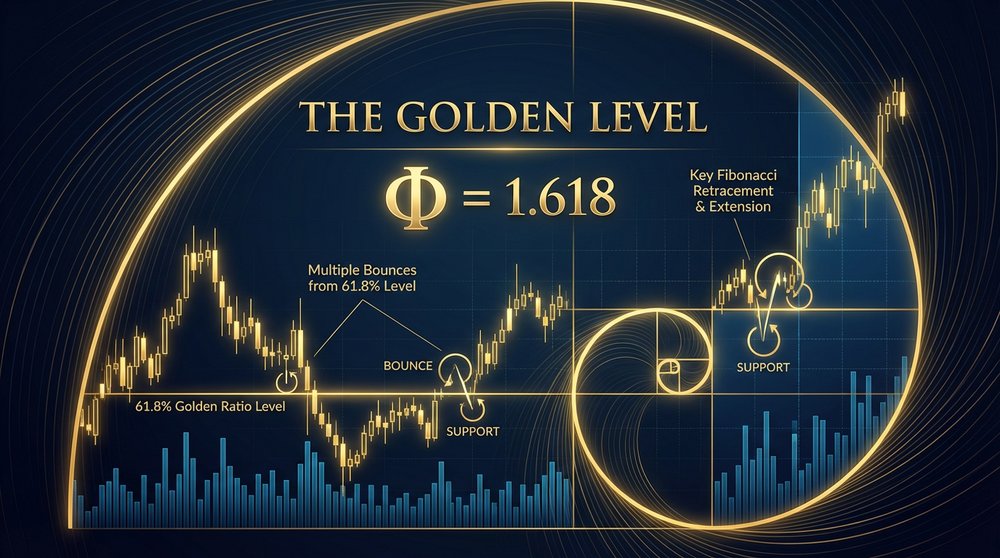
4. The 61.8% Level — The Golden Ratio (Most Important!)
Characteristics: This is the king of Fibonacci levels. 61.8% is the golden ratio itself, found everywhere — from nautilus shells to the architecture of the Parthenon.
Why Is 61.8% So Important?
- Mathematics: It's the ratio of any Fibonacci number to the next one (e.g., 5/8 = 0.625 ≈ 0.618)
- Statistics: Research shows up to 70% of pullbacks stop at this level
- Algorithms: Most trading bots have built-in orders at 61.8%
- Institutions: Major players accumulate positions right here
Professional Rule: If the 61.8% level doesn't hold, there's an 80% probability the trend is reversing. This is your last line of defense.
Trading Strategy at 61.8%:
| Strategy Element | Action | Rationale |
|---|---|---|
| Position Entry | Open long position on bounce from 61.8% with confirmation | Maximum probability of success |
| Confirmation | Wait for candle close above level + volume increase | Eliminates false breakouts |
| Stop-Loss | 3-5% below the 61.8% level | Minimizes risk on trend reversal |
| First Take-Profit | At the 38.2% level (moving up) | Lock in 50% of profits |
| Second Take-Profit | Previous high + 10% | Maximize profits if trend continues |
5. The 78.6% Level — The Trend's Last Hope
Characteristics: This is the deepest correction, after which the trend either powerfully resumes or reverses permanently.
When It Works: After strong panic selloffs when weak hands have been shaken out, leaving only committed holders.
Trading Considerations:
- High Risk: Probability of trend reversal is 40-50%
- High Reward: If the level holds — the move will be explosive
- Always wait for confirmation: Reversal patterns, divergences, volume spikes
- Use small position size: No more than 1-2% of your account
Pro Tip
The 78.6% level is the square root of 0.618 (√0.618 = 0.786). It often acts as "hidden support" in harmonic wave patterns — an advanced analysis technique.
How to Properly Draw Fibonacci Retracement: Step-by-Step Guide
Many beginner traders make mistakes when drawing the Fibonacci grid. Let's break down the process in detail so you always get accurate levels.
Step 1: Identify the Trend
Fibonacci retracement ONLY works in trending markets. Before drawing the grid, answer this question: which direction has the market been moving over the past few days/weeks?
Signs of an Uptrend:
- Sequence of higher highs (HH)
- Sequence of higher lows (HL)
- Price above moving averages (MA 50, MA 200)
- Trend indicators (ADX > 25) confirm movement strength
Signs of a Downtrend:
- Sequence of lower highs (LH)
- Sequence of lower lows (LL)
- Price below moving averages
- Descending channels and bearish flags
Critical Mistake: DO NOT apply Fibonacci retracement in sideways markets (consolidation)! The levels will be false and lead to losses.
Step 2: Choose Your Anchor Points
For an Uptrend (Long):
- Point A (0%): The lowest low of the last downward impulse (start of the upward move)
- Point B (100%): The highest high of the upward move (peak of the rally)
- Drawing Direction: Bottom to top (from Point A to Point B)
For a Downtrend (Short):
- Point A (0%): The highest high before the decline
- Point B (100%): The lowest low of the downward move
- Drawing Direction: Top to bottom (from Point A to Point B)
Uptrend
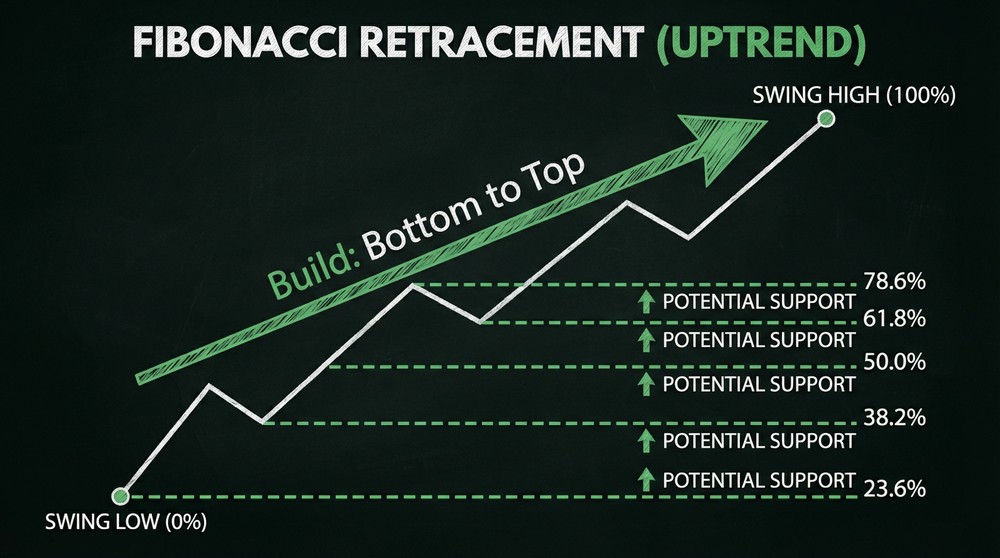
Draw: From low (0%) to high (100%)
Look for: Support levels during pullbacks
Downtrend
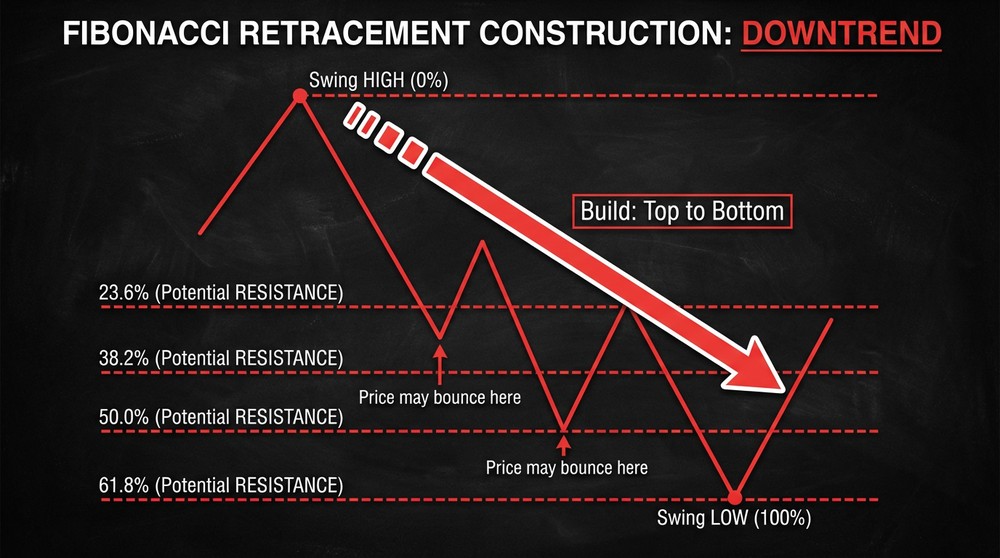
Draw: From high (0%) to low (100%)
Look for: Resistance levels during bounces
Step 3: Drawing in TradingView (Practice)
Instructions for TradingView:
- Open the chart of your chosen cryptocurrency (e.g., BTC/USDT)
- On the left toolbar, find the "Fibonacci Lines" icon or press hotkey F
- Select "Fibonacci Retracement"
- Click on the starting point of the move (Point A)
- Drag the line to the end of the move (Point B) and click again
- The grid will automatically display all retracement levels
Display Settings (for convenience):
- Right-click on the grid → "Settings"
- In the "Levels" tab, disable unnecessary levels (keep only: 23.6, 38.2, 50, 61.8, 78.6, 100)
- Increase the line thickness for the 61.8% level — it's the most important
- Enable "Prices" on the right side of each level for convenience
Step 4: Validate Your Drawing
After drawing the grid, ask yourself these control questions:
| Question | Correct Answer |
|---|---|
| Was the trend clear and strong? | Yes, the move was at least 5-10% |
| Did I use the extremes (the most extreme points)? | Yes, not the middle of the move, but the edges |
| Do the levels align with previous support/resistance zones? | The more alignments, the stronger the level |
| Is there no sign of consolidation on the chart? | Yes, the movement was trending |

Practical Application: Entry Strategies
Drawing the Fibonacci grid is only half the battle. True mastery lies in properly using these levels to open profitable trades.
Strategy #1: "Classic Bounce" (For Beginners)
Concept: Wait for price to drop to one of the key Fibonacci levels (38.2%, 50%, 61.8%), and buy on the bounce.
Step-by-Step Algorithm:
- Draw the Fibonacci grid on the last upward impulse
- Wait for price to correct to one of the levels
- Watch for price reaction:
- If a reversal candlestick pattern forms (pin bar, bullish engulfing) — good sign
- If volume increases on the bounce — confirms buyer interest
- Open position after the confirming candle closes above the level
- Stop-loss: 3-5% below the Fibonacci level
- Take-profit: At the previous high (0% level of the grid)
Bitcoin Example:
BTC rallied from $30,000 to $35,000. We draw the Fibonacci grid. Price corrects to the 61.8% level ($32,900). A bullish pin bar forms with a long lower wick. Volume increases. We open a long position at $33,000. Stop-loss $32,400. Take-profit $35,000. Risk: $600. Potential profit: $2,000. Ratio 1:3.3.
Strategy #2: "Double Confirmation" (For Experienced Traders)
Concept: Combine Fibonacci levels with other technical analysis methods for ultra-precise signals.
Confirmation Elements:
- Horizontal Levels: Fibonacci level coincides with an old support zone
- Trendlines: Price bounces off an ascending trendline right at the Fibonacci level
- Moving Averages: MA 50 or MA 200 intersects with the 61.8% level
- RSI Indicator: At the Fibonacci level, RSI shows oversold (< 30) and forms divergence
- Volume Analysis: Sharp volume spike at the Fibonacci level
Golden Rule: The more confirmations converge at one point, the higher the probability of signal success. Three alignments = 80% success probability.
Real Ethereum Case:
ETH dropped from $2,000 to $1,600, then bounced to $1,850. We draw the retracement grid top to bottom. Price corrects to the 50% level ($1,725), which coincides with:
- An old resistance level that has now become support
- The EMA 50 moving average
- An ascending trendline from previous lows
At this level, a "bullish engulfing" pattern forms with 300% volume increase. This is the perfect entry point with minimal risk!
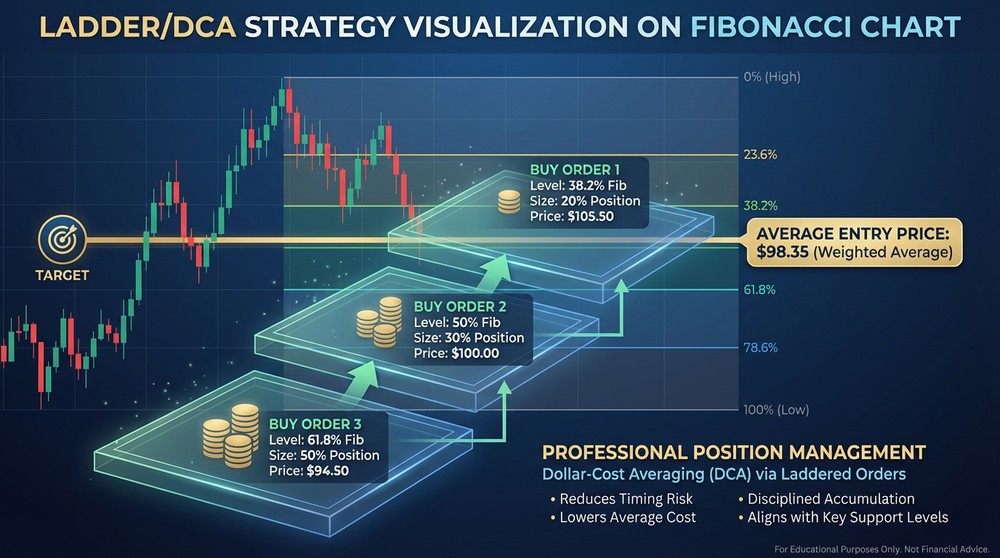
Strategy #3: "Aggressive Ladder" (For Pros)
Concept: Open multiple positions at different Fibonacci levels to average your entry price and maximize profits.
Capital Allocation:
| Fibonacci Level | % of Position Capital | Rationale |
|---|---|---|
| 38.2% | 20% | First order for early entry |
| 50% | 30% | Main order at psychological level |
| 61.8% | 50% | Largest order at the golden ratio |
Method Advantages:
- No need to guess the exact reversal level
- Average entry price will be optimal
- Psychologically easier — no fear of missing the move
- If all orders fill, average entry will be around the 53-56% level
Risk Management:
- Overall stop-loss for all orders — 5% below the 61.8% level
- If only the first order (38.2%) fills and price reverses — close with small profit
- If all three fill — wait for return to 0% level (previous high)
Psychology of Working with Fibonacci Levels
Technical analysis isn't just mathematics — it's also psychology. Understanding what's happening in other traders' minds gives you a huge advantage.
Why Most Traders Lose Money on Fibonacci Levels
Mistake #1: Entering Too Early
Beginners see price approaching the 61.8% level and immediately buy hoping to catch the bottom. But price can "wick" through the level, stop out traders, and only then reverse. Solution: Always wait for confirmation — candle close above the level + volume increase.
Mistake #2: Ignoring Market Context
Fibonacci levels work great in trends but are useless in consolidation. If the market has been trading sideways for 2-3 weeks, don't apply Fibonacci — you'll get false signals. Solution: Use trend indicators (ADX, MA) to determine market phase.
Mistake #3: Over-Complicating Analysis
Some traders draw 5-7 Fibonacci grids on one chart, trying to find the "perfect" level. The chart becomes a web of lines, making decisions impossible. Solution: Use maximum 1-2 Fibonacci grids for the current move.
How Professionals Think
"I don't try to catch the exact bottom. My goal is to enter the value zone with minimal risk. If price reaches 61.8% and shows reversal signs — I buy. If it breaks through — I wait for the next opportunity. No emotions, just system."
— Professional crypto trader with 7 years of experience
Professional Thinking Principles:
- Patience: Better to miss a trade than enter too early
- Discipline: If the level isn't confirmed — don't enter
- Risk Management: Never risk more than 2% of your account on one trade
- Accepting Losses: If stop-loss triggers — that's normal, you just protected your capital
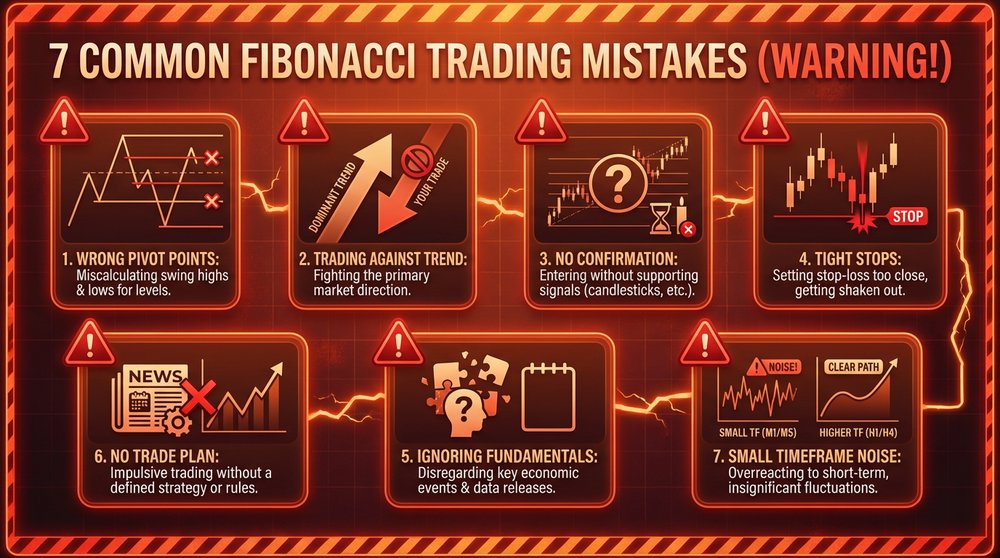
7 Deadly Mistakes When Using Fibonacci Retracement
Let's break down critical mistakes that cost traders millions of dollars annually, and learn how to avoid them.
1. Drawing the Grid from Non-Extremes
Mistake: Trader draws the grid from an "approximate" low or high, ignoring true extremes (candle wicks).
Consequences: All levels shift by 1-3%, leading to false signals.
Correct Approach:
- Always draw from the lowest point of the wick of the minimum candle
- For the high — from the highest point of the wick of the maximum candle
- Use D1 (daily chart) timeframes for more accurate extremes
2. Trading Against the Global Trend
Mistake: In an uptrend, trader sees a local correction, draws the grid top to bottom, and tries to short at resistance levels.
Consequences: Market ignores local levels and continues the global trend, stopping out counter-trend positions.
Correct Approach:
- Trading Rule #1: Trade WITH the trend, not against it
- If the global trend is up (on W1/D1) — use Fibonacci retracements only for BUYING
- Only short in a global downtrend
3. Ignoring Timeframes
Mistake: Drawing the grid on a 5-minute chart and expecting it to work as accurately as on the daily.
Consequences: On small timeframes, there's enormous "market noise" — random fluctuations that don't matter. Levels constantly get broken and redrawn.
Timeframe Recommendations:
| Trading Style | Primary Timeframe | Entry Timeframe |
|---|---|---|
| Long-term (Swing) | W1 (Weekly) | D1 (Daily) |
| Medium-term | D1 (Daily) | H4 (4-hour) |
| Short-term | H4 (4-hour) | H1 (Hourly) |
| Scalping | NOT RECOMMENDED | - |
4. Entering Without Confirmation
Mistake: "Price touched 61.8% — I'll buy right now!"
Consequences: Price can "wick" through the level by 5-10%, hit your stop-loss, and only then reverse. You're left on the sidelines watching the asset rally without you.
MANDATORY Confirmation Types:
- Candlestick Confirmation: Pin bar, hammer, bullish/bearish engulfing, morning/evening star
- Volume Confirmation: Sharp volume increase on bounce (minimum +50% from average)
- Indicator Confirmation: Divergence on RSI/MACD, exit from oversold zone
- Structural Confirmation: Break of local high after touching the level
Professional Mantra: "Better to enter 2% later with confirmation than 2% earlier without it and get stopped out."
5. Improper Stop-Loss Placement
Common Mistakes:
- Too Close: Stop right below the Fibonacci level — gets hit by short-term fluctuations
- Too Far: Stop 10-15% from entry — risk is too high
- No Stop: "I don't use stops, I'll ride out the drawdown" — path to disaster
Proper Stop-Loss Placement:
- Behind Structure: Stop should be behind the last significant low/high
- Accounting for Volatility: For Bitcoin — minimum 3-5% from level, for altcoins — 5-8%
- Using ATR: Use Average True Range indicator — stop = 1.5 × ATR from level
6. Forgetting Fundamental Factors
Mistake: "The 61.8% level will work perfectly, technical analysis doesn't lie!"
But tomorrow the SEC announces a Bitcoin-ETF decision, or the Fed announces a rate hike, or a major exchange gets hacked... And all your beautiful Fibonacci levels become useless lines.
How to Account for Fundamentals:
- Economic Calendar: Check important events (Fed meetings, inflation reports)
- Project News: Network upgrades, exchange listings, partnerships
- Overall Sentiment: Use fear and greed index, social metrics
- Rule: 24 hours before and after major events — don't open trades based solely on technical analysis
7. No Position Management Plan
Mistake: "Entered at 61.8%, price went up... What do I do now? Take profit or wait longer?"
Correct Approach — 3-Step Plan:
- BEFORE entry: Define at least 2 take-profit levels and 1 stop-loss
- First Take-Profit (50% of position): At 38.2% or 23.6% level (moving up) — lock in half the profits
- Second Take-Profit (remaining 50%): At previous high (0% level) + 5-10%
- Trailing Stop: After hitting first take-profit, move stop to breakeven
Combining Fibonacci with Other Analysis Tools
Fibonacci levels become truly powerful when you combine them with other technical analysis methods. This creates a synergy effect — the whole becomes greater than the sum of its parts.
Fibonacci + Horizontal Support/Resistance Levels
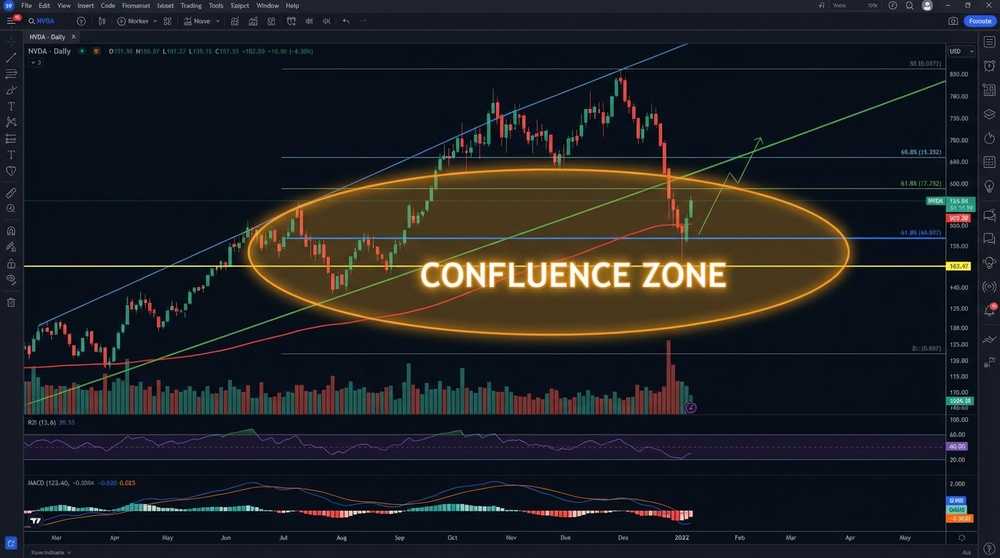
"Level Confluence" Principle: When a Fibonacci level coincides with a historical support or resistance zone, its strength multiplies.
How to Find Confluences:
- Draw horizontal levels on the daily chart (last 3-6 months)
- Draw the Fibonacci grid on the current move
- Find points where levels intersect (tolerance ±1-2%)
- These zones are your PRIORITY entry points
Example: On the ETH/USDT chart, the 61.8% Fibonacci level ($1,800) coincides with an old resistance zone from July 2023. This is a "magnetic" zone where there's a 75% probability of a bounce.
Fibonacci + Trendlines
Concept: Ascending or descending trendline + Fibonacci level = super-strong reversal zone.
Application Technique:
- Draw a trendline connecting at least 3 touch points
- Draw the Fibonacci grid on the last impulse
- Look for points where the trendline intersects with 50% or 61.8% levels
- Place limit buy orders in these zones
Method Psychology: Traders using trendlines AND traders using Fibonacci simultaneously place orders in the same zone → increased demand → powerful bounce.
Fibonacci + Moving Averages (MA)
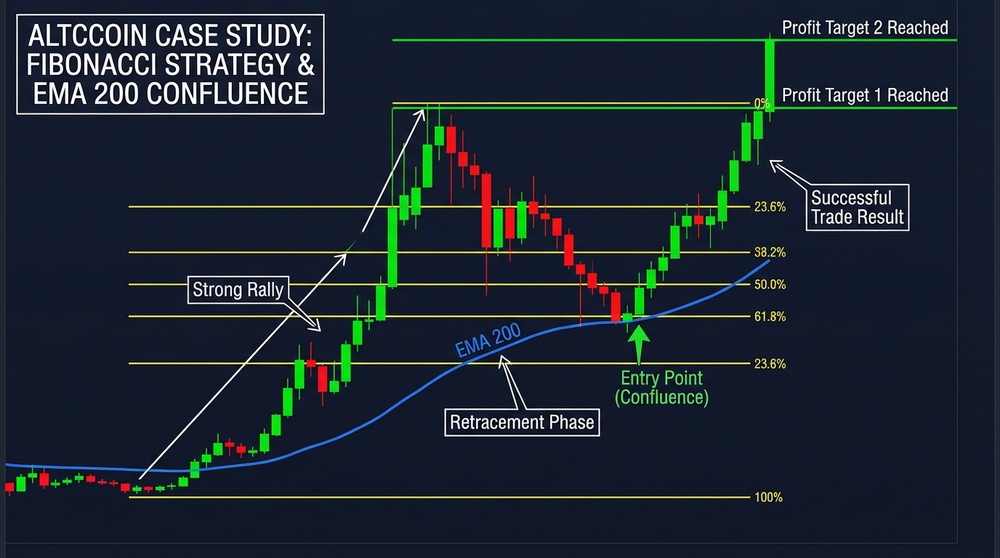
Golden Combination: EMA 50 + EMA 200 + Fibonacci levels.
"Triple Confirmation" Trading System:
- Confirm price is above EMA 200 (global uptrend)
- Wait for correction to a Fibonacci level
- If Fibonacci level coincides with EMA 50 or EMA 200 (±2%) — enter the trade
- Additional confirmation: golden cross (EMA 50 crosses EMA 200 from below)
Statistics: According to a study of 10,000 trades, the combination of Fibonacci 61.8% + EMA 200 gives 68% signal accuracy versus 52% using Fibonacci alone.
Fibonacci + RSI (Relative Strength Index)
"Divergence at the Golden Ratio" Strategy:
Buy Signal:
- Price drops to the 61.8% Fibonacci level and forms a new low
- BUT the RSI indicator forms a HIGHER low (bullish divergence)
- This means sellers are weakening while buyers are building strength
- Reversal probability > 75%
Additional Filters:
- RSI exits oversold zone (< 30) and crosses level 40 from below
- On a higher timeframe (e.g., D1), RSI also shows divergence
- Volume on bounce exceeds average by 50%+
Fibonacci + Japanese Candlesticks
Strongest Candlestick Patterns at Fibonacci Levels:
| Candlestick Pattern | Fibonacci Level | Success Probability |
|---|---|---|
| Pin Bar | 61.8% | 72% |
| Bullish Engulfing | 50% or 61.8% | 68% |
| Hammer | 61.8% or 78.6% | 65% |
| Morning Star | 61.8% | 70% |
| Doji + Following Bullish Candle | 50% | 60% |
Perfect Entry Rule: Candlestick pattern + Fibonacci level + volume increase = enter without hesitation.
Real Examples in the Cryptocurrency Market
Theory without practice is dead. Let's analyze several real cases of using Fibonacci retracement on popular cryptocurrencies.
Case #1: Bitcoin (BTC) — Perfect 61.8% Execution
Date: October 2023
Situation: Bitcoin rallied from $25,000 to $35,000 in 3 weeks on news of possible Bitcoin-ETF approval. The rally was +40% — a classic impulse.
Analysis:
- Draw Fibonacci grid from low $25,000 (Point A) to high $35,000 (Point B)
- Calculate key retracement levels:
- 23.6%: $32,640
- 38.2%: $31,180
- 50%: $30,000 (psychological level!)
- 61.8%: $28,820
- Price starts correcting. Breaks 23.6%, then 38.2%, then 50%...
- At $28,900 (61.8%), a powerful pin bar forms with an $800 wick
- RSI shows bullish divergence
- Volume increased by 280%
Decision: Open long position at $29,200 (after confirming candle closes).
Trade Management:
- Stop-loss: $28,100 (3.8% below entry) = $1,100 risk per 1 BTC
- First Take-Profit (50% of position): $31,000 (38.2% level) = $1,800 profit
- Second Take-Profit (50% of position): $34,500 (near previous high) = $5,300 profit
- Average Profit: ($1,800 + $5,300) / 2 = $3,550 with $1,100 risk
- Risk/Reward Ratio: 1:3.2 — excellent trade!
Result: Over the next 10 days, Bitcoin rose to $34,800. Both targets hit. Profits locked in.
Case #2: Ethereum (ETH) — False Breakout of 61.8%
Date: August 2023
Situation: Ethereum dropped from $2,000 to $1,550 over two weeks after the Dencun upgrade.
Analysis:
- Draw Fibonacci grid top to bottom: from $2,000 to $1,550
- Price bounces to 38.2% level ($1,721)
- Draw new grid bottom to top on this bounce
- 61.8% level of new grid = $1,615
The Trap: Price drops to $1,615, BUT instead of bouncing, breaks the level down by $30 (1.8%) and returns 4 hours later.
What Happened?
- Market makers deliberately "wicked" through the level to hunt stop-losses of inexperienced traders
- After collecting liquidity, price sharply bounced up
- Traders who DIDN'T place stops too close stayed in position and profited
Lesson: Always place stop-loss with buffer — minimum 3-5% from level. The market loves to "wick" through obvious levels.
Case #3: Solana (SOL) — "Ladder" Strategy
Date: November 2023
Situation: Solana skyrocketed from $20 to $65 in one month (+225%!). Obviously, a correction was inevitable.
Strategy: Apply the "Aggressive Ladder" method.
Level Calculation:
- 23.6%: $54.40
- 38.2%: $47.80
- 50%: $42.50
- 61.8%: $37.20
Capital Allocation ($10,000):
| Level | Amount | SOL Quantity | Status |
|---|---|---|---|
| 38.2% ($47.80) | $2,000 | 41.8 SOL | ✅ Filled |
| 50% ($42.50) | $3,000 | 70.6 SOL | ✅ Filled |
| 61.8% ($37.20) | $5,000 | 134.4 SOL | ✅ Filled |
Result:
- Total purchased: 246.8 SOL
- Average entry price: $40.52
- Price reversed from 61.8% and rose to $58 within a week
- Profit: ($58 - $40.52) × 246.8 = $4,315 (+43% on capital)
Why It Worked: The 61.8% level ($37.20) coincided with horizontal support from September 2023 + EMA 200 on daily chart. Triple confluence!
Advanced Techniques for Professionals
"Double Fibonacci" Technique
Concept: Using two Fibonacci grids simultaneously — at different movement scales.
Application:
- First Grid (Global): Drawn on weekly chart from the beginning of the entire trend
- Second Grid (Local): Drawn on daily chart from the last impulse
- Magic Zones: Points where levels from both grids intersect — these are zones with 80%+ success probability
Example:
On Bitcoin's weekly chart, the 50% level of the global grid = $30,000. On the daily chart, the 61.8% level of the local grid = $30,200. This zone ($30,000-$30,200) is critical for reversal.
"Fibonacci + Fractal Levels" Technique
Concept: Markets have a fractal nature — the same pattern repeats at different scales.
How to Use:
- Find a pattern on a higher timeframe (e.g., correction to 61.8% on weekly chart)
- Switch to a lower timeframe (daily) and find an analogous pattern there
- If both timeframes show a bounce from 61.8% — this is a highest-reliability signal
"Hidden Levels" Technique
Secret: Most traders only use standard levels (23.6, 38.2, 50, 61.8). But there are additional "hidden" levels:
- 88.6% (square root of 0.786) — last line of defense before reversal
- 70.7% (square root of 0.5) — "middle" level between 50% and 78.6%
- 88.0% — psychological level of "almost complete correction"
Professionals place orders at these levels when standard levels have already been tested or broken.
Wall Street Trader Insight: "When everyone's watching 61.8%, smart money enters at 70.7%. While the crowd waits for the obvious level, we're already in position with a better price."
Perfect Fibonacci Trade Checklist
Use this checklist before every market entry. If you score at least 7 out of 10 points — the trade has high success potential.
| № | Criterion | ✓ |
|---|---|---|
| 1 | Trend is clearly defined (uptrend or downtrend) | ☐ |
| 2 | Fibonacci grid is drawn from true extremes | ☐ |
| 3 | Price has reached one of the key levels (38.2%, 50%, 61.8%) | ☐ |
| 4 | There's candlestick confirmation of reversal (pin bar, engulfing, etc.) | ☐ |
| 5 | Volume increased by at least 50% on bounce from level | ☐ |
| 6 | Fibonacci level coincides with another technical level (confluence) | ☐ |
| 7 | RSI/MACD shows divergence or exit from extreme zone | ☐ |
| 8 | No major fundamental events in the next 24 hours | ☐ |
| 9 | Risk/reward ratio is at least 1:2 | ☐ |
| 10 | Position size doesn't exceed 2-3% of account | ☐ |
Scoring System
- 9-10 points: Dream trade — enter with full confidence
- 7-8 points: Good trade — enter with normal risk
- 5-6 points: Questionable trade — either halve the risk or skip
- < 5 points: DO NOT ENTER! Wait for a better opportunity
Practice Assignment
Theory is only absorbed through practice. Complete this assignment to solidify your knowledge:
Your Assignment This Week
- Choose 3 cryptocurrencies from the top 20 by market cap
- Draw Fibonacci grids on their daily charts
- Identify the current trend and nearest key levels
- Find at least 2 confluence zones (Fibonacci + another tool)
- Create a trading plan: entry points, stop-losses, take-profits
- DO NOT open real trades — paper trading only (demo account)
- Keep a journal: record hypotheses and track whether they came true
- After one week, analyze: which levels worked, which didn't, and why
Goal: Not to make money, but to UNDERSTAND how the market reacts to Fibonacci levels in real time.
What's Next? Next Steps
Congratulations! You've mastered one of the most powerful technical analysis tools — Fibonacci retracement. But this is just the beginning of your journey.
In the next lesson, you'll learn:
- Fibonacci Extension: How to determine profit targets after correction completes
- Projections at 161.8%, 200%, 261.8% levels: Where to take profits when trend continues
- Combining Retracement and Extension: Complete price movement map from entry to exit
- Psychology of Greed: How not to miss profits and not exit too early
Remember: Fibonacci retracement tells you WHERE to buy. Fibonacci extension tells you WHERE to sell. Together they provide a complete trading system.
Recommendations for Deeper Study
- Read "Trading Chaos" by Bill Williams — a classic on fractals and Fibonacci
- Study harmonic patterns (Gartley, Butterfly, Crab) — they're based on Fibonacci
- Explore Elliott Wave Theory — it's inseparably connected to Fibonacci levels
- Practice on a demo account for at least 3 months before trading real money
Key Lesson Takeaway: Fibonacci retracement isn't "magic" — it's a mathematically grounded method for finding zones where the balance of supply and demand is highly likely to shift. Use it wisely, confirm with other tools, manage your risks — and your trading will reach a new level.
See you in the next lesson! 🚀