














Module 2: The Mathematics and History of Fibonacci Levels
To truly understand why Fibonacci levels work in trading, you need to dive into the history of their discovery and the mathematical principles behind them. This isn't just a random set of numbers — there's a fundamental pattern that nature uses everywhere. And it's precisely this universality that makes Fibonacci tools so effective in financial markets.
Leonardo of Pisa: The Man Who Changed Mathematics
The story begins in medieval Italy, in the trading city of Pisa. Around 1170, a boy named Leonardo was born here, destined to become one of Europe's greatest mathematicians. His father, Guglielmo Bonacci, was a successful merchant and representative of the Pisan Republic in the North African port of Bugia (modern-day Béjaïa in Algeria).
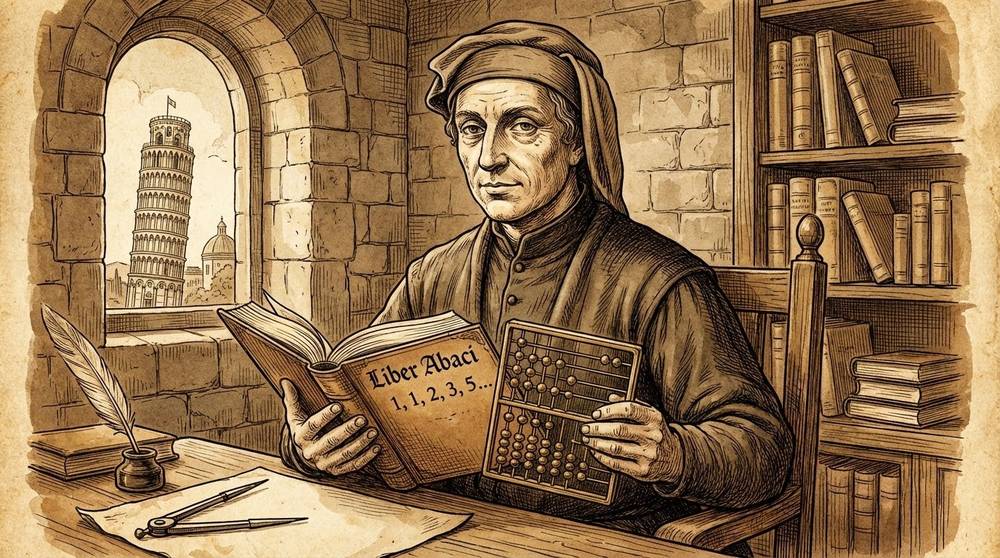
Young Leonardo accompanied his father on trading journeys across the Mediterranean. He visited Egypt, Syria, Greece, Sicily, and Provence. During these travels, he met Arab scholars and learned their mathematical knowledge, which at that time far surpassed European understanding.
Interesting fact: The nickname "Fibonacci" is a contraction of "filius Bonacci" — "son of Bonacci." The mathematician never called himself that during his lifetime; this nickname was only attributed to him in the 19th century by historian Guillaume Libri.
Leonardo's most important discovery was the Hindu-Arabic numeral system — the same ten digits from 0 to 9 that we use today. Medieval Europe was still using cumbersome Roman numerals, which made complex calculations virtually impossible.
"Liber Abaci": The Book That Changed Europe
In 1202, Fibonacci completed his masterwork — "Liber Abaci" (The Book of Calculation). This work became a turning point in the history of European mathematics. Fibonacci didn't just describe the Hindu-Arabic numeral system — he demonstrated its practical applications for merchants, bankers, and scholars.
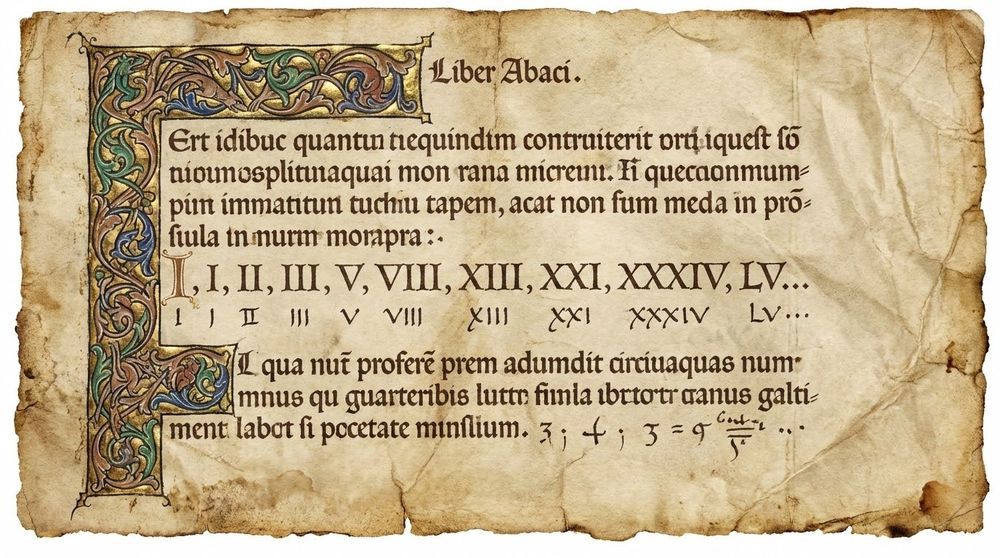
The book contained problems in commercial arithmetic: calculating profits, currency exchange, and interest computation. But among the many practical examples was one problem that immortalized the author's name — the rabbit problem.
The Rabbit Problem
"A certain man put a pair of rabbits in a place surrounded on all sides by a wall. How many pairs of rabbits will there be after one year, given that each month, starting from the second, each pair of rabbits produces one new pair?"
- Conditions: rabbits never die, each pair becomes capable of reproduction one month after birth
- Start: 1 pair of rabbits
- Question: how many pairs will there be after 12 months?
The Birth of the Fibonacci Sequence
While solving the rabbit problem, Fibonacci derived the number sequence that now bears his name. Let's trace the logic month by month:
| Month | Young Pairs | Adult Pairs | Total Pairs | Explanation |
|---|---|---|---|---|
| 1 | 1 | 0 | 1 | Initial pair is still young |
| 2 | 0 | 1 | 1 | Pair matured but hasn't bred yet |
| 3 | 1 | 1 | 2 | Adult pair produced first offspring |
| 4 | 1 | 2 | 3 | First young pair matured |
| 5 | 2 | 3 | 5 | Two adult pairs bred |
| 6 | 3 | 5 | 8 | Three adult pairs bred |
| 7 | 5 | 8 | 13 | Five adult pairs bred |
| 8 | 8 | 13 | 21 | Eight adult pairs bred |
| 9 | 13 | 21 | 34 | Thirteen adult pairs bred |
| 10 | 21 | 34 | 55 | Twenty-one adult pairs bred |
| 11 | 34 | 55 | 89 | Thirty-four adult pairs bred |
| 12 | 55 | 89 | 144 | Answer: 144 pairs of rabbits |
Thus was born the famous Fibonacci sequence:
1, 1, 2, 3, 5, 8, 13, 21, 34, 55, 89, 144, 233, 377, 610, 987...
The Main Rule of the Sequence
The principle behind building the Fibonacci series is remarkably simple:
Formation Rule
Each number equals the sum of the two preceding numbers.
- 1 + 1 = 2
- 1 + 2 = 3
- 2 + 3 = 5
- 3 + 5 = 8
- 5 + 8 = 13
- And so on to infinity...
Mathematically, this is expressed by the formula:
F(n) = F(n-1) + F(n-2), where F(1) = F(2) = 1
The Golden Ratio: The Divine Proportion
The true magic of the Fibonacci sequence reveals itself when we start dividing adjacent numbers by each other. This discovery was made long before Fibonacci — back in Ancient Greece — but his numbers provide the simplest way to approach this mysterious constant.
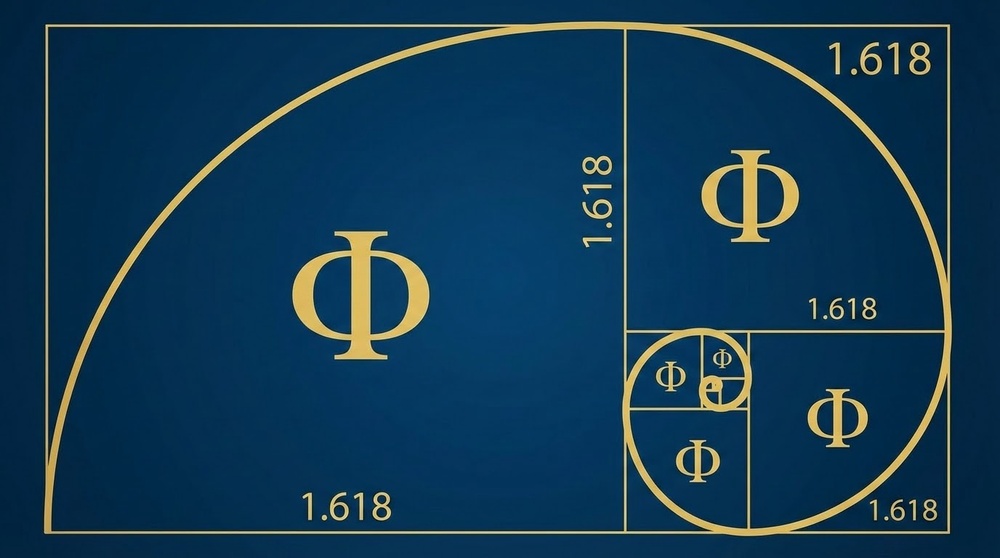
Watch what happens when dividing each number by the previous one:
| Numbers | Division | Result | Deviation from φ |
|---|---|---|---|
| 2 ÷ 1 | 2 / 1 | 2.000000 | +0.381966 |
| 3 ÷ 2 | 3 / 2 | 1.500000 | -0.118034 |
| 5 ÷ 3 | 5 / 3 | 1.666667 | +0.048633 |
| 8 ÷ 5 | 8 / 5 | 1.600000 | -0.018034 |
| 13 ÷ 8 | 13 / 8 | 1.625000 | +0.006966 |
| 21 ÷ 13 | 21 / 13 | 1.615385 | -0.002649 |
| 34 ÷ 21 | 34 / 21 | 1.619048 | +0.001014 |
| 55 ÷ 34 | 55 / 34 | 1.617647 | -0.000387 |
| 89 ÷ 55 | 89 / 55 | 1.618182 | +0.000148 |
| 144 ÷ 89 | 144 / 89 | 1.617978 | -0.000056 |
| 233 ÷ 144 | 233 / 144 | 1.618056 | +0.000022 |
| ∞ | — | 1.618034... | 0 |
The result converges to 1.6180339887... — this is the famous Golden Ratio, denoted by the Greek letter φ (phi).
Mathematical Properties of the Golden Ratio
The number φ possesses unique mathematical properties that no other constant has:
Unique Property #1
φ² = φ + 1
This is the only positive number whose square exceeds itself by exactly one.
1.618² = 2.618 = 1.618 + 1
Unique Property #2
1/φ = φ - 1
The reciprocal of the golden ratio differs from itself by exactly one.
1/1.618 = 0.618 = 1.618 - 1
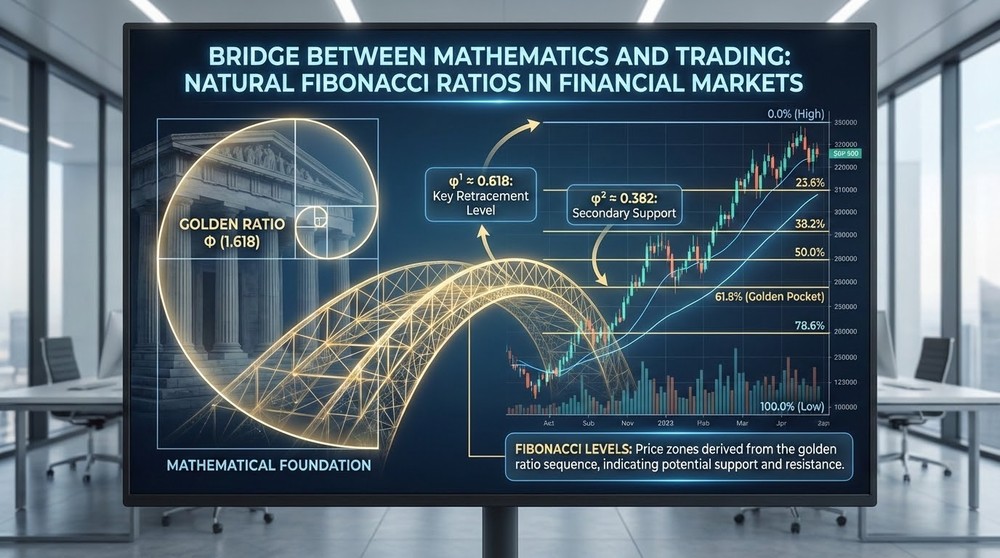
It's precisely from these properties that the key Fibonacci levels used in trading are derived:
| Level | Mathematical Origin | Exact Value |
|---|---|---|
| 23.6% | 1 - φ³ or (1/φ)³ | 0.2360679... |
| 38.2% | 1 - φ² or (1/φ)² | 0.3819660... |
| 50% | Not a Fibonacci number, but a psychologically important level | 0.5000000 |
| 61.8% | 1/φ or (φ - 1) | 0.6180339... |
| 78.6% | √(1/φ) — square root of 0.618 | 0.7861513... |
| 100% | Full retracement | 1.0000000 |
| 161.8% | φ — the golden ratio itself | 1.6180339... |
| 261.8% | φ² — square of the golden ratio | 2.6180339... |
| 423.6% | φ³ — cube of the golden ratio | 4.2360679... |
Fibonacci in Nature: Proof of Universality
Before moving on to financial markets, it's important to understand: Fibonacci numbers aren't an abstract mathematical construct. They are embedded in the very structure of our Universe. This isn't an exaggeration — nature literally "uses" these numbers everywhere.
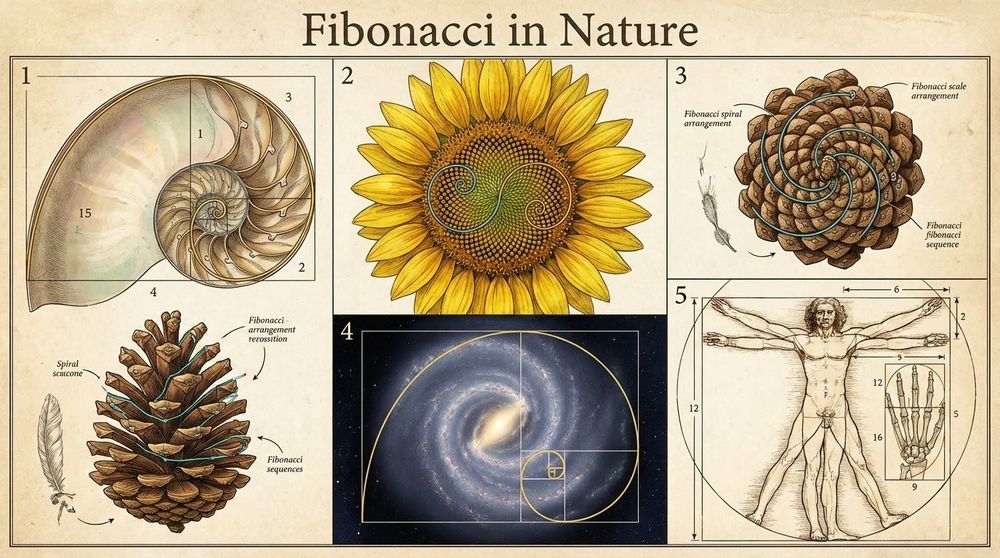
Botany: Plants Count in Fibonacci
- Sunflower: seeds are arranged in spirals. In one direction there are usually 34, in the other — 55. These are adjacent Fibonacci numbers.
- Pine cone: scales form 8 spirals in one direction and 13 in the other.
- Pineapple: 8 rows of scales diagonally in one direction, 13 in the other, 21 vertically.
- Daisy: petals almost always number 13, 21, 34, or 55 — Fibonacci numbers.
- Phyllotaxis: leaves on a stem are arranged in a spiral at an angle of 137.5° — this is the angle related to the golden ratio.
Anatomy: Body Proportions
- The distance from navel to floor and from navel to top of head relate as 1:1.618
- Finger phalanx lengths form a Fibonacci sequence
- Facial proportions considered beautiful are close to the golden ratio
- The spiral of the ear is a Fibonacci spiral
Zoology: From Shells to DNA
- The nautilus shell is coiled in a logarithmic spiral whose growth coefficient is related to φ
- The DNA molecule measures 34×21 angstroms — adjacent Fibonacci numbers
- Bee populations reproduce according to Fibonacci's law (males are born from unfertilized eggs)
Cosmos: Galaxies and Hurricanes
- Spiral arms of galaxies wind according to the Fibonacci spiral
- Hurricane and cyclone clouds form spirals with golden ratio proportions
- Distances between planets in the Solar System approximately follow Fibonacci ratios
"Geometry has two great treasures: one is the Theorem of Pythagoras, and the other the division of a line into extreme and mean ratio (the golden section). The first we may compare to a measure of gold, the second we may name a precious jewel."
— Johannes Kepler, 17th century
Why Does Fibonacci Work in Financial Markets?
Now for the main question: why do numbers from a 13th-century rabbit problem influence the price movements of Bitcoin, Apple stock, or the EUR/USD currency pair? Several theories exist:
Theory 1: The Nature of Human Perception
Our brains are evolutionarily "tuned" to recognize golden ratio proportions. We consider faces, buildings, and compositions built on these proportions to be beautiful. Perhaps traders intuitively sense when price has reached a "harmonious" level and make trading decisions accordingly.
Theory 2: Self-Fulfilling Prophecy
Millions of traders worldwide use Fibonacci levels. When price approaches the 61.8% level, thousands of people simultaneously place buy or sell orders. This creates real demand or supply, and price actually reacts to the level.
Important Observation
Even if Fibonacci levels work "only" because of self-fulfilling prophecy — this doesn't make them any less useful. If a tool works, the reason for its effectiveness is secondary. What matters is knowing how to apply it correctly.
Theory 3: The Fractal Nature of Markets
Financial markets exhibit fractal behavior: patterns on a minute chart resemble patterns on daily or weekly charts. Fractals in nature are closely related to Fibonacci numbers. Perhaps markets — as complex systems created by collective human behavior — follow the same mathematical laws as other natural systems.
Theory 4: Collective Crowd Psychology
Market movements reflect the emotions of millions of participants: fear, greed, hope, despair. These emotions develop in waves, and perhaps these waves naturally structure themselves according to Fibonacci proportions — just like any other natural processes.
The Connection Between Fibonacci and Elliott Wave Theory
In the 1930s, American accountant Ralph Nelson Elliott discovered that market movements develop in repeating patterns he called "waves." Analyzing the structure of these waves, he was surprised to find Fibonacci numbers:
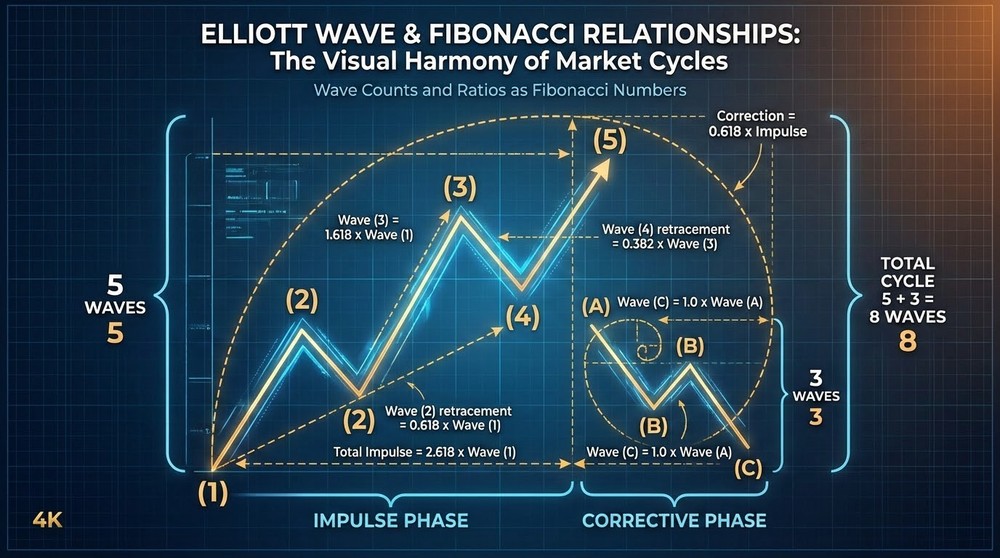
- A complete cycle consists of 8 waves (5 impulse + 3 corrective)
- Impulse phase — 5 waves
- Corrective phase — 3 waves
- Sub-waves total 34 waves at one level, 144 at the next
The numbers 3, 5, 8, 34, 144 — all are Fibonacci numbers. Elliott used Fibonacci ratios to forecast retracement depths and impulse movement targets, laying the foundation for modern application of these levels in technical analysis.
Key Levels: Deep Understanding
Now that we understand the mathematical and historical foundation, let's examine each key Fibonacci level in detail:
23.6% Level — Shallow Retracement
Derived by raising 0.618 to the third power: 0.618³ ≈ 0.236. This is the shallowest retracement level. If price reverses here, it indicates a very strong trend. Aggressive traders willing to risk continued retracement enter at this level.
38.2% Level — Moderate Retracement
Calculated as 0.618² ≈ 0.382. This is the first "serious" level where price often finds support or resistance. Healthy trends typically retrace to this level before continuing.
50% Level — Psychological Barrier
Strictly speaking, 50% is not a Fibonacci number. However, it's a psychologically important level: half of the move. Many traders intuitively watch the midpoint of a range. Historically, this level is also used in Dow Theory and Gann's work.
61.8% Level — The Golden Ratio
This is the main Fibonacci level, equal to 1/φ. A retracement to 61.8% is considered deep but not yet threatening to the trend. Many successful trades are opened at this level because it offers a good risk-to-reward ratio.
78.6% Level — Deep Retracement
Equals the square root of 0.618 (√0.618 ≈ 0.786). This is the last line of defense for the trend. If price breaks through this level, the probability of a complete reversal increases significantly.
Extension Levels: 161.8%, 261.8%, 423.6%
These levels are used to determine price targets after a retracement completes. They show how far price can travel when continuing the trend.
Remember the Key Points
Of all levels, the three most important are:
- 38.2% — healthy retracement in a strong trend
- 61.8% — the golden ratio, the main level
- 161.8% — primary target for extensions
By mastering these three levels, you'll cover most trading situations.
Historical Examples of Level Effectiveness
Fibonacci levels have proven their effectiveness over decades across all market types:
- 1987 Stock Market Crash: the S&P 500 index retraced almost exactly 61.8% of the previous rally
- 2017 Bitcoin Rally: intermediate corrections stopped at the 38.2% and 50% levels
- 2008-2009 Crisis: subsequent market recovery passed through Fibonacci extension levels
- 2020 COVID Crash: recovery from March lows followed classic Fibonacci levels
Limitations and Criticism
An honest approach to any tool requires understanding its limitations:
- Subjectivity in construction: different traders may choose different points for drawing levels
- Doesn't work in isolation: Fibonacci levels work best in combination with other analysis methods
- False signals: price may "break" a level and then return, or bounce and then break through anyway
- No guarantees: like any technical analysis tool, Fibonacci levels show probabilities, not certainties
Fibonacci levels aren't magic or a trading "holy grail." They're a tool for increasing probabilities in your favor. By understanding their mathematical foundations and limitations, you can use them most effectively.
Lesson Summary
In this lesson, we've traveled from medieval Italy to modern trading terminals:
- Leonardo Fibonacci (circa 1170-1250) discovered the sequence while solving a rabbit breeding problem
- Fibonacci sequence: each number is the sum of the two preceding ones (1, 1, 2, 3, 5, 8, 13, 21...)
- Golden ratio φ ≈ 1.618 is obtained by dividing adjacent Fibonacci numbers
- Key trading levels (23.6%, 38.2%, 50%, 61.8%, 78.6%) are mathematically derived from golden ratio properties
- Universality of Fibonacci numbers in nature explains why they work in markets created by collective human behavior
- Critical approach: understanding a tool's limitations is as important as understanding its strengths
In the next lesson, we'll move to practice and examine types of Fibonacci tools available in trading platforms: retracements, extensions, time zones, arcs, and fans.