














Module 1: Japanese Candlesticks: History and Market Philosophy
Imagine this: you're looking at a cryptocurrency chart and seeing not just lines and numbers, but a living story of the battle between buyers and sellers. Each candle on the chart is a frozen moment of market drama, where thousands of traders made decisions, experienced fear, greed, hope, and disappointment. This ability to "read" the market is what makes Japanese candlesticks the most popular technical analysis tool in the world.
In this lesson, you'll dive into the fascinating history of candlestick analysis, understand its philosophical foundations, and discover why a method invented by Japanese rice traders over three hundred years ago remains an indispensable tool for modern crypto traders.
Birth of a Legend: Homma Munehisa and the Dōjima Rice Exchange
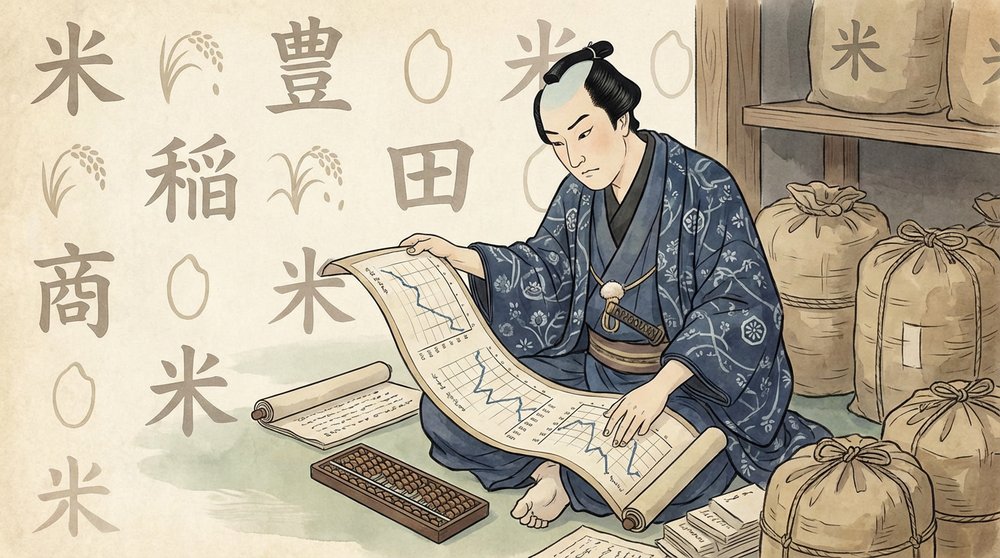
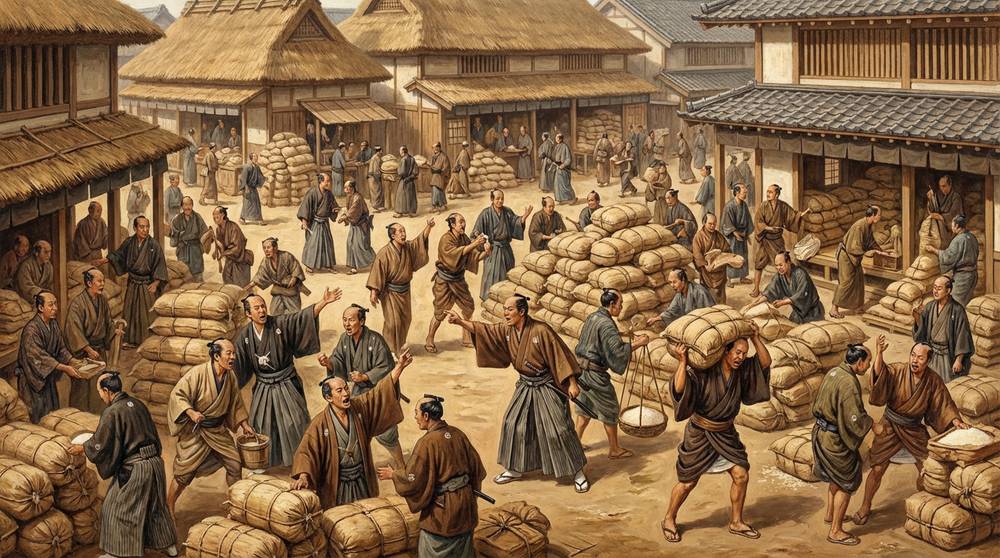
The history of Japanese candlesticks begins in the 17th century in the city of Osaka, which was then called the "kitchen of Japan." It was here, at the famous Dōjima Rice Exchange, that the world's first organized futures market was born. Rice in feudal Japan wasn't just a food product — it served as a universal currency, a measure of wealth, and even the foundation of the tax system.
The Legendary Trader from Sakata
Among the many rice traders, one man managed to rise above the rest and enter history. Homma Munehisa (本間宗久, 1724–1803) — a trader from the city of Sakata, whom contemporaries called the "god of markets." According to legend, he executed over 100 consecutive trades without a single loss, amassing a fortune equivalent to today's billions of dollars.
"When everyone is bullish, there are reasons to sell. When everyone is bearish, there are reasons to buy."
— Homma Munehisa, "Sakata Senho" (The Fountain of Gold — Three Monkey Record)
Homma's secret to success wasn't insider information or luck. He was the first to understand that price is determined not only by fundamental factors but also by the emotions of market participants. Homma created a system of signal flags stretching from Osaka to Sakata (over 600 kilometers) to receive price information faster than his competitors. But his greatest legacy was the method of visualizing price movements — the prototype of modern Japanese candlesticks.
The Dōjima Exchange: The First Futures Market in History
The Dōjima Rice Exchange, founded in 1697, was centuries ahead of its time. Here, traders dealt not only in physical rice but also in rice coupons — essentially futures contracts on future harvests. This created a unique environment for speculation, where prices could change dramatically under the influence of rumors, weather, and crowd sentiment.
Interesting Facts About the Dōjima Exchange
- Over 1,300 traders gathered daily in the trading hall
- Trading was conducted using a complex system of hand signals, reminiscent of modern trading pits
- By 1710, the volume of traded coupons exceeded actual rice production in Japan by 10 times
- The exchange operated until 1939, surviving for over 240 years
It was in this bustling atmosphere that traders began developing methods for analyzing price movements. They noticed that certain sequences of price changes repeated again and again, forming recognizable patterns. Thus, candlestick analysis was born.
Philosophical Foundations of Japanese Candlestick Analysis
To truly understand Japanese candlesticks, you need to immerse yourself in the philosophy that underlies them. Unlike the Western approach, which focuses on precise numbers and formulas, the Eastern tradition views the market as a living organism, subject to universal laws of nature.
Yin and Yang: The Eternal Dance of Opposites
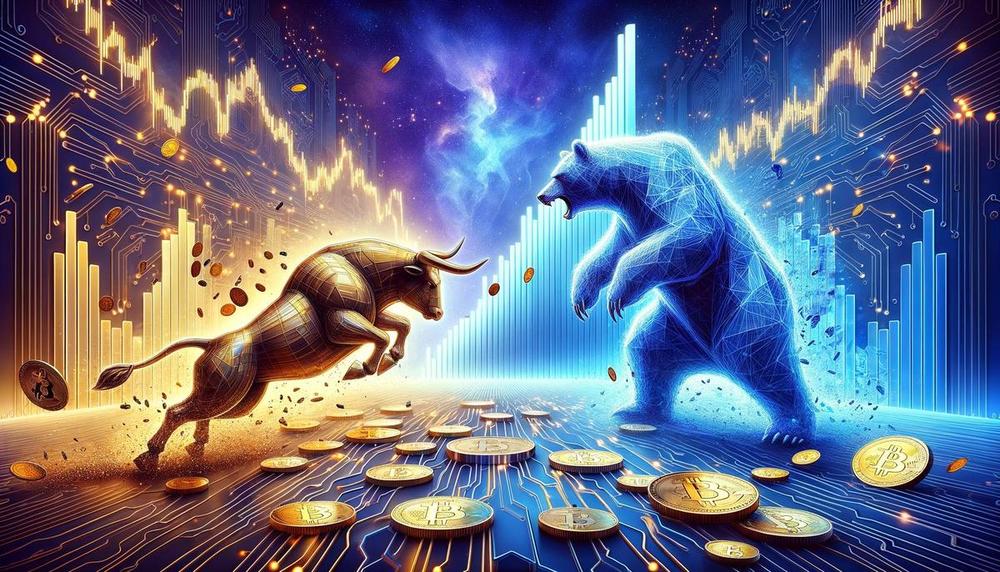
At the core of candlestick analysis lies the ancient Eastern concept of Yin and Yang — the idea that all phenomena in the Universe are generated by the interaction of two opposite but complementary forces:
Yang (陽)
Active, bright force
In the market: buyers, price increase, bullish sentiment, optimism, expansion
On the chart: green (white) candles with bodies pointing upward
Yin (陰)
Passive, dark force
In the market: sellers, price decrease, bearish sentiment, fear, contraction
On the chart: red (black) candles with bodies pointing downward
The key idea is that neither force can dominate forever. When Yang reaches its peak, a transition to Yin inevitably begins, and vice versa. This philosophy perfectly describes market cycles: every rapid rise is followed by a correction, and deep declines sooner or later give way to recovery.
The Concept of "Ki" — Market Energy
Japanese traders use the concept of "Ki" (気) — life energy — to describe the state of the market. When the market is full of Ki, prices move confidently and directionally. When Ki is depleted, the market becomes sluggish and uncertain.
Candlestick analysis allows you to "read" the Ki level through:
- Candle body size — a large body indicates strong movement energy
- Shadow length — long shadows indicate struggle and uncertainty
- Candle sequence — a series of unidirectional candles shows energy accumulation
- Trading volume — high volume confirms the strength of the movement
"The market is a battlefield. Candles are the footprints of armies. Learn to read these footprints, and you'll know who's winning before the battle ends."
— Modern interpretation of Japanese trading wisdom
Cyclicality and the Inevitability of Change
Another fundamental idea of Eastern philosophy that permeates candlestick analysis is the concept of cyclicality. Japanese traders understood that markets move in waves, passing through recognizable stages:
| Cycle Stage | Market Characteristics | Typical Candlestick Patterns |
|---|---|---|
| Accumulation | Smart money quietly buying at the bottom | Small bodies, long lower shadows |
| Markup (Yang) | Uptrend, optimism | Long green bodies, short shadows |
| Distribution | Smart money selling at the top | Small bodies, long upper shadows |
| Markdown (Yin) | Downtrend, fear | Long red bodies, short shadows |
Understanding this cyclicality helps traders avoid succumbing to crowd emotions and act rationally when others are gripped by panic or euphoria.
Why Japanese Candlesticks Work: Market Psychology in Action
Skeptics often ask: "How can a method created for trading rice in feudal Japan work on modern cryptocurrency exchanges?" The answer is simple: human psychology hasn't changed. Fear, greed, hope, and despair — these emotions drive markets today just as they did three centuries ago.
Candles as a Reflection of Emotions
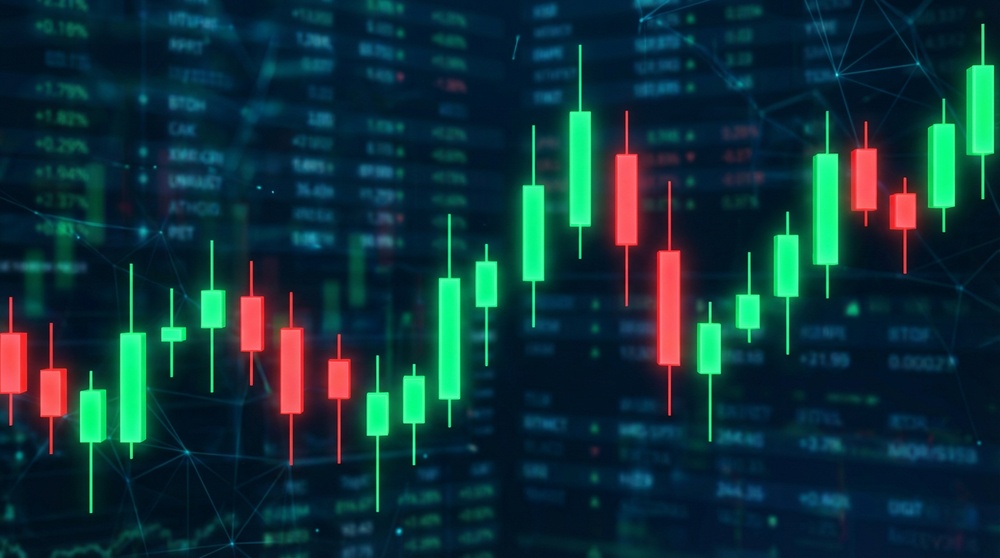
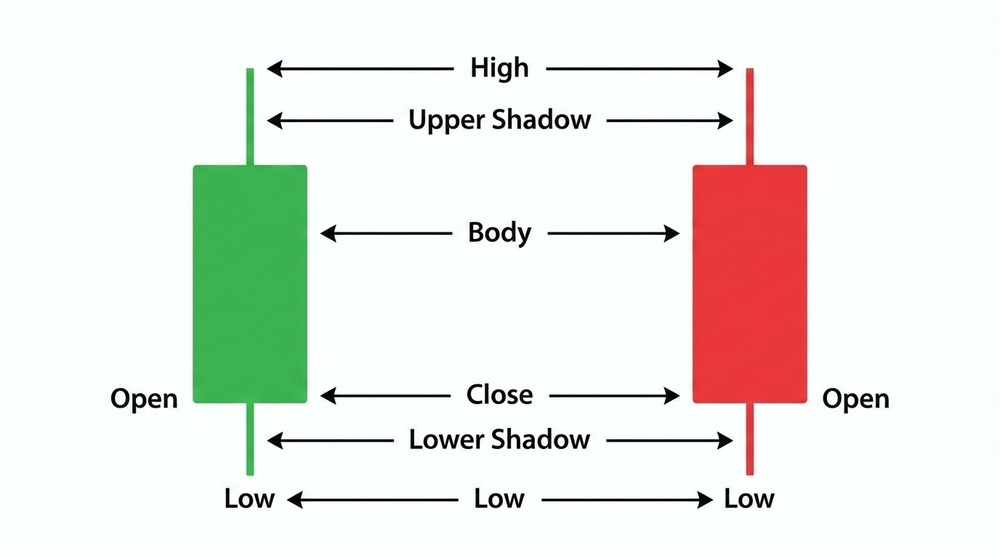
Each candle on the chart isn't just statistics. It's a visual imprint of the collective psychology of all market participants over a specific period. Here's what you can "read" from a single candle:
Psychological Content of a Candle
- Opening price — initial expectations and sentiment of traders
- High — the limit of buyer optimism, where their enthusiasm ran out
- Low — the limit of seller fear, where panic peaked
- Closing price — the market's final verdict on who won during this period
- Upper shadow — rejected high prices, resistance to buyers
- Lower shadow — rejected low prices, support from buyers
When you learn to read these emotional signals, the chart will stop being a chaotic set of lines. You'll begin to see the story of the struggle, understand who's winning — bulls or bears — and anticipate how events will unfold.
Why Patterns Repeat
Candlestick patterns work because human behavior is predictable. Traders en masse react to the same signals in similar ways:
- After a strong decline — mass fear and capitulation of weak hands
- When breaking an important level — cascade of stop orders and FOMO buying
- At historical highs — euphoria and ignoring risks
- During uncertainty — small candles and low volumes
These predictable reactions create recognizable chart patterns that repeat across any markets and timeframes — from minute Bitcoin charts to weekly charts of traditional stocks.
Advantages of Candlestick Analysis Over Other Methods
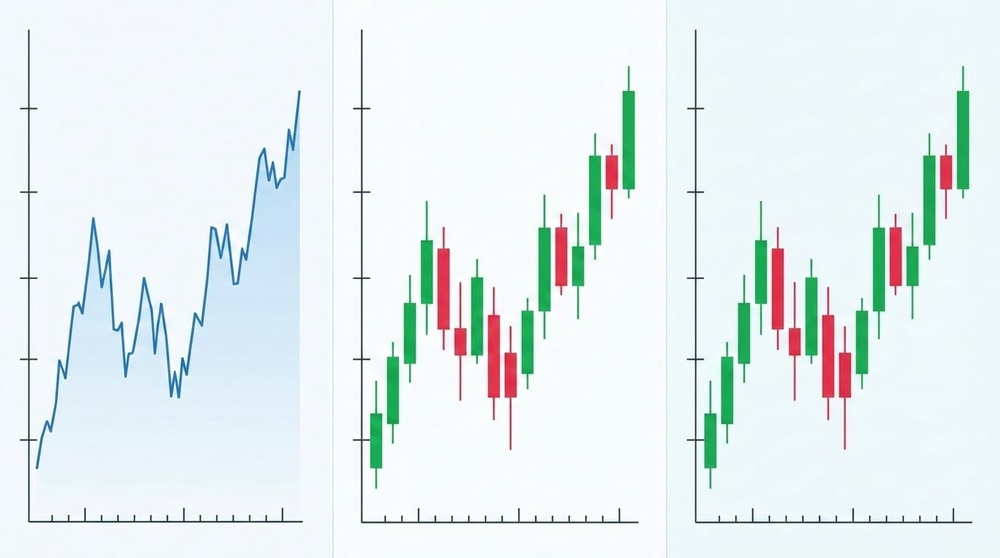
There are many ways to display price data: line charts, bars, point and figure, Renko, and others. So why have Japanese candlesticks become the standard in trading? Let's compare different chart types.
Comparison of Chart Types
Line Chart
Shows only closing prices connected by a line. Simple, but loses 75% of information (open, high, low).
Bars (OHLC)
Contains all data, but is difficult to visually perceive. Requires more effort to analyze.
Unique Advantages of Japanese Candlesticks
| Advantage | Description |
|---|---|
| Visual Clarity | Color coding allows instant identification of movement direction |
| Information Completeness | Each candle contains 4 key prices: open, high, low, close |
| Reversal Patterns | Unique ability to show market sentiment shifts through candle combinations |
| Strength Measurement | Body and shadow size shows the intensity of buyer/seller pressure |
| Universality | Works on any markets: crypto, forex, stocks, commodities, indices |
| Scalability | Applicable to any timeframes: from minutes to months |
Instant Information Reading
One of the main advantages of candles is analysis speed. An experienced trader can assess within a split second:
- Overall trend (predominance of green or red candles)
- Strength of current movement (body size)
- Levels of struggle (long shadows)
- Moments of uncertainty (small bodies, doji candles)
- Potential reversals (characteristic patterns)
This ability to "scan" the market is critically important in the fast-moving world of cryptocurrencies, where decisions often need to be made within minutes.
Transitioning from Theory to Practice: What's Next
Now that you understand the historical and philosophical foundation of candlestick analysis, you're ready to move on to practical study of this powerful tool. In the following lessons of the course, we'll progressively dive deeper into the details:
Your Path in Candlestick Analysis
- Lesson 2 — Detailed study of candle anatomy: body, shadows, and their meaning
- Lessons 3-4 — Mastering key reversal patterns
- Lesson 5 — Trend continuation patterns
- Lessons 6-7 — Combining candles with other analysis tools
- Lessons 8-10 — Practical strategies and avoiding common mistakes
Key Takeaways from This Lesson
Summarizing the first lesson, remember the main ideas:
- Japanese candlesticks — are not just a way to display price, but a philosophy of understanding the market through the lens of human emotions
- The method is time-tested — from the Dōjima Rice Exchange to modern crypto exchanges
- The market is cyclical — understanding the phases of accumulation, markup, distribution, and markdown gives you an edge
- Patterns repeat — because human psychology is unchanging
- Candles combine — information completeness with visual clarity
"Mastery in candlestick analysis comes not from memorizing patterns, but from understanding the human nature that stands behind them."
Move on to the next lesson, where we'll thoroughly examine the anatomy of a Japanese candle and learn to extract maximum information from each of its elements.