















Module 10: False Signals and Common Trader Mistakes in Candlestick Analysis
Welcome to the final lesson of the "Candlestick Analysis for Traders" course! We've come a long way: explored the history of Japanese candlesticks, dissected the anatomy of each candle, mastered dozens of reversal and trend patterns, and learned to combine candlestick analysis with support/resistance levels and volume. Now it's time to discuss what many prefer to avoid — false signals and mistakes that lead to losses.
The truth about crypto trading is this: no pattern guarantees 100% success. Even a perfectly formed hammer or engulfing pattern can turn out to be a trap. Understanding the nature of false signals and recognizing your own mistakes — that's what separates consistently profitable traders from those who constantly lose money.
Key Takeaway: The ability to recognize false signals and avoid common mistakes is more valuable than knowing a hundred patterns. Capital preservation is the first priority of any successful trader.
What Is a False Signal in Candlestick Analysis
A false signal is a candlestick pattern or combination of candles that visually meets classic criteria but fails to produce the expected price movement. Instead of a reversal or trend continuation, the market moves in the opposite direction, stopping out traders.
Classification of False Signals
False signals can be categorized based on their nature:
| Type of False Signal | Description | Characteristic Signs |
|---|---|---|
| Liquidity Trap | Large players deliberately form a pattern to collect retail traders' stop-losses | Sharp reversal immediately after pattern formation, abnormal volume |
| Market Noise | Random price fluctuations carrying no real signal | Low volume, sideways movement, lack of context |
| Incomplete Pattern | Trader enters before the candle or pattern fully forms | Premature entry, no confirmation |
| Counter-Trend Signal | Reversal pattern appears in the middle of a strong trend | Contradiction with overall market direction |
| Manipulation | Artificial pattern creation through coordinated actions | Common in low-liquidity cryptocurrencies |
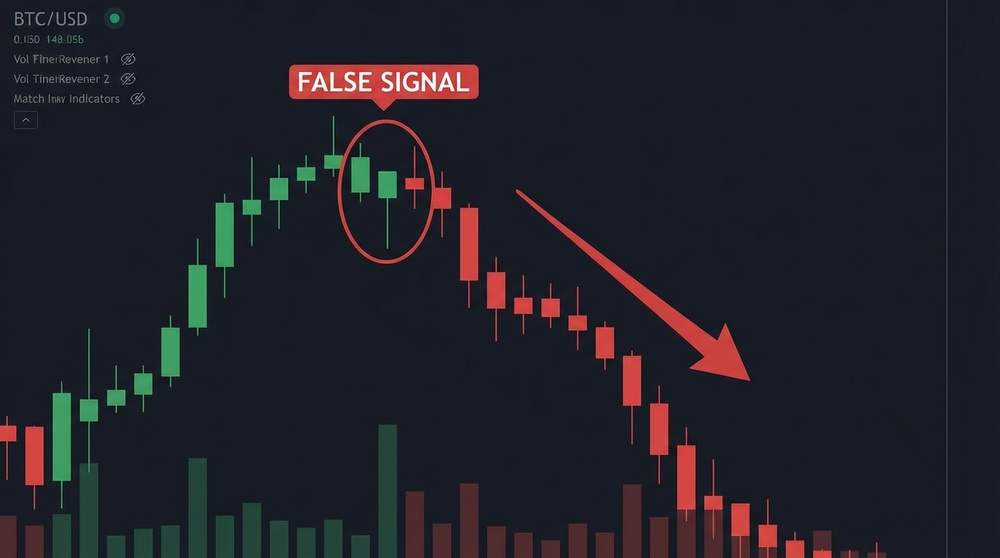
The image above shows a classic example of a false hammer. The pattern looked perfect: long lower shadow, small body, appearing after a downtrend. However, the following candles continued the decline, stopping out those who opened long positions.
Why False Signals Form
To learn how to recognize traps, it's important to understand the mechanisms behind their formation. The cryptocurrency market is particularly prone to false signals for several reasons:
1. Actions of Large Players (Whales)
Major market participants — institutional investors, market makers, large funds — have enough capital to temporarily push prices in a desired direction. They know where retail traders place their stop-losses (usually beyond levels or candle shadows) and deliberately "hunt" this liquidity.
How Stop Hunting Works
- Traders see a pattern (e.g., hammer) and enter long
- Stop-losses are placed below the hammer's lower shadow
- A large player pushes price below this level
- Stop-losses trigger, creating additional selling pressure
- The large player accumulates the asset at lower prices
- Price reverses upward — but without those who got stopped out
2. Low Liquidity in Cryptocurrency Markets
Compared to traditional financial markets, the cryptocurrency market has significantly lower liquidity. This means relatively small trading volumes can create significant price movements and form patterns that wouldn't appear under normal liquidity conditions.
3. 24/7 Trading Without Breaks
Unlike stock markets, cryptocurrencies trade 24/7/365. This creates periods of very low activity (for example, Asian nights on weekends) when patterns form on minimal volume and carry minimal informational value.
4. Impact of News and Social Media
The cryptocurrency market is extremely sensitive to news, tweets from influential figures, and regulatory announcements. A single tweet can instantly invalidate any technical pattern. Candlestick analysis doesn't account for fundamental factors that can suddenly change the situation.
5. Self-Fulfilling Prophecy in Reverse
When too many traders see the same pattern and act identically, large players can use this against them. The popularity of candlestick analysis makes classic patterns targets for manipulation.
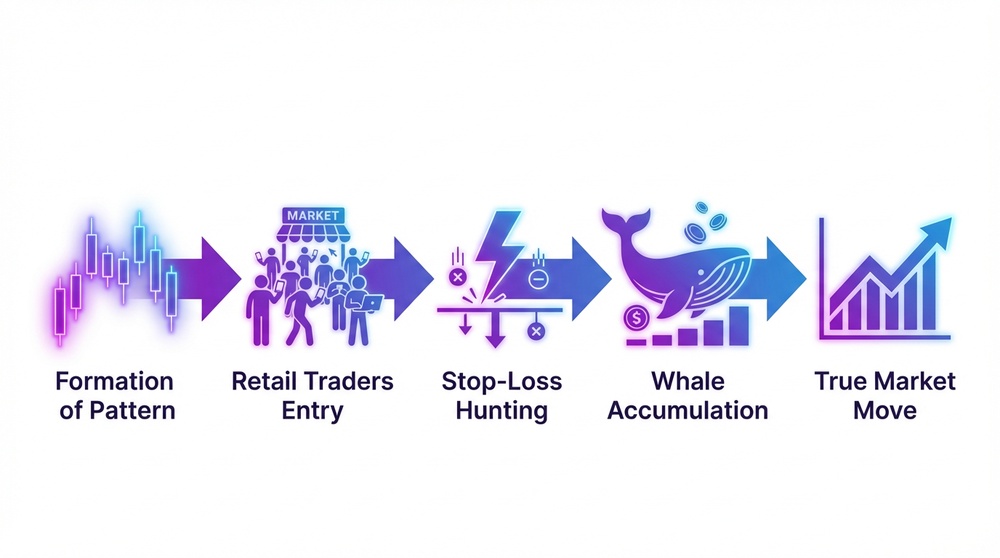
The diagram shows a typical manipulation mechanism: formation of a "perfect" pattern → retail traders enter → sharp reversal → stop-losses trigger → large player accumulates position → true movement begins.
Top 10 Common Trader Mistakes in Candlestick Analysis
Now let's examine the most common mistakes that lead to losing trades. Most of them are related not to the patterns themselves, but to their incorrect interpretation and application.
Mistake #1: Trading Without Context
This is perhaps the main mistake of beginner traders. They learn what a hammer or engulfing pattern looks like and start trading every pattern they see on the chart, completely ignoring market context.
Wrong Approach
Saw a hammer → immediately opened long
"There's a hammer on the chart — it's a reversal pattern, so price will go up!"
Right Approach
Checked context → assessed quality → waited for confirmation → entered
"The hammer appeared at a strong support level, on increased volume, after an extended decline. Waiting for a confirming candle."
Context to consider:
- Where is price relative to key support/resistance levels?
- What's the overall trend on the higher timeframe?
- Are there important horizontal levels or moving averages nearby?
- What volume accompanied the pattern formation?
- Are any important news events expected soon?
Mistake #2: Entering Before Candle Close
Impatience is a trader's enemy. Many enter trades when they see a candle that "looks like" the desired pattern, without waiting for it to close. The problem is that a candle can change dramatically in the final minutes of the trading session.
Rule: A pattern is considered formed ONLY after the candle closes. Until then, it's just a potential pattern that may not materialize.
This is especially critical in the cryptocurrency market, where volatility can turn a "perfect hammer" into an ordinary bearish candle with a small shadow within minutes.
Mistake #3: Ignoring Volume
We covered this topic in detail in Lesson 6, but let's repeat: a candlestick pattern without volume confirmation is a weak signal. Volume shows how much market participants "believe" in the current movement.
| Situation | Interpretation | Action |
|---|---|---|
| Bullish engulfing + high volume | Strong signal, buyers are active | Consider entering long |
| Bullish engulfing + low volume | Weak signal, possibly false | Wait for additional confirmation |
| Hammer at support level + volume spike | Strong reaction to level | Good buying opportunity |
| Hammer in middle of movement + normal volume | Random formation, noise | Skip the signal |
Mistake #4: Trading Against the Trend
Beginner traders often try to "catch the bottom" or "sell at the top," trading reversal patterns against a strong trend. This is an extremely dangerous strategy.
Statistics show: in a strong trend, most reversal signals turn out to be false. Trends tend to continue longer than most participants expect.
Dangerous Situations for Counter-Trend Trading
- Strong trend impulse — large candles in one direction without pullbacks
- Important level breakout — price has moved beyond a level and continues
- News background — fundamental reasons support the current trend
- Parabolic rise/fall — accelerating movement without corrections
Mistake #5: Analyzing Only One Timeframe
Lesson 8 was dedicated to working with different timeframes, and here's why it's so important: a signal on a lower timeframe can contradict the picture on a higher one. The higher timeframe always takes priority.
Example of a typical mistake:
- A beautiful bullish engulfing appears on the 15-minute chart
- Trader opens long, confident in a reversal
- But on the 4-hour chart, price is in the middle of a downtrend
- The "reversal" on M15 turns out to be just a minor pullback in the global downtrend
- Price continues to decline, hitting the stop-loss
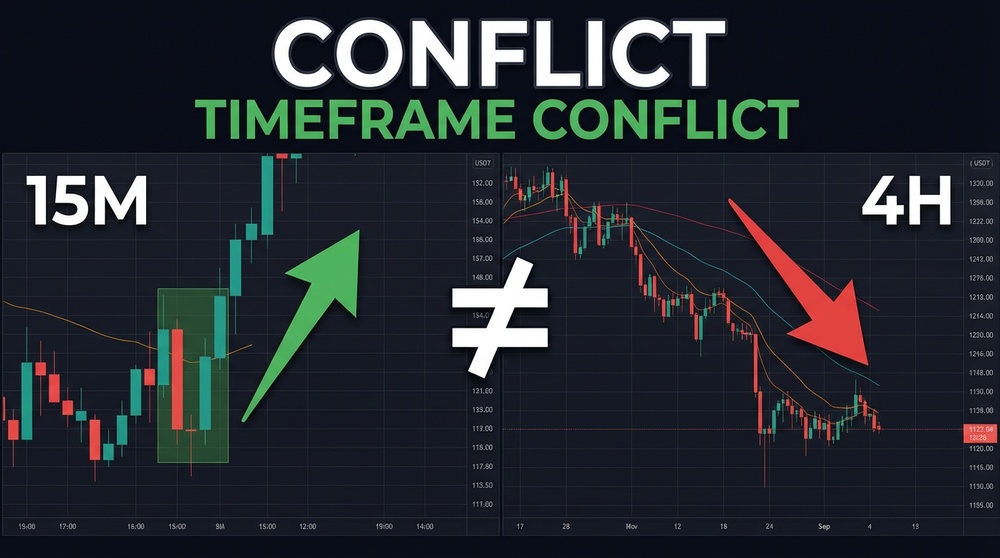
The image demonstrates a timeframe conflict: a bullish pattern on the lower TF appeared against the main downtrend on the higher TF, resulting in a false signal.
Mistake #6: Overtrading
After mastering candlestick analysis, traders start seeing patterns everywhere. Every candle seems like a signal to act. This leads to excessive number of trades, most of which have low probability of success.
Signs of overtrading:
- More than 10-15 trades per day on a single instrument
- Entering trades "out of boredom" or "not to miss a move"
- Trading low-quality patterns
- Lack of a clear trading plan
- Emotional entries after losses ("revenge trading")
Quality over quantity. It's better to make 2-3 quality trades with high probability of success than 20 mediocre ones. Patience is one of a trader's greatest virtues.
Mistake #7: No Stop-Loss
Some traders are so confident in their analysis that they don't set protective orders. Or they set them but then move them when price goes against their position. This is the path to catastrophic losses.
Even the most reliable pattern can fail. The market is unpredictable, and the only protection against major losses is disciplined risk management.
Stop-Loss Placement Rules for Candlestick Patterns
- Hammer/Hanging Man: stop beyond the shadow extreme (with a small buffer)
- Engulfing: stop beyond the extreme of the engulfing candle
- Stars: stop beyond the body of the central candle (doji/small candle)
- Three Soldiers/Crows: stop beyond the low/high of the first candle in the pattern
- General rule: add a 0.5-1% buffer to the technical stop level
Mistake #8: Searching for "Perfect" Patterns
Paradoxically, some traders fall into the opposite extreme — waiting for a "textbook" pattern that fully matches the description from a manual. The problem is that perfect patterns rarely appear in real markets.
Most working patterns are approximations of the ideal. It's important to understand the essence of a pattern (what crowd psychology it reflects), rather than mechanically comparing it to a picture from a book.
Mistake #9: Ignoring Psychology and Emotions
Candlestick analysis is a tool. But decisions are made by humans, and human emotions often sabotage even a perfect strategy:
| Emotion | How It Manifests | What It Leads To |
|---|---|---|
| Greed (FOMO) | Entering a trade after the move has already happened | Buying at highs, selling at lows |
| Fear | Closing a profitable position too early | Missed profits, cutting gains short |
| Hope | Holding a losing position, ignoring stop-loss | Catastrophic losses |
| Revenge Trading | Aggressive entries after a loss, wanting to "get even" | Series of losing trades, account blowup |
| Euphoria | Increasing position size after a winning streak | One large loss wipes out all profits |
Mistake #10: No Trading Journal
Without recording and analyzing your trades, a trader is doomed to repeat the same mistakes. A trading journal allows you to:
- Identify recurring mistakes
- Determine which patterns work best in your trading
- Evaluate the quality of your entries and exits
- Monitor your emotional state
- Improve your strategy based on statistics
How to Filter False Signals: Practical Checklist
Now that we've covered the main mistakes, let's create a practical filter to help screen out potentially false signals.
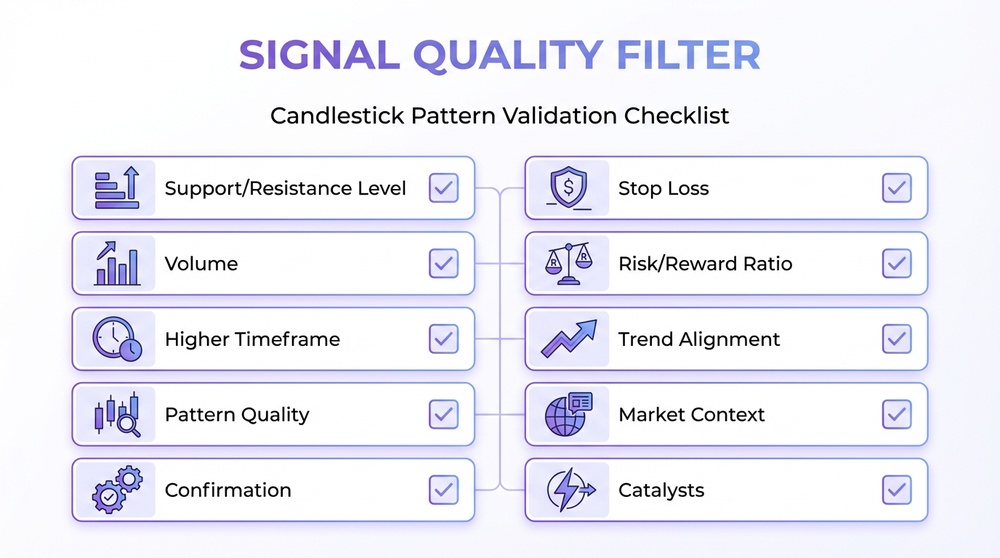
Visual checklist for evaluating candlestick signal quality before entering a trade.
Step-by-Step Checklist Before Entering a Trade
Before opening a position based on a candlestick pattern, ask yourself the following questions:
Signal Quality Checklist
- ✓ Has the candle closed? — Never enter before candle close
- ✓ Is there context? — Did the pattern appear at an important level?
- ✓ What does volume show? — Is there a volume spike?
- ✓ Is the higher TF aligned? — Does the signal contradict the trend on the higher period?
- ✓ Pattern quality? — How close is it to the textbook example?
- ✓ Is there confirmation? — Did the next candle confirm the direction?
- ✓ Is stop-loss defined? — Where will I exit if I'm wrong?
- ✓ Risk/reward ratio? — Is potential profit at least 2x the risk?
- ✓ Any important news? — Is volatility expected from news events?
- ✓ My emotional state? — Am I calm and following my plan?
Rule: If you answered "no" to more than 2-3 points — skip the trade. Wait for a better setup.
Point-Based Signal Scoring System
A more advanced approach — assign each factor a specific "weight" and only enter when a minimum score is reached:
| Factor | Points | Comment |
|---|---|---|
| Pattern at strong level | +3 | Critically important |
| Volume confirmation | +2 | Volume spike on signal candle |
| Timeframe alignment | +2 | Direction matches higher TF |
| Pattern quality (textbook) | +2 | Close to classic description |
| Confirming candle | +2 | Next candle confirmed direction |
| Additional indicator (RSI, MACD) | +1 | Indicator confirms signal |
| R/R ratio ≥ 1:2 | +1 | Profit potential exceeds risk |
Interpretation:
- 10+ points: Excellent setup, can enter with increased risk
- 7-9 points: Good setup, standard position size
- 5-6 points: Average setup, reduce position or skip
- Less than 5 points: Weak setup, don't trade
Methods for Confirming Candlestick Signals
To reduce the number of false signals, use additional confirmation methods:
1. Confirmation by the Next Candle
The simplest and most effective method — wait for the next candle to close. For reversal patterns:
- Bullish reversal: the next candle should close above the high of the signal candle
- Bearish reversal: the next candle should close below the low of the signal candle
Yes, this "eats" part of the move, but significantly increases the probability of success.
2. Using Moving Averages
Moving averages (MA) help determine trend direction:
- Buy only when price is above MA (e.g., EMA 50)
- Sell only when price is below MA
- Reversal patterns are more reliable when they appear at MA touches
3. RSI and Overbought/Oversold Zones
The Relative Strength Index (RSI) can confirm reversals:
- Bullish reversal pattern + RSI < 30 = strong buy signal
- Bearish reversal pattern + RSI > 70 = strong sell signal
- Divergences between RSI and price strengthen reversal signals
4. Horizontal Levels
A pattern appearing in "empty space" is significantly less reliable than one at a strong level:
- Historical highs and lows
- Levels where strong moves originated
- Round psychological levels (10000, 50000, etc.)
- Fibonacci levels
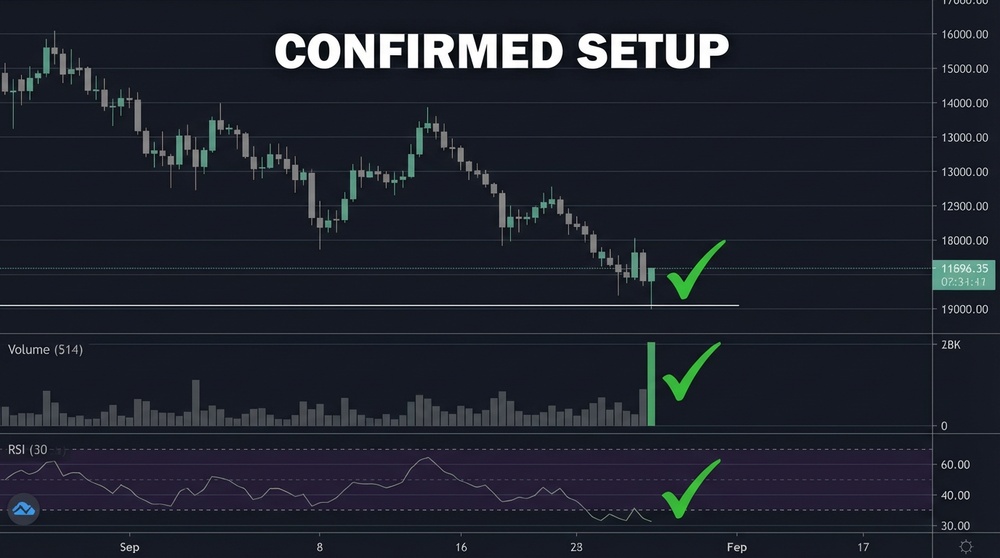
The image shows an example of comprehensive signal confirmation: candlestick pattern + support level + volume spike + RSI in oversold zone = strong setup for buying.
Psychology of a Successful Trader: Learning from Mistakes
Technical analysis is only half the battle. The other half is psychology and discipline. Let's examine the key aspects:
Accepting Losses as Part of the Process
Losing trades are an inevitable part of trading. Even the best traders in the world have a win rate of around 50-60%. The key to profitability isn't the number of winning trades, but the ratio of average profit to average loss.
Success Formula: You can be profitable even with 40% winning trades if your average profit is 3 times your average loss. Math is on your side if you follow risk management.
Practicing Mindful Trading
Before each trade, ask yourself:
- Why do I want to enter this trade?
- What objective factors support my entry?
- Am I trading out of boredom, fear of missing out, or desire to get even?
- Am I psychologically prepared to accept a loss on this trade?
Regular Results Analysis
Set aside time each week to analyze your trades:
- Which trades were profitable and why?
- Which trades were losing and what went wrong?
- Are there recurring mistakes?
- Which patterns show the best results?
- How can I improve my trading process?
Final Exercise: Analyzing False Signals
To reinforce the material, complete the following practical assignment:
Practical Assignment
- Open a chart of any cryptocurrency (BTC, ETH) on the daily timeframe
- Find 10 examples of candlestick patterns (hammer, engulfing, stars, etc.)
- For each pattern, determine:
- Did it work or was it false?
- What factors indicated its quality?
- Was volume elevated?
- Was the pattern at an important level?
- Calculate the percentage of patterns that worked
- Compare the quality of patterns that worked versus those that were false
This exercise will help develop an "eye" for quality setups and teach you to distinguish them from false signals.
Course Conclusion: Your Journey in Candlestick Analysis
Congratulations! You've completed the full "Candlestick Analysis for Traders" course. Let's summarize what you've learned:
- Lesson 1: History and philosophy of Japanese candlesticks
- Lesson 2: Candle anatomy — body, shadows, their meaning
- Lesson 3: Reversal patterns — Doji, Hammer, Shooting Star
- Lesson 4: Engulfing patterns and "Stars"
- Lesson 5: Trend continuation patterns
- Lesson 6: Combining candles, levels, and volume
- Lesson 7: Psychology of candlestick patterns
- Lesson 8: Working with different timeframes
- Lesson 9: Practical entry and exit strategies
- Lesson 10: False signals and common mistakes
Main Course Takeaway: Candlestick analysis is a powerful tool that allows you to read market psychology through charts. But it requires practice, discipline, and constant improvement. There's no "holy grail" or strategy that gives 100% results. The key to success lies in a comprehensive approach, risk management, and working on your own mistakes.
Recommendations for Further Development
- Practice on a demo account before trading real money
- Start small — minimum positions until you build statistics
- Keep a trading journal — record every trade, analyze results
- Deepen your knowledge — study other analysis methods (technical indicators, wave analysis, volume analysis)
- Work on psychology — read books on trading psychology, develop discipline
- Join a community — communicate with other traders, exchange experiences
Remember: the trader's path is a marathon, not a sprint. Don't expect instant results. Invest time in learning, practice, analyze your mistakes — and results will definitely come.
Good luck with your trading! 🚀