















Module 7: Candlestick Pattern Psychology: Reading Crowd Emotions
Behind every candle on a chart lies the story of thousands of traders — their fears, hopes, greed, and panic. Understanding this psychology transforms abstract charts into a living map of market emotions. In this lesson, you'll learn to read crowd sentiment and use this knowledge to make profitable trading decisions.

Why Psychology Matters More Than Technical Indicators
Many traders make a critical mistake: they treat candlestick patterns as mechanical signals for entries and exits. However, Japanese candlesticks are primarily a visual representation of mass psychology. Each candle tells the story of the battle between buyers and sellers, between fear and greed.
"The market is a place where money transfers from the impatient to the patient, from the emotional to the rational." — Warren Buffett
When you understand the psychology behind a pattern, you stop blindly following rules and start feeling the market. This fundamentally changes the quality of your trading decisions.
Three Levels of Candlestick Analysis Understanding
- Surface level: I see a pattern → I open a trade
- Technical level: I see a pattern + confirmation from volume and levels → I open a trade
- Psychological level: I understand what emotions created the pattern + I assess the strength of those emotions → I make an informed decision
Third-level traders statistically show better results because they trade not patterns, but crowd behavior.
The Two Main Market Emotions: Fear and Greed
All market movements are ultimately driven by two basic emotions: fear and greed. These emotions are cyclical and create behavioral patterns familiar to all traders.
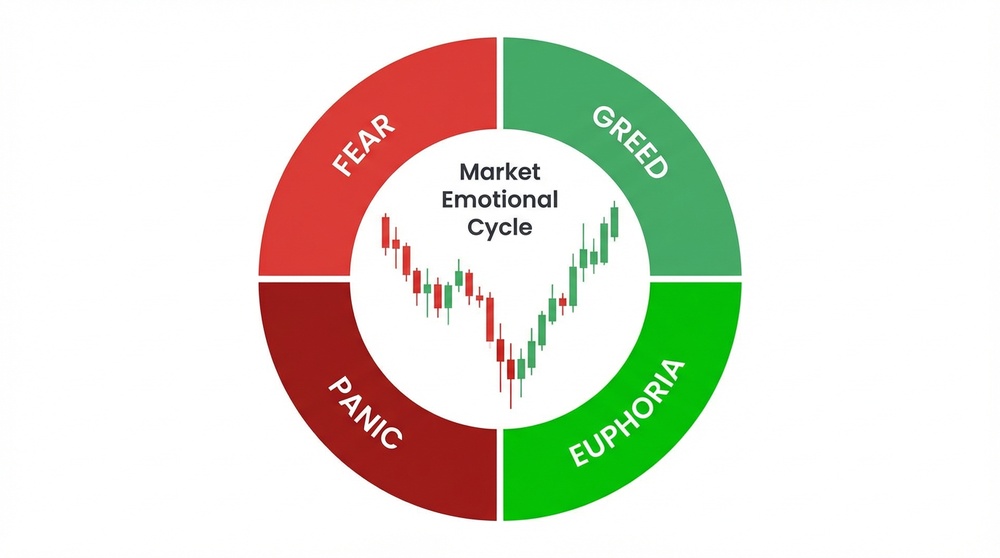
🟢 Greed
Manifestation: Long bullish bodies, minimal shadows, aggressive buying on breakouts.
Crowd thinking: "Price will leave without me! I need to buy right now!"
Danger: Buying at the top, ignoring risks.
🔴 Fear
Manifestation: Long bearish candles, gaps down, panic selling.
Crowd thinking: "Everything is crashing! I need to sell immediately!"
Danger: Selling at the bottom, locking in losses at the worst moment.
The Emotional Market Cycle
The market moves through a predictable emotional cycle. Understanding which stage the crowd is in gives you a strategic advantage:
| Stage | Crowd Emotion | Candlestick Signs | Experienced Trader Action |
|---|---|---|---|
| Accumulation | Indifference, skepticism | Narrow bodies, sideways movement, dojis | Gradual position building |
| Markup | Optimism → Euphoria | Growing bullish candles, shrinking shadows | Holding position with trailing stop |
| Distribution | Anxiety, denial | Long upper shadows, dojis at tops | Partial profit taking |
| Markdown | Panic → Capitulation | Long bearish candles, gaps down | Waiting for reversal signs |
Psychology of Individual Candles
Before analyzing complex patterns, learn to read the psychology of each individual candle. Every element of a candle carries information about market participant sentiment.
Bullish Candle with Long Body
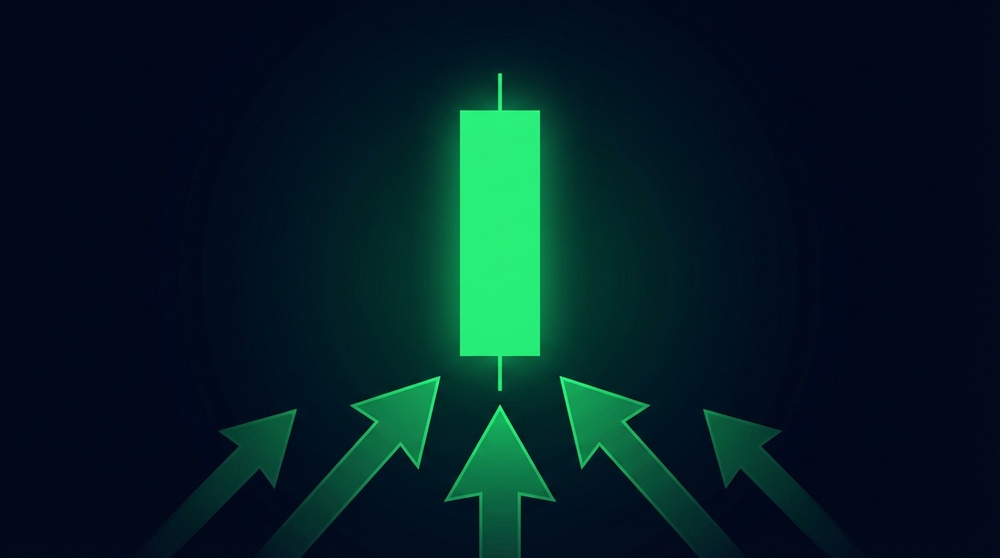
What happened: Buyers dominated throughout the entire period. Price opened at the low and closed at the high.
Crowd psychology:
- Buyers are confident and aggressive
- Sellers cannot put up resistance
- New participants enter the market on a wave of optimism
- FOMO (Fear Of Missing Out) is present — fear of missing profits
Psychological Insight
The longer the bullish candle, the stronger the buyer confidence. However, extremely long candles often indicate exhaustion — the crowd has expended all buying energy in one period.
Bearish Candle with Long Body
What happened: Sellers controlled the situation. Price opened at the high and closed at the low.
Crowd psychology:
- Sellers are aggressive, taking profits or opening shorts
- Buyers are demoralized and not engaging in battle
- Fear of further decline spreads
- Stop-losses trigger, amplifying the movement
Doji: The Moment of Uncertainty
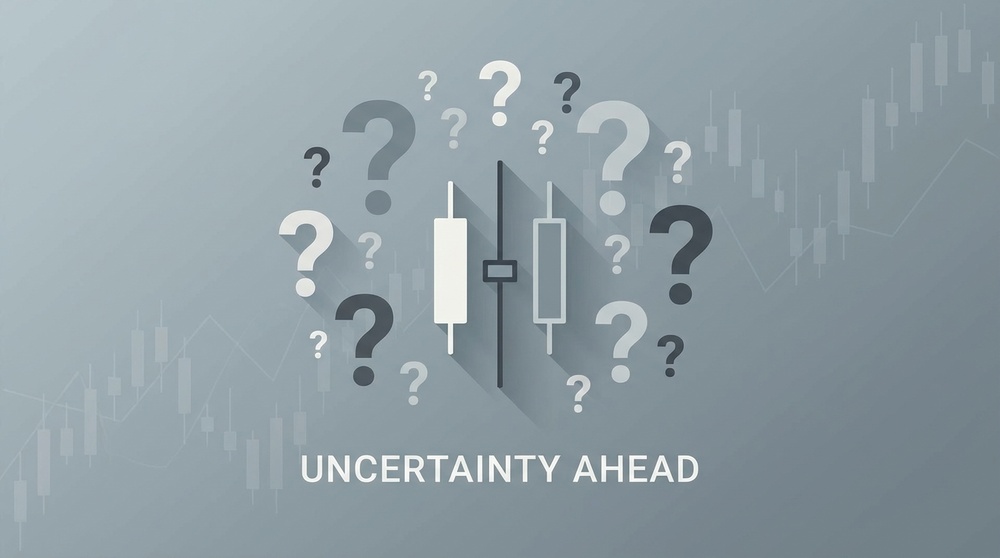
What happened: Opening and closing prices virtually coincided after a battle within the period.
Crowd psychology:
- Balance between buyers and sellers
- Uncertainty about further direction
- Many traders are waiting for confirmation
- Important: Doji after a strong trend = potential sentiment shift
A doji is the market's "question mark." The crowd is essentially saying: "We don't know what to do next." After such uncertainty, a sharp move in one direction often follows.
Candles with Long Shadows: Battle Scars
Candle shadows are scars from the battle between bulls and bears. They tell a story not visible in the open and close prices.
| Shadow Type | What Happened | Psychological Interpretation |
|---|---|---|
| Long upper shadow | Price rose high but was pushed back | Buyers tried to seize control, but sellers put up strong resistance. Sign of bull weakness. |
| Long lower shadow | Price fell low but recovered | Sellers pushed, but buyers aggressively bought the dip. Sign of bull strength or seller exhaustion. |
| Long shadows on both sides | High volatility within the period | Strong uncertainty, battle for control. The market is "nervous." |
Psychology of Reversal Patterns
Reversal patterns are moments when crowd psychology changes dramatically. Understanding these turning points is critically important for successful trading.
Hammer: A Story of Hope
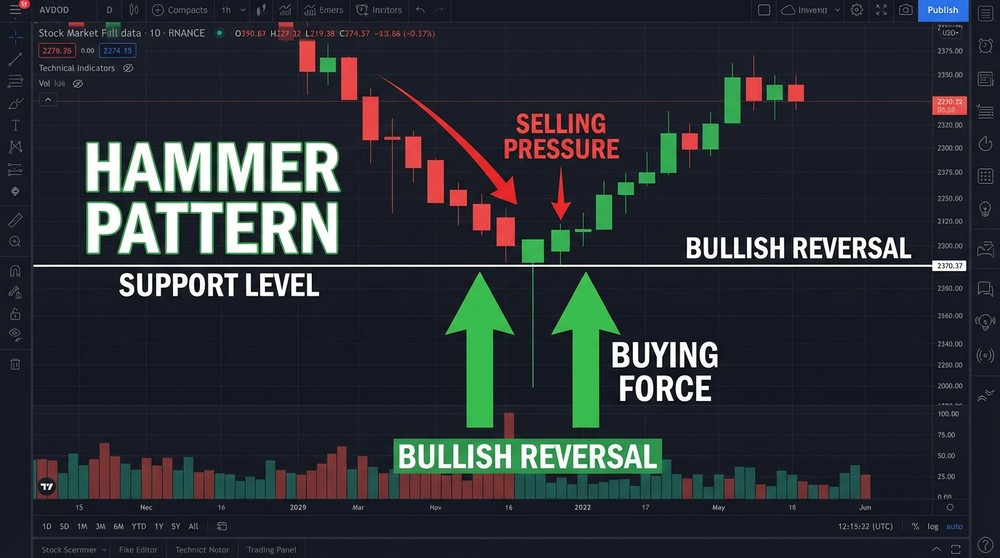
Formation scenario:
- Market is in a downtrend, fear dominates
- Sellers continue to push, price falls significantly
- At a certain level, aggressive buyers appear
- They absorb all supply and push price back up
- Candle closes near the high with a long lower shadow
Psychological shift:
- Sellers who opened positions at the bottom are trapped
- Their stop-losses are above, creating potential for a "short squeeze"
- Buyers gain confidence: "We stopped the decline!"
- Sellers begin to doubt: "Maybe it's time to close shorts?"
Critical Moment
A hammer is strongest when it forms at a significant support level. This means buyers are defending an important psychological mark, which strengthens their confidence.
Shooting Star: The Moment of Disappointment
Formation scenario:
- Market is in an uptrend, euphoria is building
- Buyers try to break new highs
- At a certain level, large sellers appear
- They absorb all buying and push price down
- Candle closes near the low with a long upper shadow
Psychological shift:
- Buyers who bought at the high are now at a loss
- Euphoria turns to concern
- Sellers gain confidence: "The rally is exhausted!"
- Many start thinking about taking profits
Engulfing: Psychological Takeover
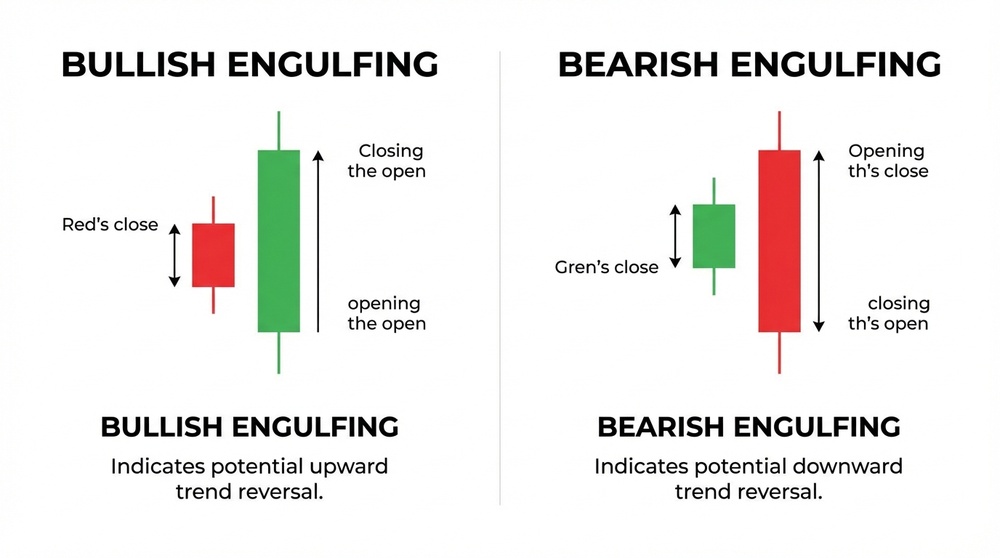
The engulfing pattern is a dramatic moment of power shift in the market. One side completely overwhelms the other.
🟢 Bullish Engulfing
Psychology: Buyers completely absorb previous selling. This is a demonstration of strength and determination.
Bull thinking: "We've completely seized control. Time to buy!"
Bear thinking: "Our selling has been wiped out. Time to close shorts."
🔴 Bearish Engulfing
Psychology: Sellers completely override previous buying. This signals bull capitulation.
Bear thinking: "Buyers have surrendered. Time to sell!"
Bull thinking: "Our buying has been destroyed. Time to cut losses."
Morning and Evening Star: A Three-Act Drama
These three-candle patterns represent a complete psychological story in three acts:
Morning Star (bullish reversal):
- Act 1 (bearish candle): Sellers dominate, fear is at maximum
- Act 2 (doji/small candle): Seller exhaustion, uncertainty, gap down on open
- Act 3 (bullish candle): Buyers take the initiative, hope is born
Evening Star (bearish reversal):
- Act 1 (bullish candle): Buyers dominate, euphoria is at maximum
- Act 2 (doji/small candle): Buyer exhaustion, uncertainty, gap up on open
- Act 3 (bearish candle): Sellers take the initiative, fear begins
Gaps in "star" patterns are especially important — they show that participants were so caught up that they opened positions significantly above or below the previous close. This is a sign of extreme emotions.
How the Crowd Creates Patterns
Understanding the mechanism of pattern formation gives you an advantage over traders who simply memorize names and shapes.
The Self-Fulfilling Prophecy Mechanism
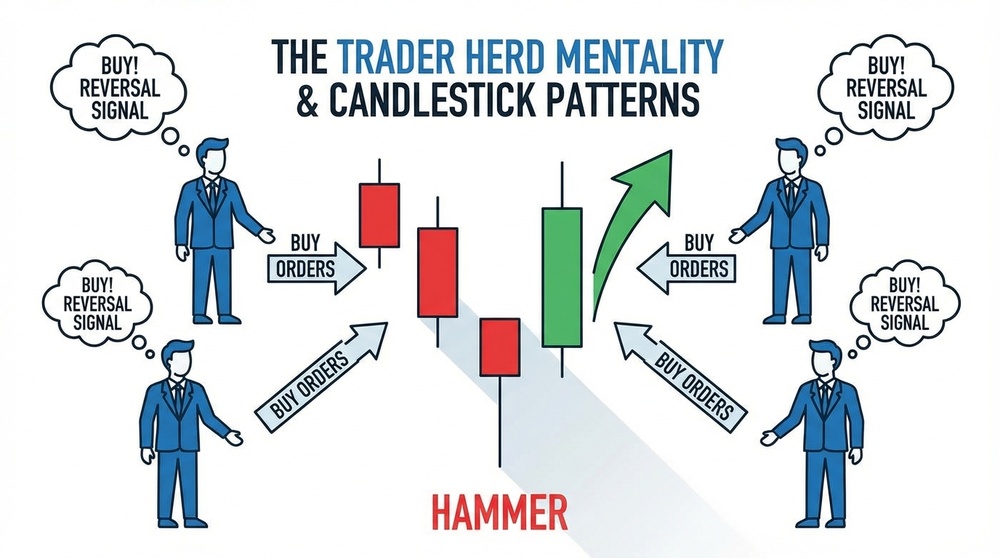
Candlestick patterns work partly because many traders see the same thing and act the same way:
- A recognizable pattern forms (e.g., hammer at support)
- Thousands of traders identify the pattern
- They place buy orders
- Combined buying volume pushes price up
- The pattern "works," confirming expectations
Practical Takeaway
The more well-known a pattern is, the higher the probability of it working in liquid markets. But this also makes it vulnerable to manipulation — large players know where the crowd stands and can use this against them.
Psychology of Support and Resistance Levels
Candlestick patterns gain additional strength at important price levels. Why do these levels work?
Support psychology:
- Traders remember buying here before and making profits
- Many place pending buy orders
- Logic kicks in: "If it bounced before, it will bounce again"
- Fear of missing the opportunity forces quick action
Resistance psychology:
- Traders remember selling here before or failing to break through
- Many take profits at this level
- Logic kicks in: "If it didn't break before, it won't break again"
- Fear of losing profits forces selling
The Role of Volume in Confirming Psychology
Trading volume is an indicator of participant conviction. High volume shows that many traders agree with the current movement.
| Scenario | What It Means | Psychological Interpretation |
|---|---|---|
| Bullish candle + high volume | Strong bullish signal | Many traders are convinced of growth and willing to risk money |
| Bullish candle + low volume | Weak bullish signal | Growth is due to lack of sellers, not buyer strength |
| Reversal pattern + high volume | Strong reversal signal | Serious sentiment shift, large players changing positions |
| Reversal pattern + low volume | Weak reversal signal | Possibly just a pause in the trend, not a real reversal |
Emotional Traps for Traders
Even understanding market psychology, traders often fall into emotional traps. Recognizing these traps is the first step to overcoming them.
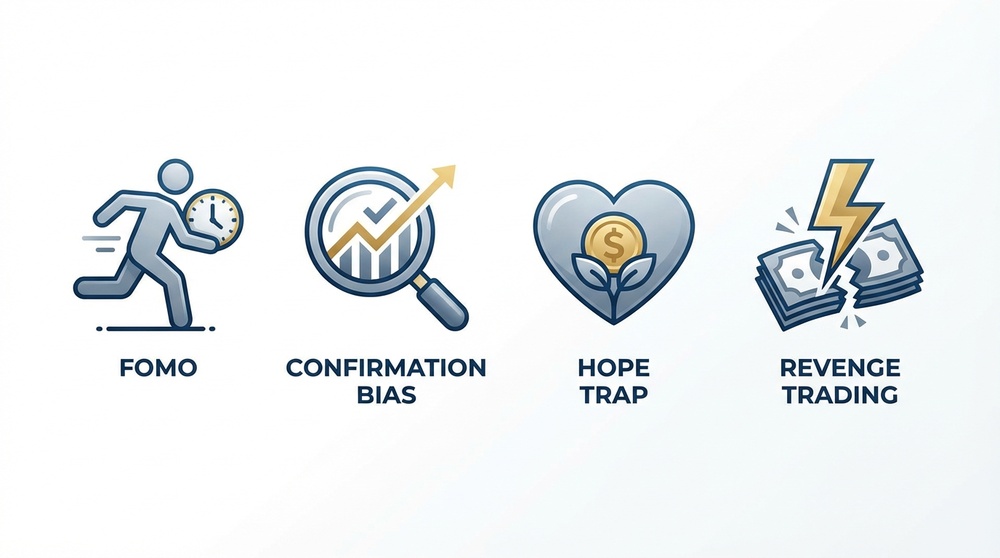
Confirmation Bias
What happens: A trader sees only signals that confirm their already-made decision, ignoring opposing ones.
Example: You've decided Bitcoin will rise. Now you perceive every bullish candle as confirmation, while explaining bearish candles as "temporary corrections."
How to avoid:
- Deliberately look for arguments against your position
- Ask yourself: "What would have to happen for me to admit I'm wrong?"
- Set clear exit criteria before entering a trade
FOMO Trap (Fear Of Missing Out)
What happens: Fear of missing profits forces entering the market without analysis, usually at the peak of a move.
Candlestick signs of a FOMO entry:
- Buying after a series of long bullish candles
- Entering on a candle with an extremely long body
- Buying after a gap up
How to avoid:
- If you feel urgency — that's a red flag
- Wait for a pullback and enter on a correction
- Remember: the market will provide thousands more opportunities
Hope Trap (Hope Trading)
What happens: A trader holds a losing position hoping for a reversal, ignoring all new signals against them.
Candlestick signs being ignored:
- Series of bearish candles with increasing body size
- Support level breakdowns
- Formation of downtrend continuation patterns
How to avoid:
- Set a stop-loss before entry and don't move it
- Determine the maximum loss you're willing to accept
- Remember: admitting a mistake is a sign of strength, not weakness
Revenge Trading Trap
What happens: After a loss, a trader tries to "get even," making impulsive decisions without proper analysis.
Typical mistakes:
- Increasing position size after a loss
- Entering a trade without a clear candlestick signal
- Ignoring risk management rules
How to avoid:
- Set a rule: after a loss — take a break for at least one analysis period
- Keep a trading journal for emotional release
- Remember: one loss is part of the process, a series of impulsive losses is a disaster
Professional's Rule
Professional traders trade the process, not the outcome. They know that even a perfect signal may not work, and that's normal. Their goal is to consistently follow the strategy, not to win every trade.
Reading Crowd Emotions: Practical Techniques
Now let's combine all knowledge into practical techniques for reading market psychology.
Technique 1: Analyzing Candle Character Changes
Watch how the character of candles changes as a trend develops:
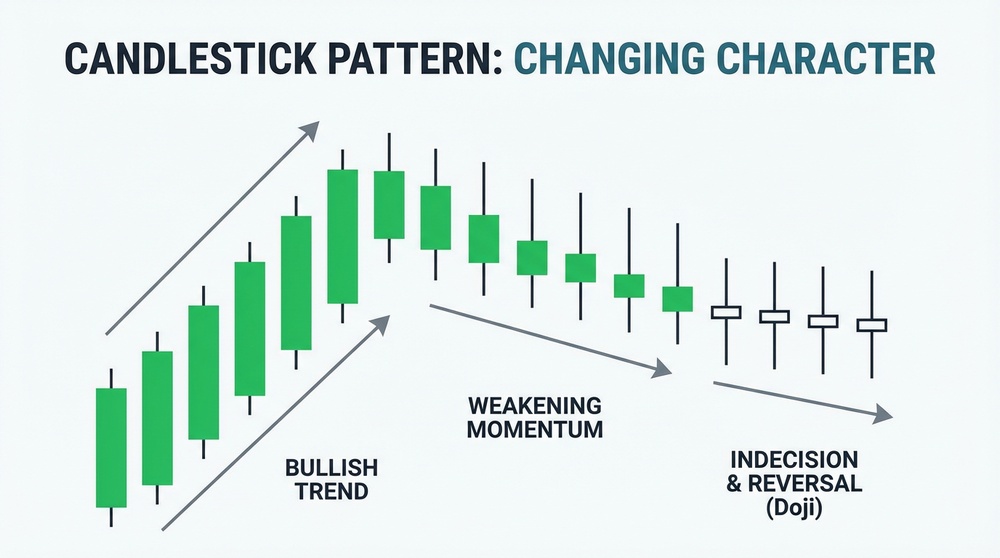
Signs of bullish trend exhaustion:
- Candle bodies become smaller
- Long upper shadows appear
- Number of red candles increases
- Volume on rallies decreases
Signs of bearish trend exhaustion:
- Candle bodies become smaller
- Long lower shadows appear
- Number of green candles increases
- Volume on declines decreases
Technique 2: The "What Is the Opposite Side Thinking?" Method
Before every trade, ask yourself: "Why is someone taking the opposite position?"
If you're buying, someone is selling. Understand their logic:
- What do they see on the chart?
- What are their arguments?
- Where are their stop-losses?
- What will force them to close their positions?
This exercise helps you see the complete picture and avoid one-sided interpretation.
Technique 3: Evaluating Pattern "Quality"
Not all patterns are equal. Evaluate each pattern on a quality scale:
| Criterion | High Quality | Low Quality |
|---|---|---|
| Location | At a significant support/resistance level | In "empty space," not tied to levels |
| Volume | Above average, confirms the pattern | Below average, weak participation |
| Trend context | After a significant move | In a sideways range without a clear trend |
| Form clarity | Classic pattern proportions | Unclear, "blurry" form |
| Timeframe | Higher timeframes (H4, D1) | Lower timeframes (M1, M5) |
Technique 4: Emotion Journal
Keep a separate journal where you record your emotions when analyzing charts:
- What do I feel looking at this chart?
- Do I have an urge to enter a trade immediately?
- Am I afraid of missing the move?
- Am I hoping the market will go my way?
Over time, you'll learn to recognize patterns in your own emotional state and use this as a contrarian indicator.
"When you feel an overwhelming urge to buy — the market is probably near a top. When you feel terror and want to sell everything — the market is probably near a bottom." — Old trader wisdom
Integrating Psychology into Your Trading System
Knowledge of psychology should become part of your trading system, not just theoretical knowledge.
Psychological Analysis Checklist
Before every trade, check:
- What is the current phase of the emotional cycle? (accumulation, markup, distribution, markdown)
- What emotion dominates in current candles? (greed, fear, uncertainty)
- Are there signs of extreme emotions? (very long candles, large gaps)
- Does volume confirm the emotional sentiment?
- At what level is the pattern forming? (psychologically significant or random)
- What are my own emotions? (neutral or biased)
When NOT to Trade
Psychological analysis also helps determine when it's better to stay out of the market:
- Period of uncertainty: Multiple dojis, contradictory signals
- Extreme emotions: After panic selloffs or euphoric buying — wait for stabilization
- Your personal emotions: If you're excited, upset, or distracted — don't trade
- Absence of a clear pattern: Don't invent signals where there are none
Practical Exercise
To reinforce the material, complete the following exercise:
Assignment: Psychological Chart Analysis
- Open the daily chart of any top-10 cryptocurrency
- Find the last significant trend reversal
- Describe crowd psychology in three phases: before the reversal, at the moment of reversal, after the reversal
- Determine what emotions led to the formation of the reversal pattern
- Evaluate the pattern quality using criteria from this lesson
- Write down what emotions you experienced during the analysis
Key Lesson Takeaways
- Candles are a visual representation of emotions, not just technical signals
- Fear and greed are the two main driving forces of the market, creating all patterns
- Understanding the psychology of the opposite side gives you a strategic advantage
- Emotional traps (confirmation, FOMO, hope, revenge) are a trader's main enemies
- Pattern quality depends on context, volume, and location
- Your own emotions are an important indicator of market state
- Psychological analysis should be integrated into your trading system
In the next lesson, we'll examine how to apply candlestick analysis across different timeframes and why the same candle can mean different things on a one-minute versus a daily chart.