















Module 3: Reversal Candlesticks: Doji, Hammer, Shooting Star
The ability to recognize reversal candlesticks is one of the most essential skills for any technical analyst. These patterns signal a potential change in the current trend and give traders the opportunity to enter the market at the very beginning of a new move. In this lesson, we'll break down five key reversal candles in detail: Doji, Hammer, Inverted Hammer, Shooting Star, and Hanging Man.
Understanding the mechanics behind how these patterns form will give you more than just formal rules — you'll gain a deep awareness of market psychology and learn to read the battle between buyers and sellers directly on the chart.
What Are Reversal Candlesticks and Why Do They Matter
Reversal candlesticks are individual candle formations that appear at the end of a trending move and signal a probable change in price direction. Unlike continuation candles, reversal patterns indicate exhaustion of the dominant force in the market.
Key Characteristics of Reversal Candles
- They appear after a defined trend — without a preceding move, a reversal candle loses its meaning
- They reflect a shift in the balance of power — showing that one side (bulls or bears) is starting to lose control
- They require confirmation — a single candle is rarely sufficient grounds for opening a position
- They have characteristic proportions — the ratio of body to shadows determines the signal's strength
Important to understand: Reversal candles do not guarantee a trend change. They only signal a potential reversal opportunity that must be confirmed with additional analysis tools.
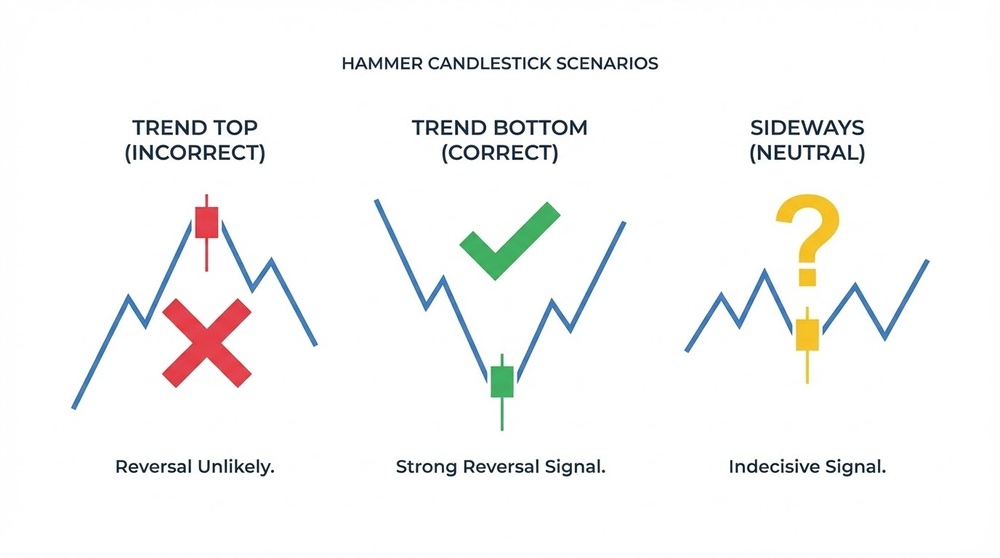
Context — The Key to Correct Interpretation
The same candlestick formation can have completely different meanings depending on where it appears:
- At the top of an uptrend — a signal of potential downward reversal
- At the bottom of a downtrend — a signal of potential upward reversal
- In the middle of sideways movement — the signal is unreliable and often false
- At a key support/resistance level — the signal is strengthened
Doji — The Candle of Market Indecision
A Doji is a candle where the opening price is virtually equal to the closing price, resulting in a very small or nonexistent body. Visually, a doji resembles a cross or plus sign. This formation reflects a state of equilibrium between bulls and bears — neither side was able to prevail.
The Psychology Behind Doji Formation
When a doji forms, the following occurs:
- Price moves in one direction at the start of the period
- The opposing side seizes the initiative
- Several swings occur in both directions
- By the close, price returns almost to the opening point
This price behavior shows that the market is in a state of uncertainty. Neither buyers nor sellers have enough strength to establish a clear direction. This is especially significant after a prolonged trend — a doji may indicate exhaustion of the dominant side.
Main Types of Doji
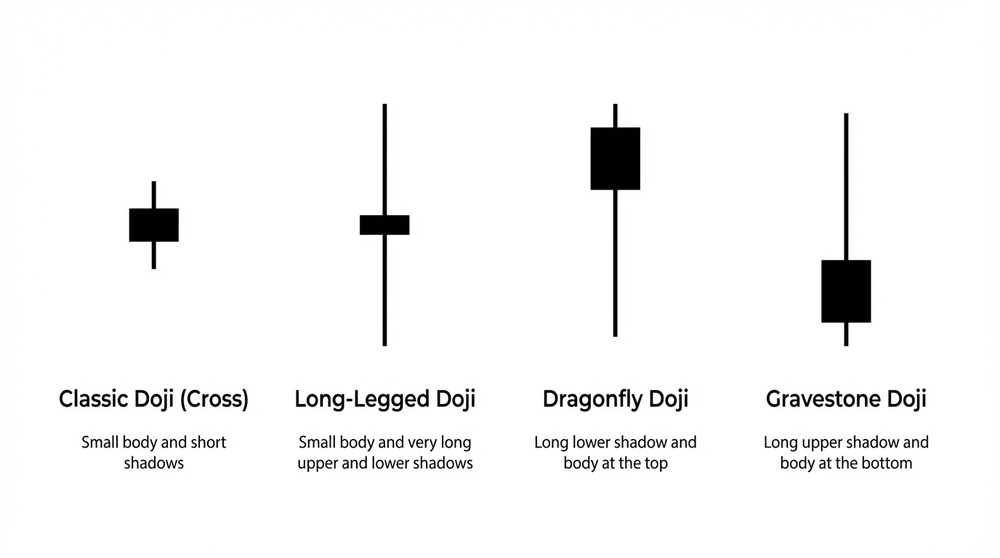
Classic Doji
The body is virtually absent, with upper and lower shadows of approximately equal length. Signals pure equilibrium of forces in the market.
Long-Legged Doji
Very long shadows in both directions with a minimal body. Shows strong volatility and extreme uncertainty among participants.
Dragonfly Doji
Long lower shadow, with body and upper shadow virtually absent. At the bottom of a trend — a strong bullish reversal signal.
Gravestone Doji
Long upper shadow, with body and lower shadow minimal. At the top of a trend — a strong bearish reversal signal.
Rules for Interpreting Doji
Key Rules for Working with Doji
- After an uptrend — doji warns of a possible downward reversal
- After a downtrend — doji warns of a possible upward reversal
- In sideways movement — doji has no significant predictive value
- A series of doji in a row — indicates strong consolidation before a powerful move
- Doji at a key level — significantly strengthens the signal
Confirming the Doji Signal
Never trade based on a single doji. Always wait for confirmation:
- The next candle — should close in the direction of the expected reversal
- Trading volume — increased volume on the confirming candle strengthens the signal
- Support/resistance levels — a doji at a key level is more reliable
- Additional indicators — RSI, MACD can confirm the reversal
Hammer — A Bullish Reversal Signal
The Hammer is a single-candle pattern that forms at the end of a downtrend and signals a potential upward reversal. The pattern gets its name from its characteristic shape: a small body at the top and a long lower shadow, resembling a hammer.
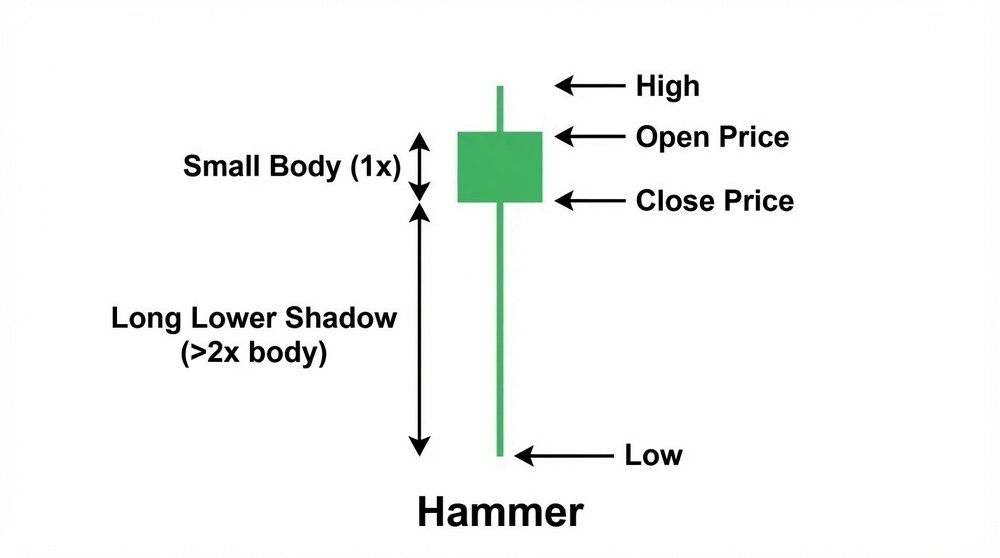
Characteristics of an Ideal Hammer
| Parameter | Requirement | Significance |
|---|---|---|
| Preceding trend | Downtrend | Mandatory condition |
| Body size | Small | The smaller, the stronger the signal |
| Lower shadow | Minimum 2x body length | Ideal — 2.5-3x |
| Upper shadow | Absent or minimal | No more than 10% of lower |
| Body color | Any | Green (bullish) strengthens signal |
| Position | At support level | Significantly increases reliability |
The Psychology Behind Hammer Formation
The hammer tells the story of a battle between bears and bulls:
- Open: Price opens at a certain level after a downward move
- Bear attack: Sellers continue pressure, pushing price significantly lower
- Turning point: Buyers become active at the lows, and a reversal begins
- Bull counterattack: Buyers absorb all selling volume and push price back up
- Close: Price closes near the period's high, forming a long lower shadow
The long lower shadow shows that bears tried to continue the decline, but bulls aggressively rejected those levels. This is the first sign that sellers are losing control of the market.
Professional insight: The longer the hammer's lower shadow relative to its body, the more aggressively buyers defended the level. A shadow 3 or more times longer than the body is a very strong signal.
Trading the Hammer Pattern
Algorithm for working with the hammer:
- Identification: Find a candle matching the criteria after a clear downtrend
- Wait for confirmation: Wait until the next candle closes above the hammer's body
- Entry point: On a break of the confirming candle's high
- Stop-loss: Placed below the hammer's low (tip of the lower shadow)
- Take-profit: At the nearest resistance level or by risk/reward ratio
Inverted Hammer
The Inverted Hammer is a bullish reversal pattern appearing at the end of a downtrend. Visually, it's a mirror image of the regular hammer: a small body at the bottom of the candle with a long shadow pointing upward.
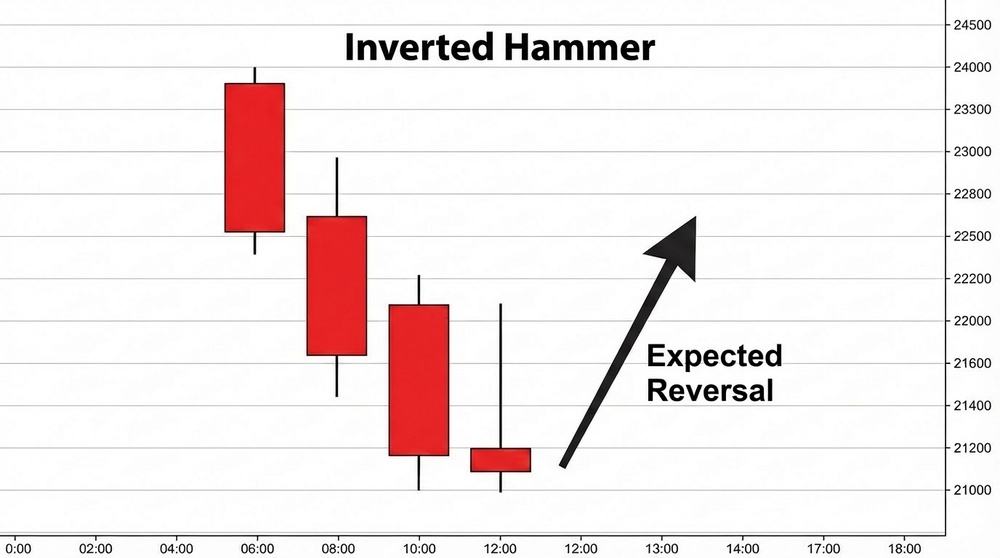
Psychology of the Inverted Hammer
Although a long upper shadow is usually associated with selling pressure, in the context of a downtrend, the inverted hammer carries a bullish meaning:
- Price opens at a low level after a decline
- Buyers attempt to push price significantly higher
- Sellers are still strong and push price back down
- However, the very attempt at a rally indicates emerging buying interest
The inverted hammer shows that buyers are starting to test the sellers' strength. It's the first warning bell that the downtrend may be running out of steam.
Key Difference from the Hammer
- The inverted hammer requires stronger confirmation than the regular hammer
- The next candle must be clearly bullish and close above the inverted hammer's body
- Increased volume on the confirming candle is critically important
- Without confirmation, the pattern is considered unreliable
Shooting Star — A Bearish Reversal
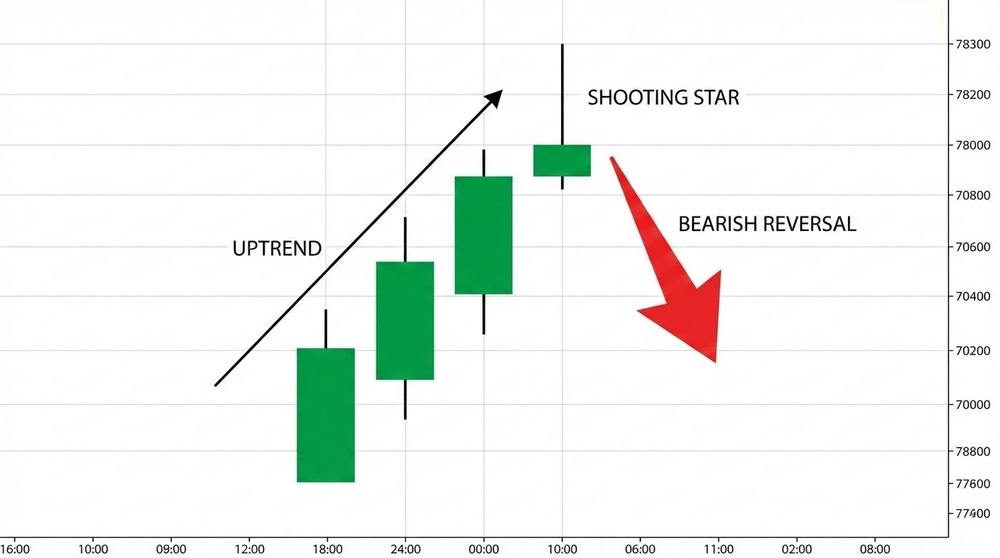
The Shooting Star is a bearish reversal pattern that forms at the top of an uptrend. In shape, it's identical to the inverted hammer: a small body at the bottom and a long upper shadow. However, the context of its appearance completely changes the interpretation.
Characteristics of an Ideal Shooting Star
| Parameter | Requirement | Significance |
|---|---|---|
| Preceding trend | Uptrend | Mandatory condition |
| Body size | Small | Located at the bottom of the candle |
| Upper shadow | Minimum 2x body length | The longer, the stronger the signal |
| Lower shadow | Absent or minimal | No more than 10% of upper |
| Body color | Any | Red (bearish) strengthens signal |
| Gap up | Desirable | Opening above previous candle strengthens pattern |
Psychology Behind Shooting Star Formation
The shooting star illustrates a dramatic reversal in intraday dynamics:
- Bull optimism: Price opens at high levels after an upward move
- Final push: Buyers push price even higher, creating a new high
- Sellers emerge: Large sellers become active at the highs
- Collapse: Selling pressure is so strong that price retreats to the period's lows
- Close: The candle closes near its low, leaving a long upper shadow
The long upper shadow is the trace of bulls' failed attempt to continue the rally. Sellers aggressively rejected higher levels, showing their strength.
Market interpretation: The shooting star is a candle of disappointment. Bulls tried to storm new heights but were pushed back. The longer the upper shadow, the more decisive the rejection of higher prices.
Trading the Shooting Star
- Identification: Find the characteristic formation after a sustained rally
- Wait for confirmation: The next candle should close below the shooting star's body
- Entry point: On a break of the confirming candle's low
- Stop-loss: Above the shooting star's high (tip of upper shadow)
- Take-profit: At the nearest support level
Hanging Man — A Bearish Signal
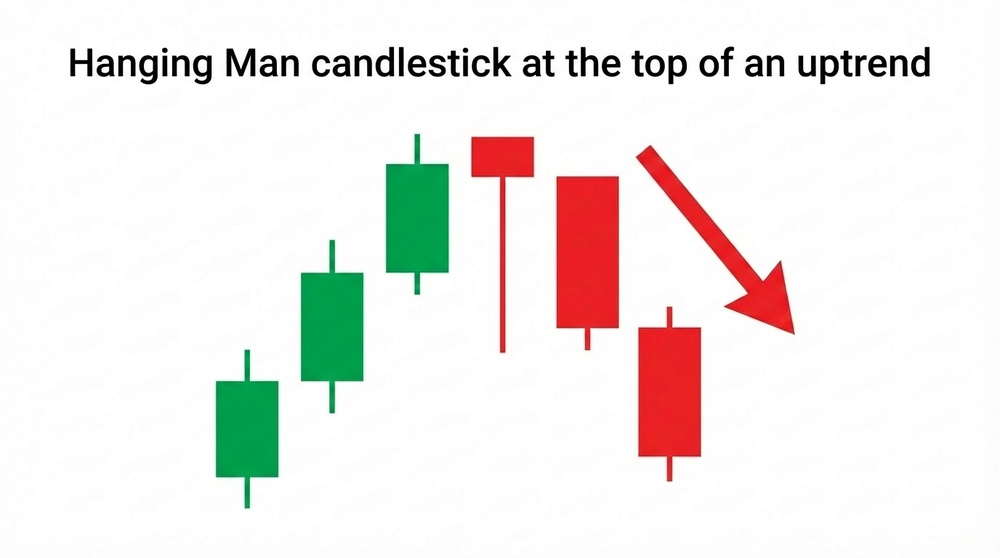
The Hanging Man is a bearish reversal pattern appearing at the top of an uptrend. In shape, it's identical to the hammer: a small body at the top and a long lower shadow. However, context completely changes the interpretation.
Why Does the Same Shape Have Opposite Meaning?
The key to understanding lies in context:
Hammer (at bottom)
The long lower shadow shows that bears attacked, but bulls bought up all the decline. Buyer strength after a drop — bullish signal.
Hanging Man (at top)
The long lower shadow shows there was a strong drop during the day. Emergence of sellers after a rally — bearish signal.
The hanging man warns: "Although price closed high, a serious selloff occurred within the period. Sellers have awakened."
Confirming the Hanging Man
The hanging man requires mandatory confirmation, as it's not as unambiguous as the shooting star:
- The next candle must be bearish and close below the hanging man's body
- A gap down on the next candle is very strong confirmation
- Increased volume on the declining candle strengthens the signal
- Without confirmation, opening short positions is not recommended
Comparative Table of Reversal Candles
For quick memorization and practical application, use this reference table:
| Pattern | Context | Signal | Characteristic Features | Reliability |
|---|---|---|---|---|
| Doji | End of trend | Indecision | Body ≈ 0, any shadows | Medium |
| Dragonfly Doji | Trend bottom | Bullish | Long lower shadow | High |
| Gravestone Doji | Trend top | Bearish | Long upper shadow | High |
| Hammer | Trend bottom | Bullish | Long lower shadow ≥2x body | High |
| Inverted Hammer | Trend bottom | Bullish | Long upper shadow ≥2x body | Medium |
| Shooting Star | Trend top | Bearish | Long upper shadow ≥2x body | High |
| Hanging Man | Trend top | Bearish | Long lower shadow ≥2x body | Medium |
Strengthening Reversal Candle Signals
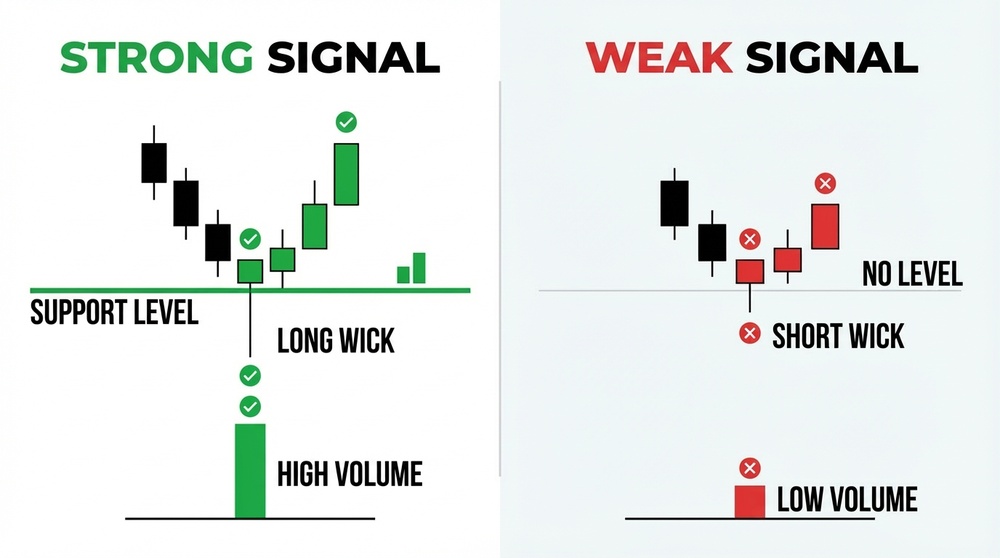
Not all reversal candles are equally reliable. There are factors that significantly strengthen or weaken their predictive value:
Signal Strengthening Factors
- Key level: Pattern forms at a strong support or resistance level
- Trend duration: The longer the preceding trend, the more reliable the reversal signal
- High volume: Increased volume on the reversal candle confirms serious intent
- Shadow size: A shadow 3 or more times longer than the body is a very strong signal
- Gap: A gap before the reversal candle strengthens the pattern
- Divergence: Divergence with oscillators (RSI, MACD) confirms the reversal
- Round numbers: Formation near psychologically significant levels (10000, 50000, etc.)
Signal Weakening Factors
- Sideways market: In the absence of a trend, reversal candles are unreliable
- Low volume: Formation on low volume indicates lack of interest from large players
- Short shadow: A shadow less than 2 times the body length is a weak signal
- No key levels: A pattern "in mid-air" without level anchoring is less reliable
- Contradiction with higher timeframe trend: A local reversal against the global trend is often false
Practical Trading Strategies
Strategy #1: Conservative Entry with Confirmation
The safest approach for beginner traders:
- Identify a reversal candle at the end of a defined trend
- Wait for the confirming candle to close in the direction of the expected reversal
- Enter on a break of the confirming candle's extreme
- Stop-loss — beyond the reversal candle's extreme
- Target profit — nearest significant level or minimum 1:2 risk/reward ratio
Strategy #2: Aggressive Entry
For experienced traders when strong confirming factors are present:
- Enter immediately after the reversal candle closes
- Mandatory conditions: key level + high volume + long shadow
- Use a smaller position size (half of standard)
- Add to the position after receiving confirmation
Example Trading Situation
Scenario: After 5 consecutive green candles on the BTC daily chart, a shooting star forms at the $65,000 resistance level with above-average volume.
- Entry: On a break of the next red candle's low
- Stop-loss: Above the shooting star's high (tip of upper shadow)
- Target: Nearest support at $60,000
- Ratio: Risk $1000, potential $5000 = 1:5
Common Mistakes When Working with Reversal Candles
Avoid these common mistakes:
Mistake #1: Ignoring Context
A hammer at the top of a trend or a shooting star at the bottom are not reversal signals. Always assess where exactly the candle appeared.
Mistake #2: Trading Without Confirmation
Entering the market immediately after a reversal candle forms without waiting for confirmation is a risky strategy with a low success rate.
Mistake #3: Incorrect Stop-Loss Placement
The stop-loss should be placed beyond the reversal candle's extreme. A stop that's too tight will knock you out of the position on normal volatility.
Mistake #4: Looking for Patterns on Low Timeframes
On 1-minute and 5-minute charts, reversal candles generate many false signals. Start your analysis from at least the hourly timeframe.
Mistake #5: Ignoring Volume
A reversal candle on low volume is a weak signal. Always check trading volume.
Practical Assignment
To reinforce the material, complete the following exercise:
- Open the daily chart of any cryptocurrency from the top 20 by market cap
- Find at least 3 examples of each pattern (Doji, Hammer, Shooting Star)
- For each example, determine:
- Was the preceding trend sufficiently defined?
- Did the candle's proportions match the ideal criteria?
- Was there confirmation from the next candle?
- Would the signal have worked with a conservative entry?
- Keep an observation journal — record your findings
Pro tip: Don't rush to trade with real money. Spend at least 2-3 weeks observing reversal candle formation in real time. This will create an intuitive understanding of patterns that's impossible to get from theory alone.
Key Takeaways from This Lesson
- Doji — a candle of indecision, signaling possible trend exhaustion
- Hammer — a bullish reversal signal at the bottom with a long lower shadow
- Inverted Hammer — a bullish signal at the bottom with a long upper shadow (requires strong confirmation)
- Shooting Star — a bearish reversal signal at the top with a long upper shadow
- Hanging Man — a bearish signal at the top with a long lower shadow
- Context is everything — the same candle shape has opposite meaning at different market points
- Confirmation is mandatory — never trade based solely on a single candle
- Combine with levels — patterns at key levels are significantly more reliable
In the next lesson, we'll study more complex reversal patterns consisting of multiple candles: engulfing patterns and "Star" patterns. They provide even stronger signals and are essential tools for the professional trader.