














Module 9: Practical Strategies: Entry and Exit Points
Candlestick analysis theory without practical application is like a treasure map without coordinates. You might know all the patterns by heart, but if you don't know how to properly enter and exit trades, profits will slip through your fingers. In this lesson, we'll transform your knowledge into a working trading system with clear rules and action algorithms.
Entry and exit points are the foundation of any trading strategy. They determine whether you'll profit from a trade or lose. Professional traders spend years honing this skill, but we'll shorten that path through a systematic approach and proven methodologies.
Core Principle: Your entry point determines your risk, your exit point determines your profit. Both decisions must be made BEFORE opening a position, not during trading under emotional influence.
Anatomy of the Perfect Entry Point
An entry point isn't just the moment you click "Buy" or "Sell." It's the result of analyzing multiple factors that must align. Let's break down what constitutes a quality position entry.
Three Pillars of Successful Entry
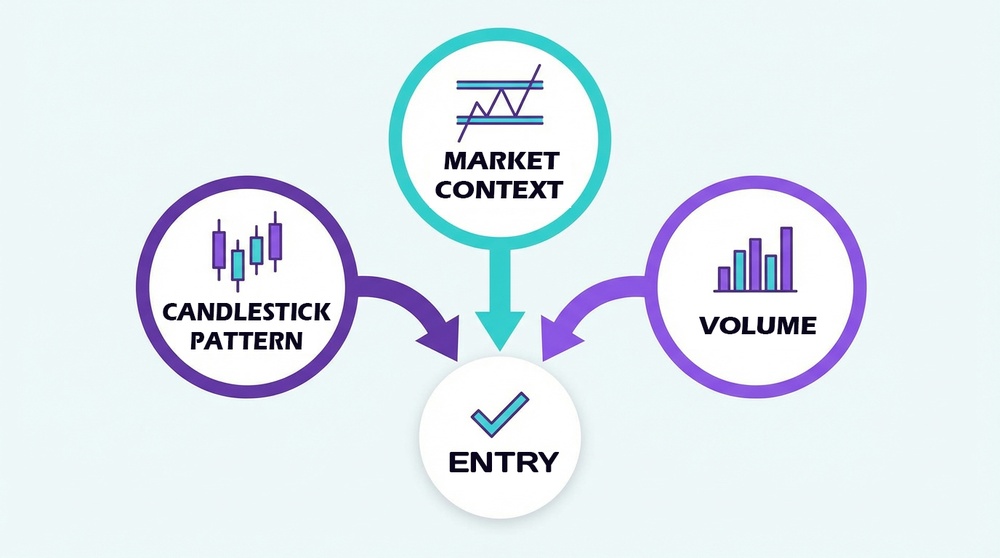
Every entry point should rest on three fundamental elements:
- Confirmed candlestick pattern — a signal you learned to recognize in previous lessons
- Market context — the pattern's position relative to support/resistance levels and trend
- Volume confirmation — market participant activity validating your signal
If even one element is missing, signal quality decreases. Experienced traders only enter when all three factors align.
Types of Entry Points by Candlestick Patterns
Depending on market conditions and your goals, several entry strategies exist:
🎯 Aggressive Entry
Opening a position immediately after a candlestick pattern forms, without waiting for additional confirmation. Suitable for scalping and trading on lower timeframes.
Risk: High
Potential: Maximum
⚖️ Conservative Entry
Waiting for pattern confirmation by the next candle. Entry occurs only after breaking the key level of the previous candle.
Risk: Moderate
Potential: Optimal
Entry Point Determination Algorithm
Use this step-by-step algorithm for every potential trade:
| Step | Action | Pass Criteria |
|---|---|---|
| 1 | Pattern identification | Candle matches the pattern catalog description |
| 2 | Context check | Pattern is at a significant level or within a trend |
| 3 | Volume analysis | Volume is above average or shows characteristic dynamics |
| 4 | Stop-loss determination | Stop level is logical and doesn't exceed acceptable risk |
| 5 | R/R ratio calculation | Potential profit is at least 2x the risk |
| 6 | Decision making | All criteria met — enter the trade |
Entry Strategies for Reversal Patterns
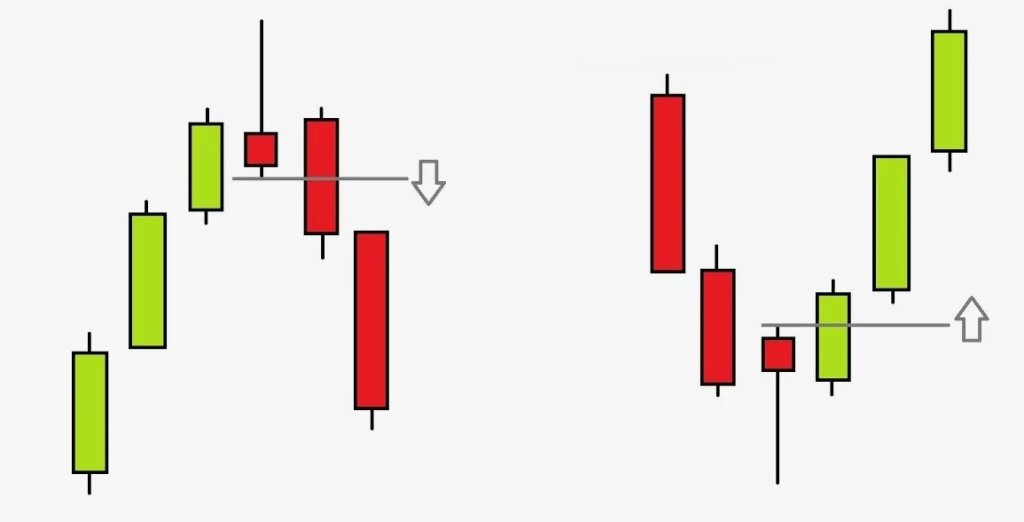
Reversal patterns are among the most profitable signals, but also the most dangerous when used incorrectly. Let's examine specific entry strategies for each type.
"Hammer at Support" Strategy
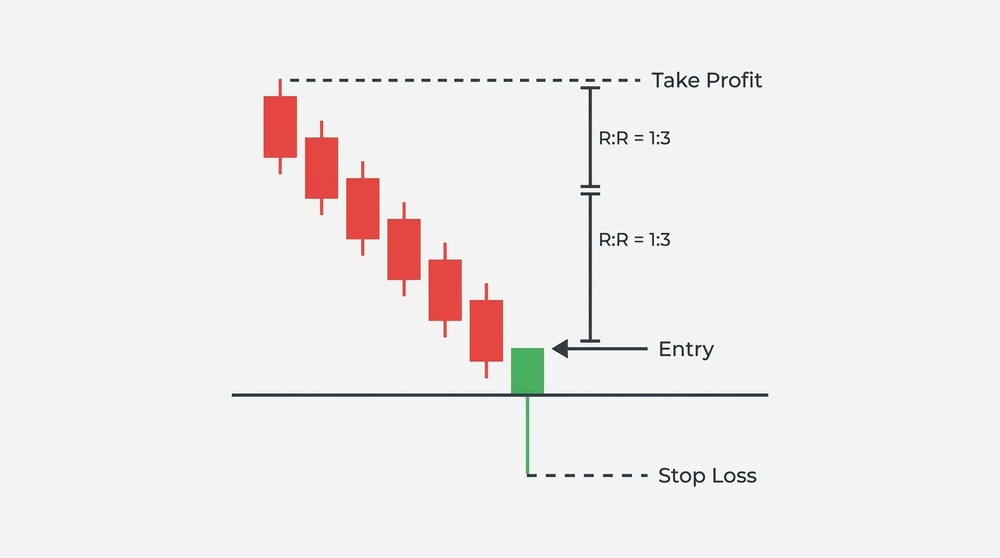
This is a classic strategy for entering a long position after a downward move.
Entry Conditions:
- Trend: Clear downward movement (minimum 5-7 candles)
- Level: Price has reached a support zone (historical low, round number, Fibonacci level)
- Pattern: A classic Hammer with a long lower shadow has formed
- Volume: Elevated volume on the Hammer candle
Entry Rules:
- Aggressive entry: Open position at the opening of the next candle after the Hammer
- Conservative entry: Enter on breakout above the Hammer's high
- Stop-loss: Place 1-2% below the Hammer's shadow low
- Take-profit: First target — nearest resistance level
"Shooting Star at Resistance" Strategy
A mirror strategy for opening short positions at the top of an upward move.
Entry Conditions:
- Trend: Clear upward movement (minimum 5-7 candles)
- Level: Price has reached a resistance zone
- Pattern: A Shooting Star with a long upper shadow has formed
- Volume: Abnormally high volume — a sign of buying climax
Entry Rules:
- Aggressive entry: Short at the opening of the next candle
- Conservative entry: Enter on breakdown below the Shooting Star's low
- Stop-loss: 1-2% above the upper shadow's high
- Take-profit: Nearest support level or previous local low
"Bullish Engulfing" Strategy
The engulfing pattern provides a more reliable signal than single candles, thanks to the clear demonstration of control shift between bulls and bears.
Long Position Entry Rules:
- Identification: A large bullish candle completely engulfs the body of the previous bearish candle
- Entry point: Breakout above the engulfing candle's high
- Stop-loss: Below the pattern's low (both candles)
- Signal enhancement: Volume on the bullish candle is significantly higher than on the bearish one
Pro Tip: The greater the size difference between the engulfing and engulfed candle, the stronger the signal. Ideal ratio — the engulfing candle is at least 1.5x larger than the previous one.
Entry Strategies for Continuation Patterns
Trading with the trend is statistically more profitable than trying to catch reversals. Continuation patterns allow you to join an existing move with minimal risk.
"Three White Soldiers" Strategy — Trend Entry
This pattern signals the beginning or continuation of a strong bullish trend.
| Strategy Element | Description |
|---|---|
| Context | After a consolidation period or shallow correction in an uptrend |
| Signal | Three consecutive bullish candles with rising highs and lows |
| Entry | At the opening of the fourth candle or on breakout of the third's high |
| Stop-loss | Below the first candle's low in the pattern |
| Take-profit | Pattern movement size projected from the breakout point |
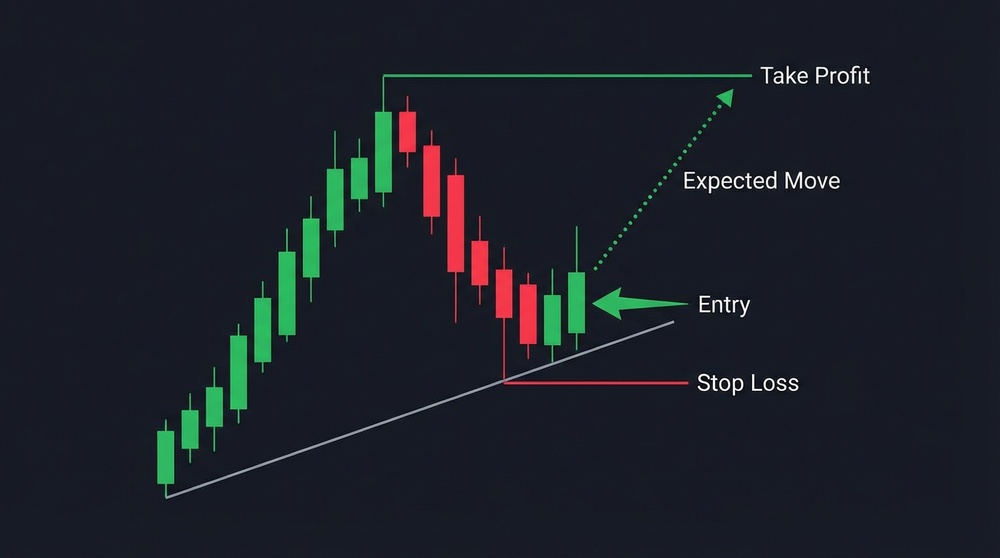
"Pullback to Level" Strategy
One of the most reliable strategies — entering in the trend direction after a pullback to a significant level.
Action Algorithm:
- Determine trend direction on the higher timeframe
- Wait for a pullback on your working timeframe
- Find the level — support in an uptrend or resistance in a downtrend
- Wait for a candlestick signal — a reversal pattern in the main trend direction
- Enter the trade upon signal confirmation
The Art of Determining Exit Points
The exit point is no less important than the entry point. Many traders lose profits not because they enter incorrectly, but because they don't know when to exit. Let's examine all aspects of closing positions.
Two Types of Position Exits
🛑 Protective Exit (Stop-Loss)
Closing a losing position when a predetermined loss level is reached. This is your insurance against catastrophic losses.
Mandatory for every trade!
✅ Target Exit (Take-Profit)
Locking in profits when a predetermined target is reached. Protects against greed and emotional decisions.
Planned before entering the trade
Stop-Loss Placement Methods
Several approaches exist for placing protective orders:
1. Technical Stop-Loss
Placed beyond a significant technical level — below support for longs, above resistance for shorts.
- For Hammer pattern: Below the lower shadow's low + 0.5-1% buffer
- For Engulfing: Below the entire pattern's low + buffer
- For Doji: Below/above the shadow's extreme in the direction against the trade
2. Percentage Stop-Loss
A fixed percentage from entry price. Simple, but doesn't account for instrument volatility.
| Trading Type | Recommended Stop | Comment |
|---|---|---|
| Scalping | 0.3-0.5% | Minimal stops for quick trades |
| Intraday | 1-2% | Standard range for day trading |
| Swing Trading | 3-5% | Accounts for greater volatility |
| Position Trading | 5-10% | For long-term positions |
3. ATR Stop (Volatility-Based)
The most professional method. Stop is set at 1.5-2 ATR (Average True Range) values from entry price.
How to Calculate ATR Stop:
- Find the ATR value on your working timeframe (usually 14-period)
- Multiply ATR by a coefficient (1.5 for aggressive trading, 2 for conservative)
- For long: Stop = Entry Price − (ATR × coefficient)
- For short: Stop = Entry Price + (ATR × coefficient)
Take-Profit Placement Methods
Determining profit targets is the art of balancing greed and caution.
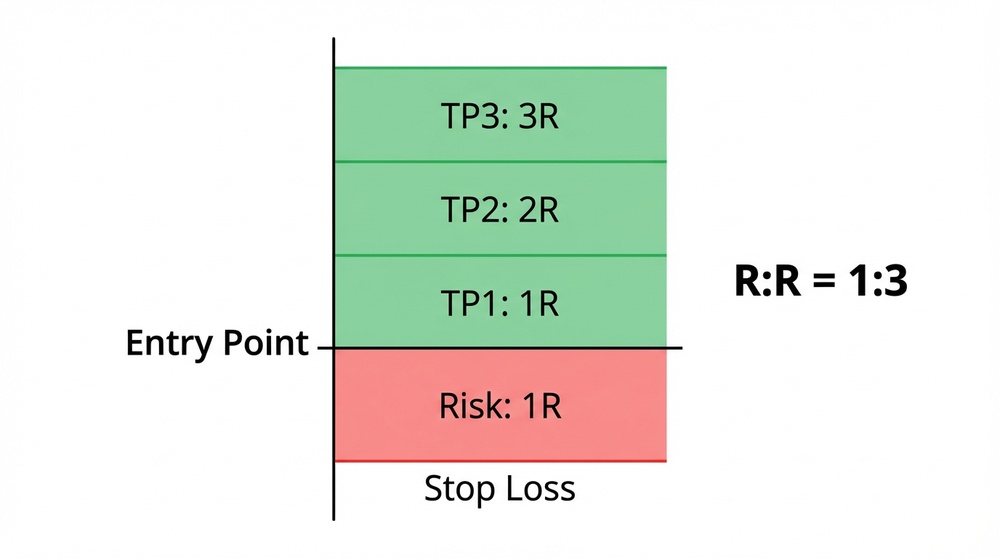
1. Fixed Risk/Reward Ratio (R:R)
The simplest method: profit target is N times the risk.
- R:R = 1:2 — minimum acceptable ratio
- R:R = 1:3 — optimal ratio for most strategies
- R:R = 1:5 and higher — for trend trading and major moves
Calculation Example:
- Entry price: 50,000
- Stop-loss: 49,000 (risk = 1,000 or 2%)
- Take-profit at R:R 1:3: 50,000 + (1,000 × 3) = 53,000
2. Technical Targets
Take-profit is set at significant technical levels:
- Nearest resistance/support level
- Previous local high/low
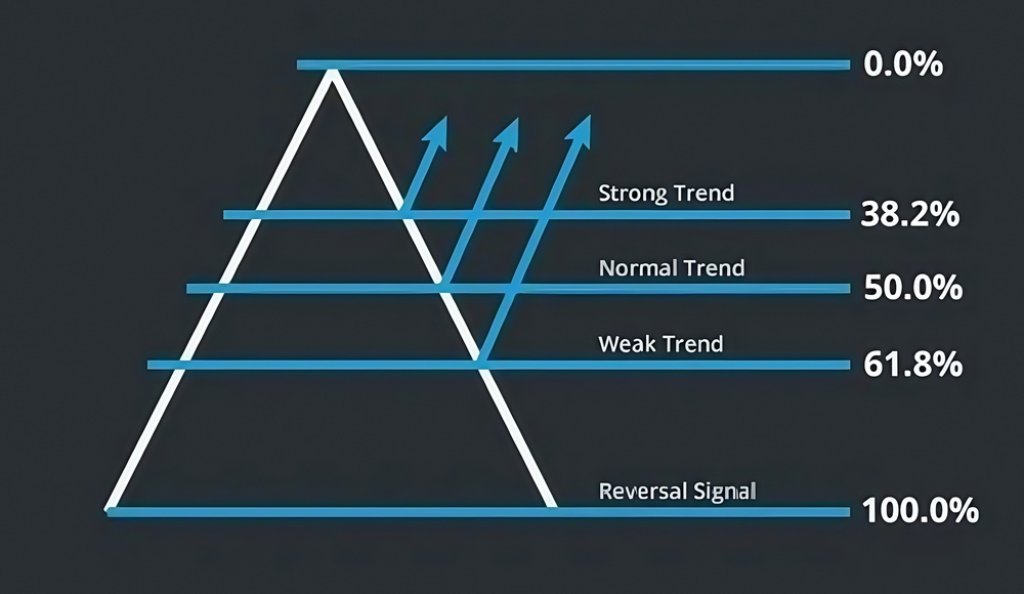
- Fibonacci levels (38.2%, 50%, 61.8% retracement)
- Round psychological levels (10,000, 50,000, 100,000)
3. Partial Position Closing
A professional approach — taking profits in stages:
| Stage | Closing | Action |
|---|---|---|
| Target 1 | 33% of position | Lock in first profit, move stop to breakeven |
| Target 2 | 33% of position | Lock in second portion, trailing stop on remainder |
| Target 3 | 34% of position | Close at final target or trailing stop |
Advantage of Partial Closing: You guarantee profit while leaving part of the position for potentially larger moves. This reduces psychological pressure and allows you to "let profits run."
Comprehensive Trading Strategies
Now let's combine everything into ready-to-use trading systems you can implement immediately after studying.
Strategy #1: "Reversal at Level"
Strategy Parameters:
- Timeframe: H1-H4
- Instruments: Any cryptocurrencies with sufficient liquidity
- Type: Counter-trend
- Win rate: 45-55%
- R:R: 1:2.5 - 1:3
Long Entry Rules:
- Price reaches a strong support level (tested at least 2-3 times)
- A reversal pattern forms: Hammer, Bullish Engulfing, or Morning Star
- Volume on the signal candle is above the 20-period average
- Enter on breakout of the pattern's high
- Stop-loss below the pattern's low + buffer (1 ATR)
- Take-profit = Nearest resistance or risk × 2.5
Short Entry Rules: Mirror conditions at resistance level with bearish patterns.
Strategy #2: "Trend Continuation"
Strategy Parameters:
- Timeframe: H4-D1
- Type: Trend-following
- Win rate: 50-60%
- R:R: 1:3 - 1:5
Entry Rules:
- Determine trend direction on D1 (series of higher highs and lows = uptrend)
- On H4, wait for a correction to MA50 or support level
- Find a reversal pattern in the main trend direction
- Confirmation: RSI exits oversold zone (for longs)
- Enter on breakout of the signal candle's high
- Stop-loss below the correction's local low
- Partial closing at levels + trailing stop
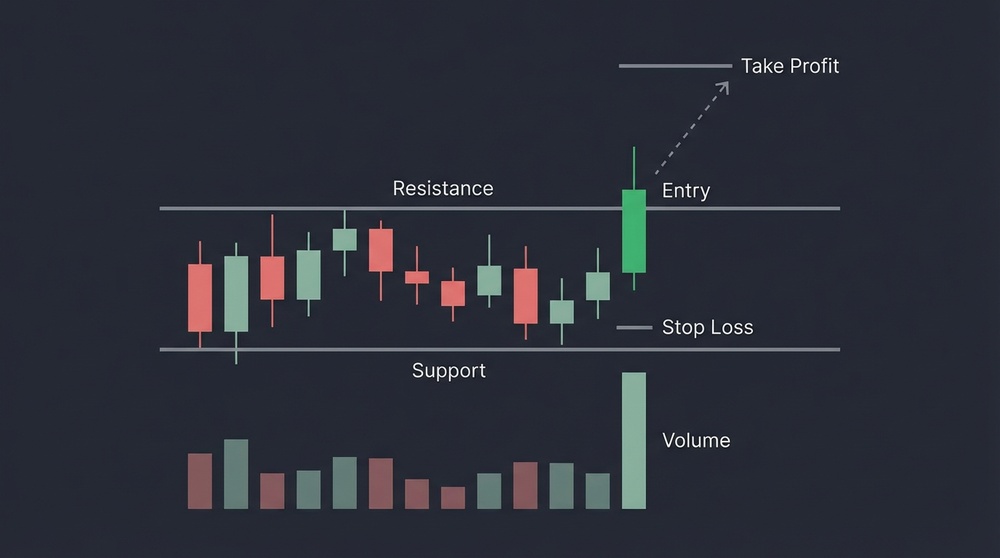
Strategy #3: "Breakout with Confirmation"
Strategy Parameters:
- Timeframe: M15-H1
- Type: Breakout
- Win rate: 40-50%
- R:R: 1:2 - 1:4
Entry Rules:
- Identify a consolidation zone (horizontal channel of at least 10-15 candles)
- Wait for a channel boundary breakout with a strong candle (Marubozu or candle with small shadows)
- Volume on breakout is significantly above average (minimum × 1.5)
- Enter at breakout candle close or on retest of the broken level
- Stop-loss inside the channel, beyond the opposite boundary
- Take-profit = Channel height projected from the breakout point
Position Management After Entry
Entering a trade is just the beginning. Proper management of an open position can turn a losing trade into breakeven, and a profitable one into very profitable.
Moving Stop-Loss to Breakeven
When price has moved in your favor by a distance equal to your initial risk (1R), move your stop-loss to entry level plus a small buffer.
Example:
- Entry: 50,000
- Initial stop: 49,000 (risk 1,000)
- Price reached 51,000 (moved 1R)
- New stop: 50,050 (breakeven + commission)
Trailing Stop
A dynamic stop-loss that follows price, locking in profits on reversal.
| Trailing Method | Description | When to Use |
|---|---|---|
| By local lows | Stop moves below each new local low (for longs) | Trending moves |
| By moving average | Stop follows MA20 or MA50 | Strong trends |
| By ATR | Stop at 2 ATR distance from current price | Volatile instruments |
| Percentage | Stop at fixed distance from maximum reached price | Simple implementation |
Adding to Position (Pyramiding)
Experienced traders scale into profitable positions, but follow strict rules:
- Only add to winning positions — never to losing ones
- Each addition is smaller than the previous — the pyramid narrows upward
- Recalculate total risk after each addition
- Add on pullbacks — not at movement highs
Warning: Pyramiding is an advanced technique. Beginner traders should first master basic single-position management.
Checklists for Practical Application
Use these checklists before every trade. Print them out or keep them visible near your trading terminal.
Trade Entry Checklist
Check Before Entry:
- Candlestick pattern is clearly identified and matches the description
- Pattern is in the correct context (at a level, in a trend)
- Volume confirms the signal
- Stop-loss is defined and doesn't exceed 2% of account
- Risk/reward ratio is at least 1:2
- No major news in the coming hours
- You are calm and not trading on emotions
- Position size is calculated according to money management rules
Trade Exit Checklist
When to Close Position:
- Profit target reached (take-profit)
- Stop-loss triggered — automatic closure
- Opposite signal appeared on the same timeframe
- Trend structure has changed (for trend trades)
- Major news approaching or trading session closing
- Maximum trade holding time expired (if set)
Position Size Calculation
Even the perfect entry point won't save you if position size is too large. Proper position sizing is the foundation of market survival.
Position Size Formula
Use this formula for every trade:
Position Size = (Account × Risk per trade%) ÷ (Entry Price − Stop-Loss)
Calculation Example:
- Account: 10,000 USDT
- Risk per trade: 1% = 100 USDT
- Entry price: 50,000
- Stop-loss: 49,000
- Position size = 100 ÷ (50,000 − 49,000) = 100 ÷ 1,000 = 0.1 BTC
Risk Management Rules:
- Risk per trade: 1-2% of account (maximum 3% for aggressive trading)
- Maximum daily risk: 5-6% of account
- Maximum weekly risk: 10-15% of account
- Correlated positions: Count as one trade
Common Mistakes and How to Avoid Them
Knowing common mistakes will save you from losing money through your own experience.
Entry Mistakes
| Mistake | Consequence | Solution |
|---|---|---|
| Entry without confirmation | High percentage of false signals | Always wait for signal candle to close |
| Ignoring context | Hammer in mid-trend isn't a signal | Check pattern position relative to levels |
| Chasing price | Entry at worse price, increased risk | If you missed entry — wait for next signal |
| Too early entry | Stop triggers on volatility | Use conservative entry method |
Exit Mistakes
| Mistake | Consequence | Solution |
|---|---|---|
| No stop-loss | Catastrophic losses | Stop-loss is mandatory for EVERY trade |
| Manually moving stop | Increased losses | Only move stop in profit direction |
| Taking profits too early | Missed profits | Use partial closing and trailing |
| Greed — unwillingness to take profits | Profit turns into loss | Set take-profit before entering trade |
Practical Assignment
Theory without practice is useless. Complete this assignment to reinforce the material:
Assignment:
- Choose 3 cryptocurrencies from the top 20 by market cap
- Open charts on H4 timeframe
- Find 5 historical situations with reversal patterns at levels
- For each situation determine:
- Entry point (aggressive and conservative)
- Stop-loss level
- Three take-profit levels
- Risk/reward ratio
- Evaluate the result: Would the trade have been profitable or not?
- Record conclusions in your trading journal
Important: Don't trade with real money until you've conducted at least 50 such historical analyses. Statistics is your best teacher.
Conclusion
Entry and exit points are skills that improve with practice. You've learned:
- How to identify quality entry points based on candlestick patterns
- Methods for setting stop-loss and take-profit
- Three ready-to-use trading strategies for different market conditions
- Open position management techniques
- Position sizing rules
In the next lesson, we'll cover the most painful topic — false signals and common trader mistakes. You'll learn how to distinguish real signals from traps and preserve your capital.
Remember: The market rewards discipline and patience. Follow your rules, keep statistics, and results will follow.