















Module 8: Fibonacci Arcs and Fans
Welcome to the eighth lesson of the Fibonacci levels course! Today we'll dive into two powerful yet often underrated technical analysis tools — Fibonacci Arcs and Fibonacci Fans. These tools add a new dimension to classic horizontal levels — time and angle, making cryptocurrency chart analysis significantly deeper and more precise.
Unlike standard retracement levels, arcs and fans account for price movement dynamics, helping traders see not only where a reversal might occur, but also when. This is especially valuable in the volatile crypto market, where entry timing often determines trade success.
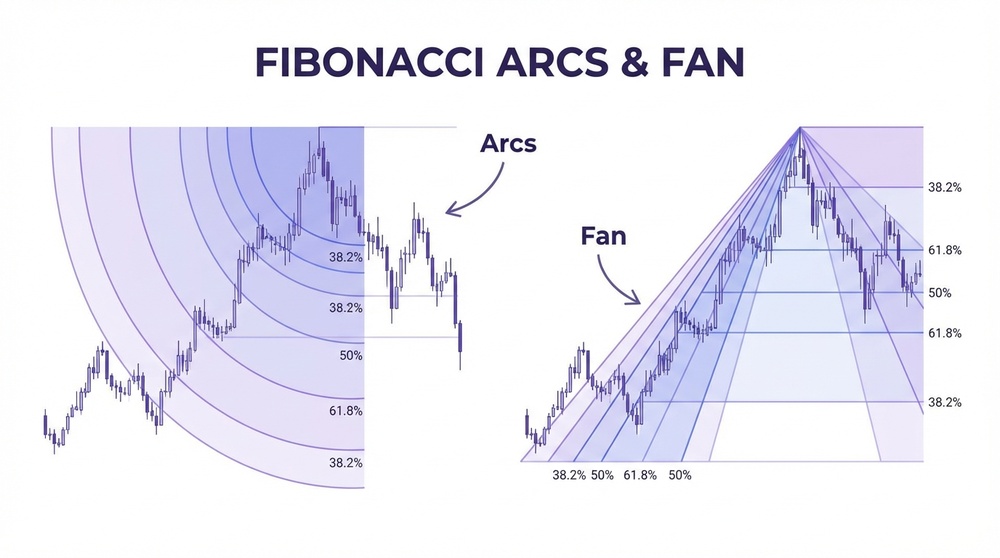
What Are Fibonacci Arcs
Fibonacci Arcs are curved support and resistance levels constructed as semicircles based on key Fibonacci ratios: 38.2%, 50%, and 61.8%. The main difference between arcs and regular retracement levels is that they expand over time, creating dynamic potential reversal zones.
Imagine throwing a stone into water — concentric circles spread from the point of impact. Fibonacci Arcs work on a similar principle: they show how the influence of a significant price movement spreads through time.
Key Feature of Arcs
Fibonacci Arcs combine price and time analysis in one tool. The further in time from the starting point, the wider the arcs become, reflecting the natural "decay" of the initial movement's momentum.
How to Construct Fibonacci Arcs
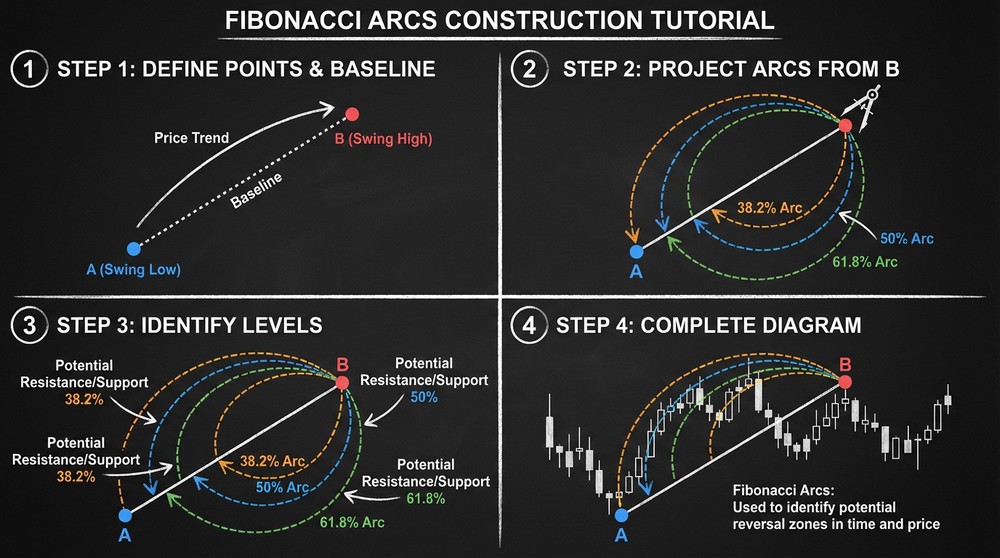
Building Fibonacci Arcs requires identifying two key points on the chart:
- Starting point — a significant low or high where the movement began
- Ending point — the opposite extreme where the movement ended
After connecting these points with a baseline (trendline), the tool automatically draws three semicircles centered at the ending point. The radii of these arcs correspond to Fibonacci levels relative to the baseline length.
Step-by-Step Arc Construction
- Identify the trend — find a clear uptrend or downtrend on the chart
- Select the extremes — mark the beginning and end of this movement
- Apply the tool — in most trading platforms (TradingView, MetaTrader) Fibonacci Arcs are found in the drawing tools menu
- Draw the baseline — from the starting point to the ending point
- Analyze intersections — observe how price interacts with the arcs
Important: When constructing arcs for an uptrend, the baseline is drawn from bottom to top (from low to high). For a downtrend — from top to bottom (from high to low). This determines which side the arcs will be positioned on.
Interpreting Fibonacci Arcs
Each arc represents a potential support or resistance zone:
| Arc Level | Characteristics | Trading Application |
|---|---|---|
| 38.2% | First retracement level, closest to the extreme | Shallow corrections in strong trends, aggressive entries |
| 50% | Middle level, often acts as a key zone | Balance between buyers and sellers, moderate entries |
| 61.8% | Deep correction, the "golden ratio" | Last defense for trend preservation, conservative entries |
Arc Scaling Considerations
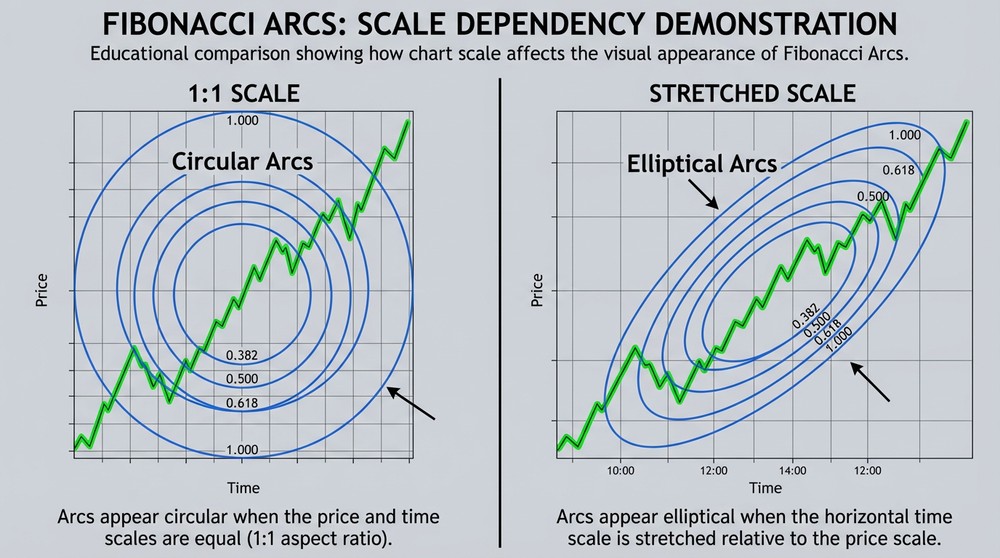
A critically important aspect of working with Fibonacci Arcs is their dependence on chart scale. When the ratio between vertical and horizontal axes changes, the arc shape changes. This can lead to confusion if you don't understand this nuance.
Most professional traders use a fixed axis ratio or configure arcs based on percentage deviation from the baseline. Some platforms allow switching between "true" arcs (maintaining circular shape) and "elliptical" arcs (adapting to scale).
What Are Fibonacci Fans
Fibonacci Fans are a set of diagonal lines emanating from a single point and passing through Fibonacci levels on a vertical line. The fan creates a series of trendlines with different angles of inclination, each representing potential dynamic support or resistance.
If arcs resemble expanding circles on water, then a fan is like spotlight beams — all lines originate from one point and diverge at different angles, "illuminating" potential reversal levels.
Fan Geometry
The Fibonacci Fan is based on the principle that trend angle is as significant as price levels. Fan lines show at what angle the trend may continue or correct.
How to Construct a Fibonacci Fan
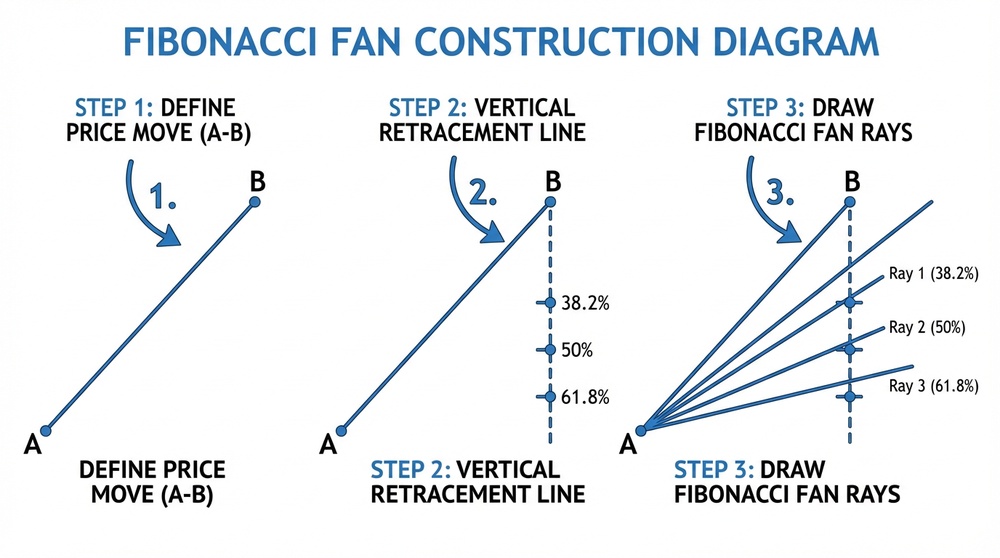
Fan construction also begins with identifying two key points — the start and end of a significant price movement:
- Identify the extremes — find the low and high of the movement
- Draw a vertical line — from the ending point downward (or upward)
- Mark Fibonacci levels — on the vertical line (38.2%, 50%, 61.8%)
- Draw rays — from the starting point through each mark on the vertical line
Interpreting Fan Lines
Each fan line represents a dynamic trendline with a specific angle of inclination:
| Fan Line | Angle of Inclination | Trading Significance |
|---|---|---|
| 38.2% | Steeper angle | First support/resistance line, quick market reaction |
| 50% | Medium angle | Key balance line, often determines medium-term trend |
| 61.8% | Shallower angle | Last line of trend defense, breakout indicates reversal |
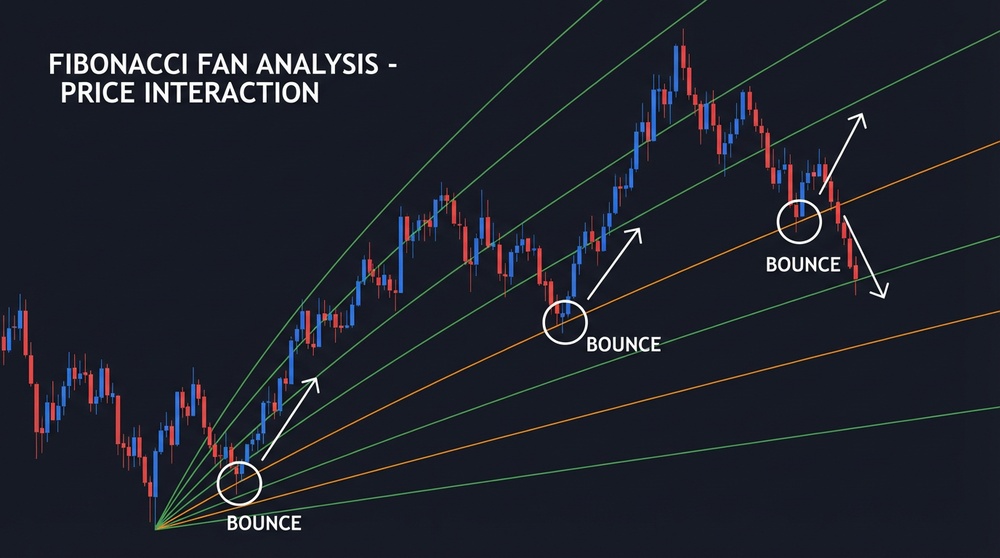
How the Fan Works in Practice
During a correction after an upward movement, price sequentially tests fan lines:
- Bounce from 38.2% line — sign of a strong trend, shallow correction
- Break of 38.2%, bounce from 50% — moderate correction, trend preserved
- Break of 50%, bounce from 61.8% — deep correction, trend at risk
- Break of 61.8% — high probability of trend reversal
Pro Tip: The Fibonacci Fan is especially effective in trending markets. In sideways (ranging) markets, fan lines can generate many false signals, so always determine the overall market context first.
Comparing Fibonacci Arcs and Fans
Although both tools are based on Fibonacci ratios and are constructed similarly, they have significant differences in application:
Fibonacci Arcs
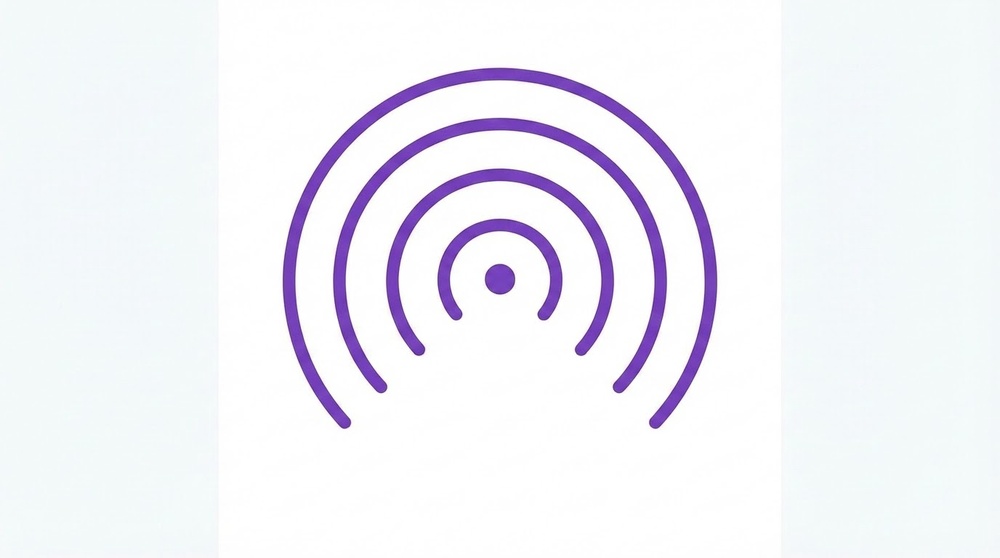
Shape: Curved (semicircles)
Time aspect: Expand over time
Best for: Determining time zones for reversals
Sensitivity: Dependent on chart scale
Fibonacci Fans
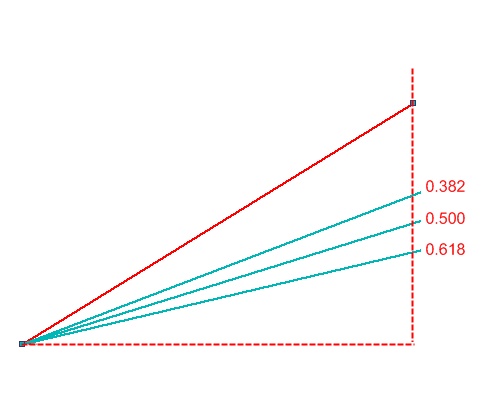
Shape: Linear (rays)
Time aspect: Constant angle of inclination
Best for: Dynamic trendlines
Sensitivity: Independent of scale
When to Use Arcs
- When it's important to determine not only the level but also the time of a potential reversal
- In markets with clear cyclical movements
- For analyzing long-term charts where the time factor plays a key role
- In combination with Fibonacci time zones for comprehensive analysis
When to Use Fans
- For building dynamic levels of support and resistance
- When trading with the trend to identify pullback entry points
- When you need a tool independent of chart scale
- In combination with classic trendlines for confirmation
Combining Arcs and Fans with Other Tools
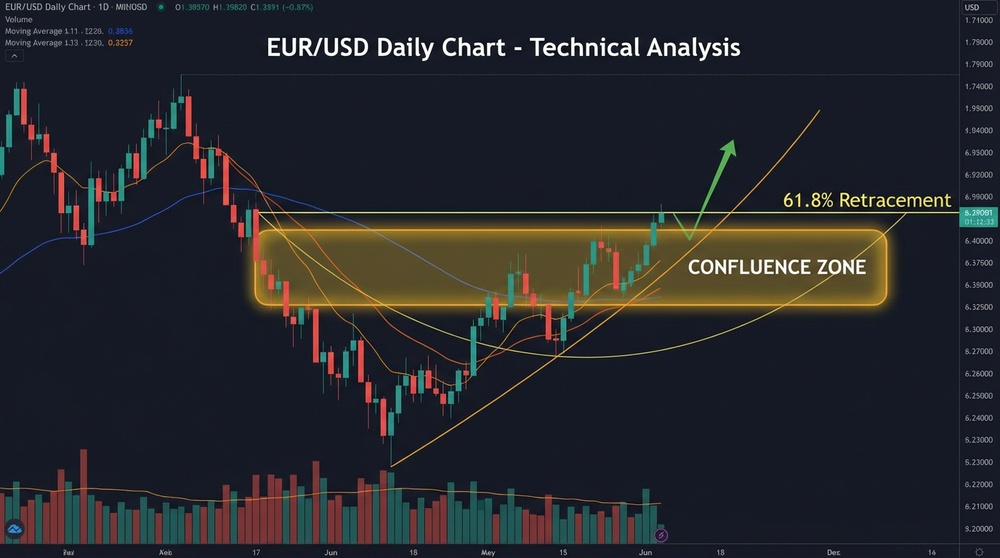
Fibonacci Arcs and Fans show maximum effectiveness when combined with other technical analysis methods. A single signal from any tool is just a hint, but confluence (convergence) of multiple signals significantly increases the probability of a successful trade.
Combining with Fibonacci Retracement Levels
The most powerful combination is when a horizontal Fibonacci retracement level coincides with an arc or fan line of the same percentage value. Such convergence creates a reinforced zone of support or resistance.
Combining with Technical Indicators
Arcs and fans work effectively together with:
- RSI (Relative Strength Index) — arc/fan line touch + oversold/overbought RSI reading
- MACD — MACD line crossover as price approaches a Fibonacci level
- Moving Averages — arc/fan + moving average create a confluence zone
- Volume — increased volume at arc/fan touch confirms level significance
Combining with Candlestick Patterns
Formation of a reversal candlestick pattern (hammer, engulfing, doji) at an arc or fan line level is a strong trading signal:
| Pattern | Meaning at Arc/Fan | Signal Strength |
|---|---|---|
| Hammer/Hanging Man | Reversal at support/resistance level | High |
| Bullish/Bearish Engulfing | Strong reversal momentum | Very High |
| Doji | Indecision, possible reversal | Medium (requires confirmation) |
| Morning/Evening Star | Complex reversal pattern | Very High |
Practical Strategies with Arcs and Fans
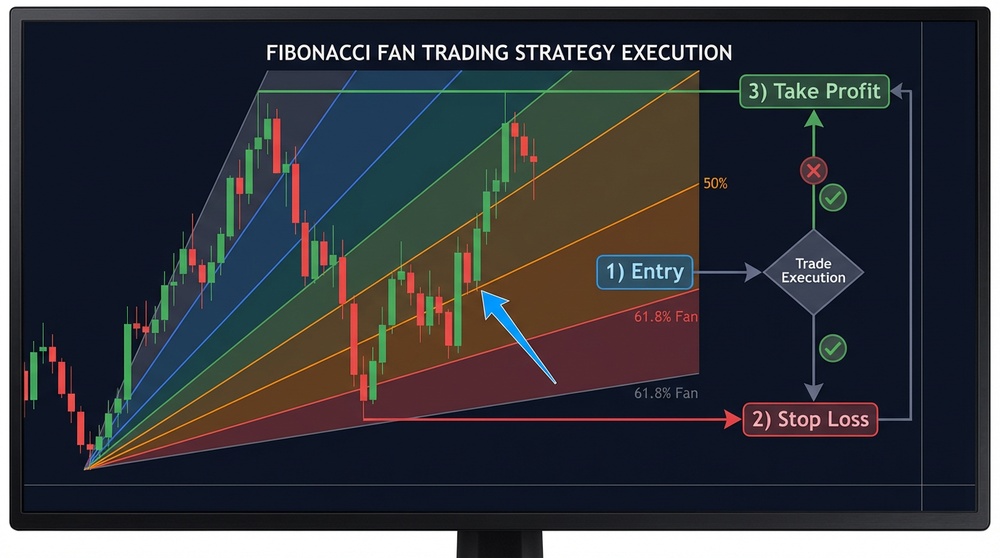
"Fan Bounce" Strategy
This simple but effective strategy uses fan lines as dynamic levels for trend-following entries:
- Identify the trend — uptrend or downtrend
- Build the fan — from the trend start to the last extreme
- Wait for a pullback — price corrects to one of the fan lines
- Look for confirmation — candlestick pattern, RSI divergence, volume increase
- Enter the trade — in the direction of the main trend
- Stop-loss — beyond the next fan line
- Take-profit — previous extreme or Fibonacci extension level
"Time Arc" Strategy
This strategy focuses on the time aspect of Fibonacci Arcs:
- Find a completed movement — from low to high (or vice versa)
- Build the arcs — from the start to the end of the movement
- Identify time zones — when price might reach specific arcs
- Plan your trades — prepare orders for when price approaches an arc
- React to price behavior — enter upon confirmation of reversal at the arc
Time Analysis with Arcs
Arcs show that the 61.8% level will be reached later in time than the 38.2% level. This allows you to plan trades in advance and prepare for potential reversal points.
Common Mistakes When Using Arcs and Fans
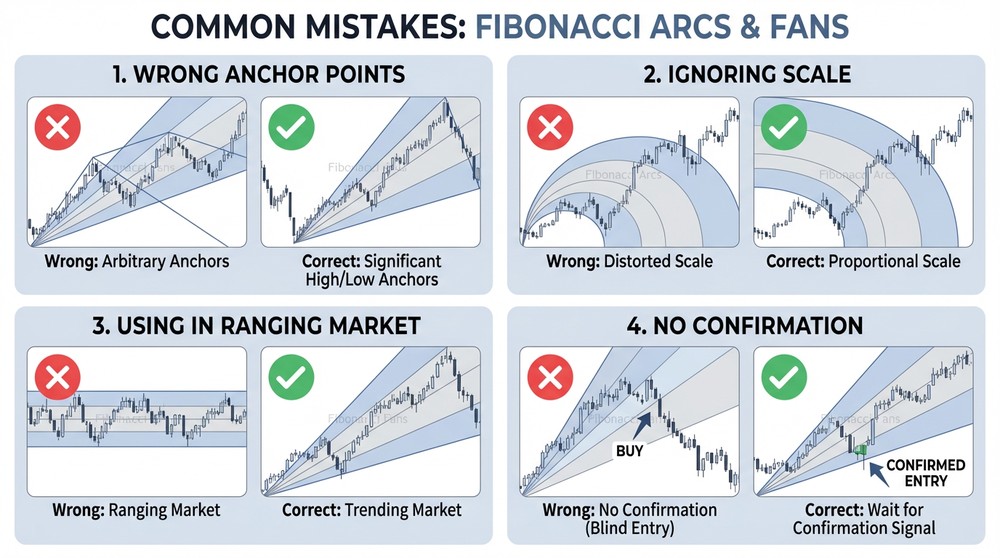
Even experienced traders make mistakes when using these tools. Here are the most common ones:
Mistake 1: Incorrect Anchor Point Selection
Arcs and fans are built from significant extremes. Using insignificant local highs or lows leads to ineffective levels.
Solution: Choose clear, obvious pivot points on the chart. If in doubt — use a higher timeframe to identify key extremes.
Mistake 2: Ignoring Scale (for Arcs)
Arc shape changes when chart scale changes. Many traders don't account for this and get distorted levels.
Solution: Use a fixed axis ratio or configure arcs based on percentages. Some platforms have a "True Arcs" option to maintain proper shape.
Mistake 3: Using in Sideways Markets
Fans and arcs are trend tools. In ranging markets, they generate many false signals.
Solution: Always determine the market phase before applying tools. In sideways markets, horizontal levels work better.
Mistake 4: Trading Without Confirmation
Price touching an arc or fan line by itself is not a trading signal.
Solution: Always wait for confirmation — candlestick pattern, indicator signal, volume change.
Arc and Fan Settings on Different Platforms
Different trading platforms may have various settings for these tools. Here are key parameters to pay attention to:
TradingView
- Location: Drawing menu → Gann and Fibonacci Tools
- Level settings: Ability to add/remove levels (0.236, 0.382, 0.5, 0.618, 0.786)
- Colors and styles: Individual customization of each line/arc
- Extensions: Ability to extend lines beyond the base construction
MetaTrader 4/5
- Location: Insert → Fibonacci → Arcs / Fan
- Arc scaling: "Ellipse" parameter for adapting to chart scale
- Levels: Editable in object properties
Recommended Level Settings
The standard set (38.2%, 50%, 61.8%) works for most situations. For more detailed analysis, you can add:
- 23.6% — for shallow corrections in impulsive movements
- 78.6% — for deep corrections before potential reversal
Practice Exercises
To reinforce the lesson material, complete the following assignments:
Exercise 1: Building Arcs
Open the Bitcoin daily chart. Find the last significant upward movement (at least 20% gain). Build Fibonacci Arcs and analyze how price interacted with them during the subsequent correction.
Exercise 2: Building a Fan
On the same chart, build a Fibonacci Fan. Compare which tool more accurately identified bounce levels. Mark zones where arcs and fan coincide.
Exercise 3: Combining Tools
Add standard Fibonacci retracement levels to the chart. Find confluence zones where horizontal level, arc, and/or fan line coincide. Evaluate how strong the price reaction was in these zones.
Conclusion
Fibonacci Arcs and Fans are advanced technical analysis tools that add the dimension of time and angle to traditional Fibonacci levels. They are especially valuable for traders who want to understand market dynamics more deeply and find more precise entry points.
Key takeaways from this lesson:
- Fibonacci Arcs create curved levels that expand over time
- Fibonacci Fans form dynamic trendlines with different angles of inclination
- Both tools require proper identification of anchor points
- Maximum effectiveness is achieved when combining with other analysis methods
- Signal confirmation is mandatory — don't trade solely on level touch
In the next lesson, we'll examine practical examples of applying all the Fibonacci tools we've studied on real cryptocurrency charts. You'll see how professionals combine levels, extensions, time zones, arcs, and fans to build a comprehensive trading system.
Final Tip: Start with the Fibonacci Fan — it's easier to understand and doesn't depend on chart scale. Once you've mastered the fan, move on to arcs for more advanced time analysis.