















Module 6: Fibonacci Extension
Fibonacci Extension: Pinpointing Profit Targets with Mathematical Precision
In the previous lesson, we covered Fibonacci retracement — a powerful tool for finding market entry points. Now it's time to explore its logical continuation — Fibonacci Extension. If retracement answers the question "where to enter?", then extension provides the answer to an equally important question — "where to exit with profit?"
This tool allows traders to forecast where price may move after a correction completes, and to set well-founded profit-taking targets. Without understanding extensions, your trading system will be incomplete — you'll know where to enter, but not where to exit.
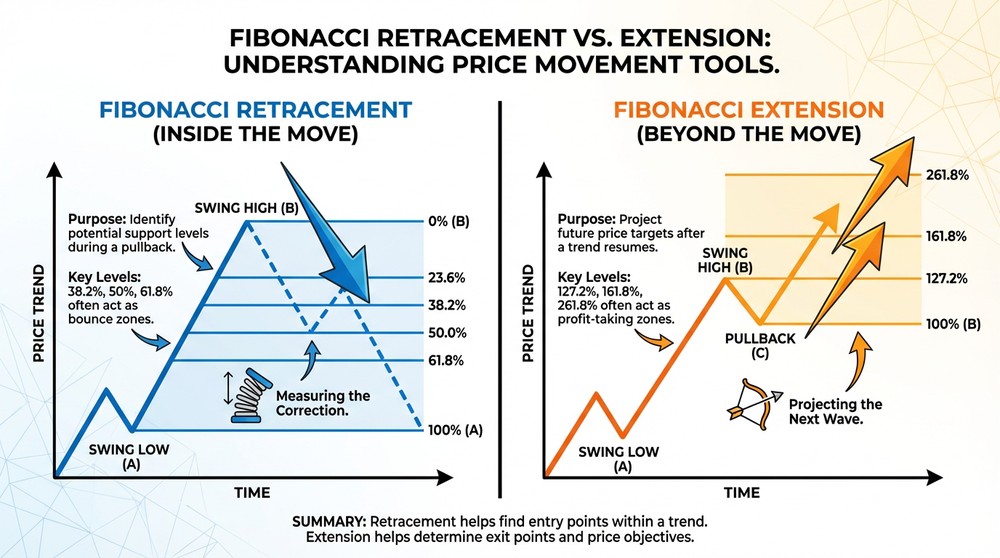
Key Concept: Fibonacci Extension projects potential levels where price may reach after a pullback completes. It's an indispensable tool for planning trade exits and managing profits.
What Is Fibonacci Extension and How Does It Differ from Retracement
Fibonacci Extension is a technical tool that uses Fibonacci ratios to forecast potential price movement targets beyond the original impulse. Unlike retracement, which measures pullbacks within a trend, extension shows where price may go after the correction ends.
📉 Fibonacci Retracement
Measures the depth of pullback within an existing move. Levels are located between the start and end of the impulse (23.6%, 38.2%, 50%, 61.8%, 78.6%).
Purpose: Identifying entry points in the direction of the trend
📈 Fibonacci Extension
Projects potential movement targets beyond the original impulse. Levels start from 100% and higher (127.2%, 161.8%, 200%, 261.8%).
Purpose: Determining profit targets (Take Profit)
The Logic Behind Extension: Why It Works
Markets move in impulses and corrections. When a strong trend forms an impulse, a pullback (correction) follows, and then the movement continues in the direction of the main trend. Fibonacci Extension helps forecast how far this continuation may go.
The mathematical foundation is the same — the golden ratio and Fibonacci sequence ratios. Traders and algorithms worldwide use the same levels, creating a self-fulfilling prophecy: when many market participants expect a reaction at a certain level, it often occurs.
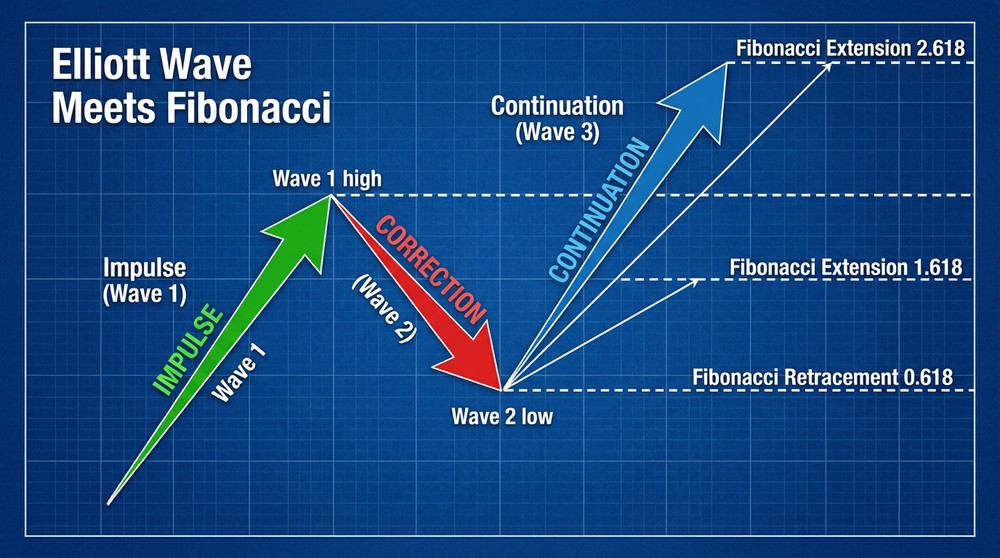
Key Fibonacci Extension Levels
Fibonacci Extension includes several key levels, each with its own significance and probability of being reached. Understanding these levels is critical for effective trade exit planning.
| Level | Mathematical Meaning | Level Strength | Practical Application |
|---|---|---|---|
| 100% | Full size of the original impulse | Medium | First conservative target; often broken through |
| 127.2% | √φ (square root of golden ratio) | High | First significant target for weak trends |
| 138.2% | 1 + 0.382 (derivative) | Medium | Intermediate target, often used as a stop |
| 161.8% | φ (golden ratio) | Very High | Primary target for most trends |
| 200% | Double the impulse size | High | Target for strong trends |
| 261.8% | φ² (square of golden ratio) | Very High | Target for very strong trends; major reversals |
| 423.6% | φ³ (cube of golden ratio) | Extreme | Rarely reached; extreme movements |
The Three Main Extension Levels
In everyday trading, the most attention is paid to three levels:
- 127.2% — first conservative target, suitable for partial profit-taking
- 161.8% — the "golden" level, most common target for completing a move
- 261.8% — aggressive target for strong trends and breakout movements
Detailed Breakdown of Key Levels
127.2% Level — First Significant Target
The 127.2% level represents the square root of the golden ratio (√1.618 ≈ 1.272). This is the first level beyond 100% that has mathematical justification in the Fibonacci sequence.
Characteristics:
- Reached in most trending moves (probability ~70-80%)
- Often serves as a zone for first partial profit-taking
- May become a reversal point in weak trends
- Ideal for conservative traders
161.8% Level — The Golden Ratio
This is the most important extension level because it's directly tied to the golden ratio (φ = 1.618). Significant reversals or consolidations often occur at this level.
Characteristics:
- Classic target for standard trending moves
- High probability of price reaction (reversal or consolidation)
- Used as the primary target in most trading strategies
- Confluence with other levels creates strong resistance/support zones
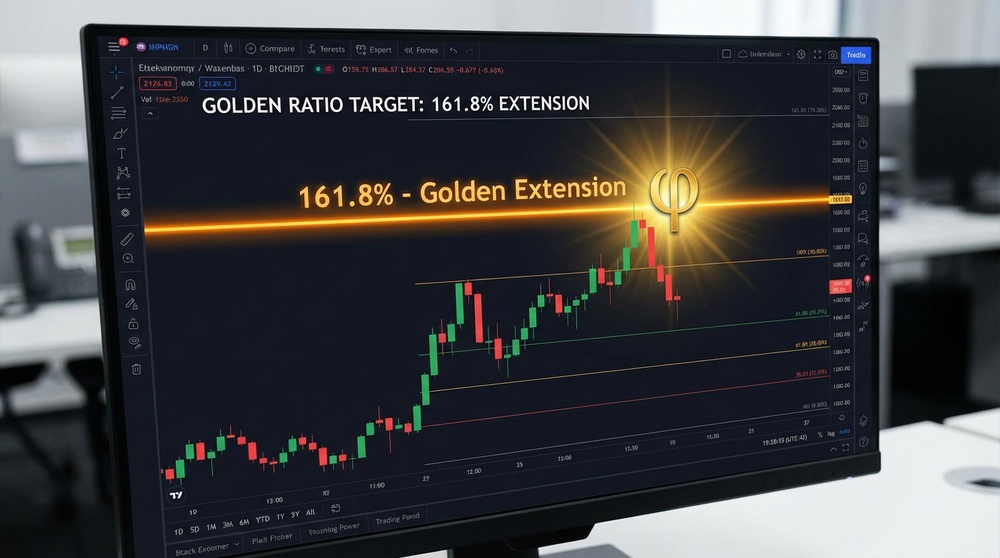
261.8% Level — Square of the Golden Ratio
The 261.8% level (φ² = 2.618) is reached in strong trending moves. This is an aggressive target that materializes when there's a powerful fundamental or technical driver.
Characteristics:
- Only reached in strong trends (probability ~30-40%)
- Often coincides with completion of major wave structures
- Suitable for highly volatile cryptocurrencies
- Requires confirmation from other indicators
How to Properly Draw Fibonacci Extension
Drawing Fibonacci Extension requires identifying three key points on the chart. Unlike retracement, which uses two points, here you need to account for the impulse start, its end, and the correction end.
Three-Point Method (Classic)
The classic extension drawing method uses three points:
- Point A — start of the impulse move (trend beginning)
- Point B — end of the impulse move (trend high/low)
- Point C — end of the correction (trade entry point)
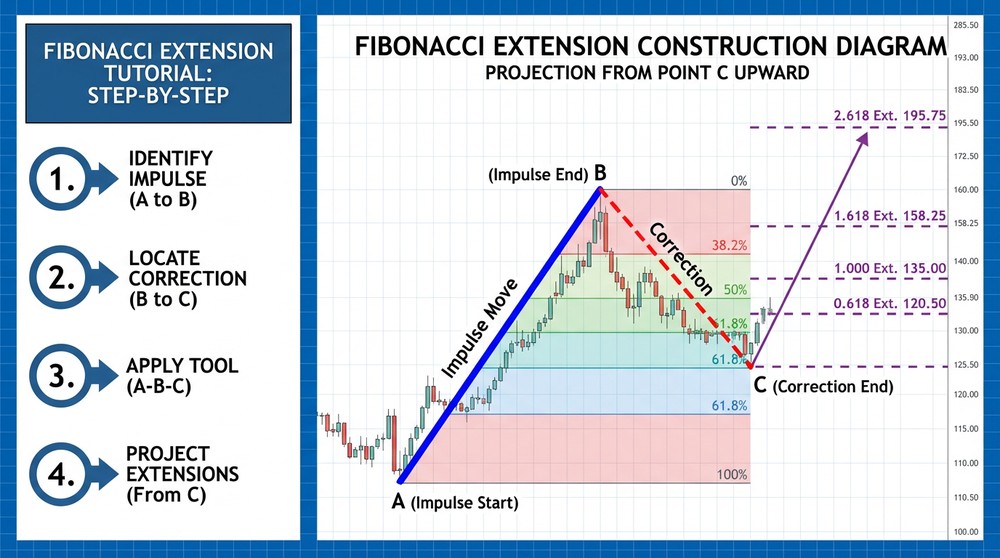
Step-by-Step Drawing Instructions
- Identify a completed impulse (points A and B)
- Wait for correction formation and identify its end (point C)
- Select the "Fibonacci Extension" tool in your trading platform
- Click on point A, then point B, then point C
- Extension levels will automatically project from point C
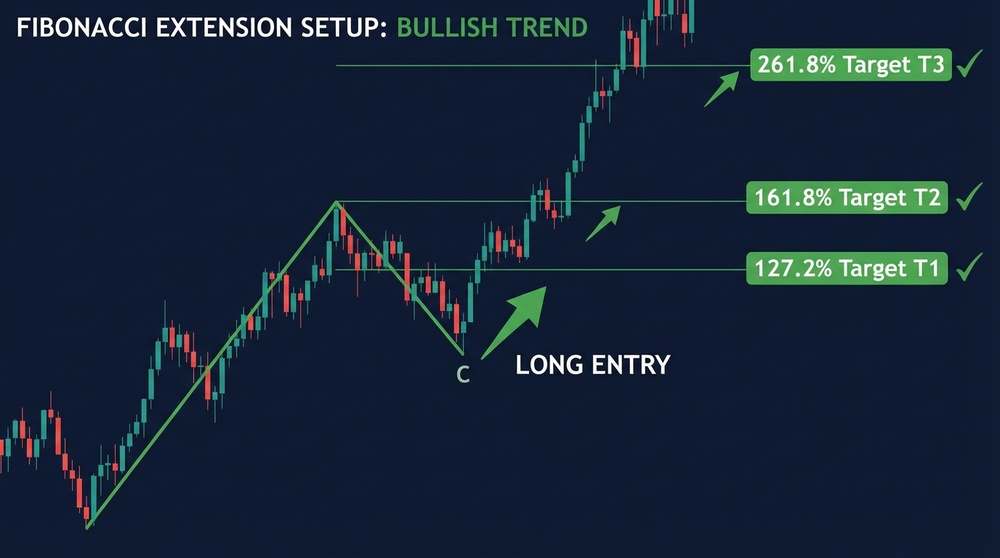
Drawing for an Uptrend
In an uptrend, extension is drawn as follows:
- Point A: Local low (start of the rise)
- Point B: Local high (impulse peak)
- Point C: Correction low (end of pullback)
Extension levels will be projected upward from point C, showing potential targets for long positions (buys).
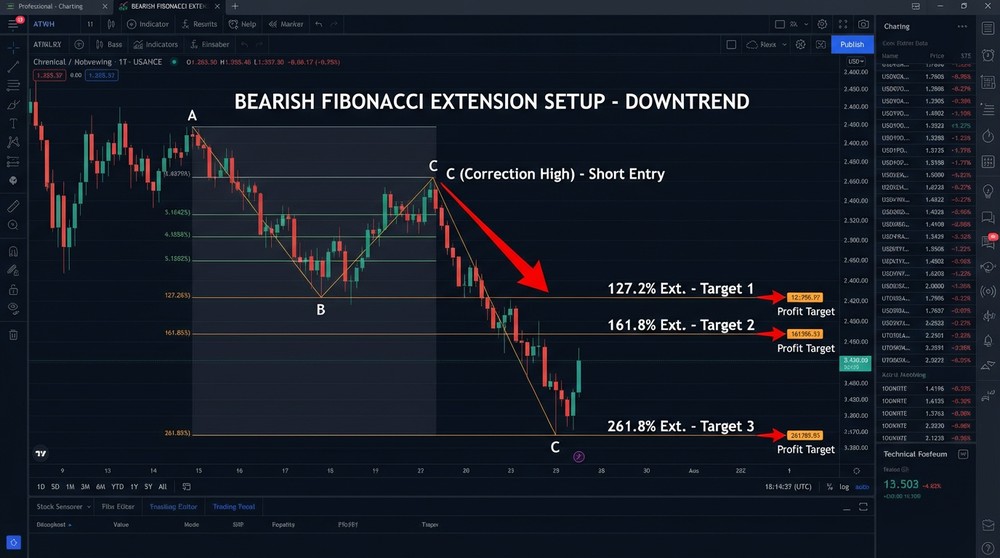
Drawing for a Downtrend
In a downtrend, the logic is mirrored:
- Point A: Local high (start of the decline)
- Point B: Local low (impulse bottom)
- Point C: Correction high (end of bounce)
Extension levels will be projected downward from point C, showing potential targets for short positions (sells).
Alternative Method: Two-Point Extension
Some platforms offer a simplified extension drawing method using only two points (impulse A-B). In this case, levels are projected from point B, not point C. This method is less accurate but can be used for quick assessment of movement potential.
Recommendation: Use the classic three-point method for greater accuracy. The alternative method is only suitable for preliminary assessment and should be confirmed by other tools.
Practical Application of Fibonacci Extension
Theory without practice is dead. Let's break down how to use Fibonacci Extension in real trading for determining profit targets and building an effective trade exit strategy.
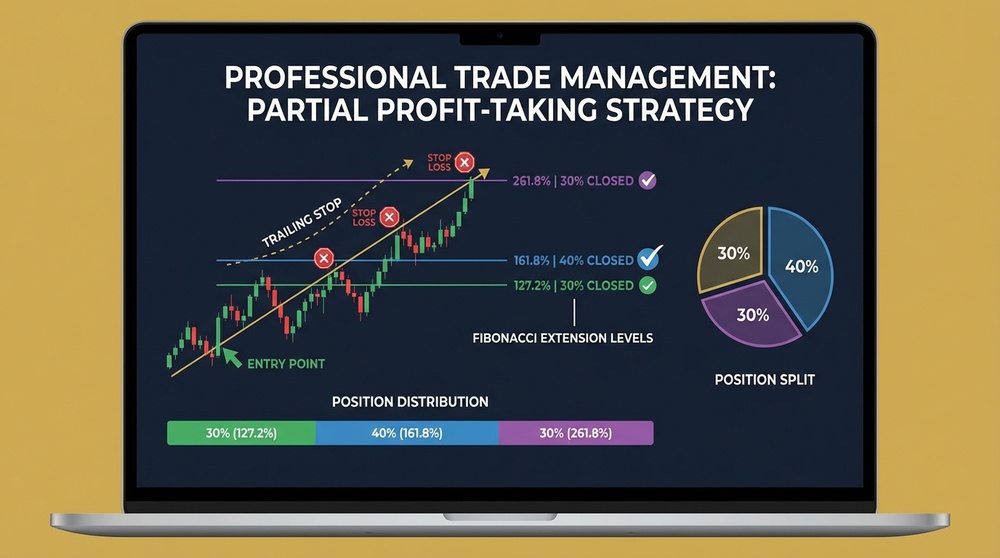
Partial Profit-Taking Strategy
One of the most effective strategies is staged profit-taking at different extension levels. This allows you to lock in guaranteed profits while leaving part of the position for potentially larger moves.
| Extension Level | Action | % of Position | Decision Logic |
|---|---|---|---|
| 127.2% | First take profit + move stop to breakeven | 30-40% | Guarantee profit, eliminate risk |
| 161.8% | Second take profit | 30-40% | Close main portion at the "golden" level |
| 200-261.8% | Full close or trailing stop | Remainder | Maximize profit in strong trend |
Extension Trading Example (Uptrend)
Let's look at a practical example on a Bitcoin chart:
- Impulse identification: BTC rose from $25,000 (point A) to $30,000 (point B) — impulse was $5,000
- Correction: Price pulled back to $27,500 (point C) — 50% Fibonacci retracement
- Drawing extension: Project levels from point C
- Target calculation:
- 127.2%: $27,500 + ($5,000 × 1.272) = $33,860
- 161.8%: $27,500 + ($5,000 × 1.618) = $35,590
- 261.8%: $27,500 + ($5,000 × 2.618) = $40,590
- Execution: Entry at $27,500, take-profit in portions at calculated levels
Target Calculation Formula
For an uptrend:
Target = Point C + (Impulse Size × Extension Coefficient)
For a downtrend:
Target = Point C - (Impulse Size × Extension Coefficient)
Confluence: Strengthening Signals
Confluence is the coincidence of multiple technical levels in one price zone. When a Fibonacci Extension level aligns with other significant levels, its strength multiplies.
Look for alignments with:
- Horizontal levels: Historical highs/lows, support/resistance zones
- Psychological levels: Round numbers ($30,000, $50,000, $100,000)
- Moving averages: 200 MA, 50 EMA, and other significant averages
- Other Fibonacci levels: Extension from one timeframe + retracement from another
- Trendlines: Upper channel boundary, trend line
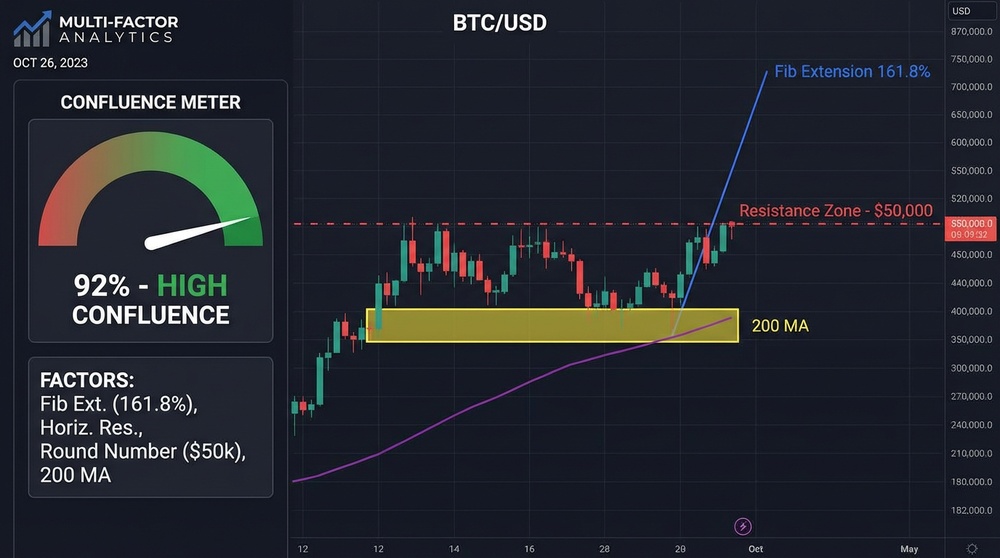
Confluence Rule: The more technical factors align at one level, the higher the probability of price reaction. A zone with three or more alignments is considered "strong confluence" and deserves special attention.
Fibonacci Extension Across Different Timeframes
Fibonacci Extension works on all timeframes, but its application depends on trading style and investment time horizon.
| Timeframe | Trading Style | Application Features | Recommended Levels |
|---|---|---|---|
| 1M - 15M | Scalping | Fast moves, high noise; requires confirmation | 127.2%, 138.2% |
| 1H - 4H | Day Trading | Balance of accuracy and speed; main working TF | 127.2%, 161.8% |
| 1D | Swing Trading | Reliable signals, less noise | 161.8%, 200%, 261.8% |
| 1W - 1M | Position Trading | Long-term targets, high reliability | 161.8%, 261.8%, 423.6% |
Multi-Timeframe Analysis
For increased accuracy, it's recommended to use multi-timeframe analysis:
- Higher timeframe (1D/1W): Determine global trend direction and major extension levels
- Medium timeframe (4H): Find local impulses and corrections, draw working levels
- Lower timeframe (1H/15M): Refine entry point and stop-loss
When extension levels from different timeframes align — it's a powerful signal for profit-taking or expecting a reversal.
Combining Extension with Other Tools
Fibonacci Extension is most effective when used in combination with other technical analysis tools. This helps filter false signals and increase the probability of successful trades.
Extension + RSI (Relative Strength Index)
The RSI indicator helps determine how "overbought" or "oversold" an asset is when reaching an extension level:
- RSI > 70 at extension level: High probability of reversal, recommended to take profit
- RSI in neutral zone (40-60): Possible continuation to the next level
- RSI divergence at extension level: Strong reversal signal
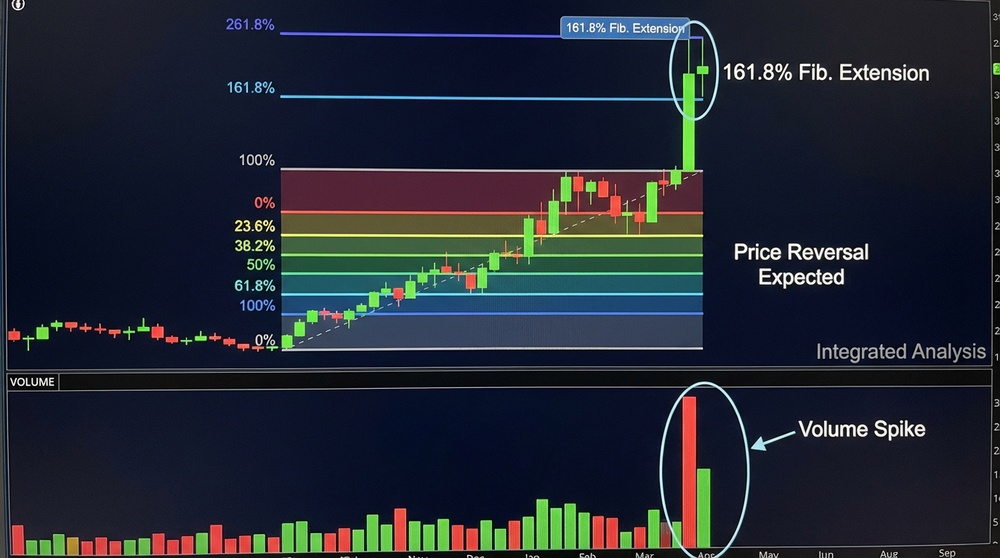
Extension + Volume
Volume analysis at extension levels provides additional information:
- High volume at level: Confirmation of level significance, reaction likely
- Low volume on approach: Weak movement, possible reversal even without reaching target
- Volume increase on breakout: Likely continuation to next level
Extension + Candlestick Patterns
Candlestick patterns at extension levels serve as triggers for decision-making:
- Doji, hammer, shooting star: Uncertainty signals, possible reversal
- Engulfing: Strong reversal signal, especially at 161.8% level
- Pin bar: Level rejection, high probability of pullback
The Ideal Exit Point
The most reliable profit-taking signal occurs when three factors align:
- Price has reached a Fibonacci Extension level (161.8% or 261.8%)
- RSI shows overbought (>70) or divergence
- A reversal candlestick pattern is forming
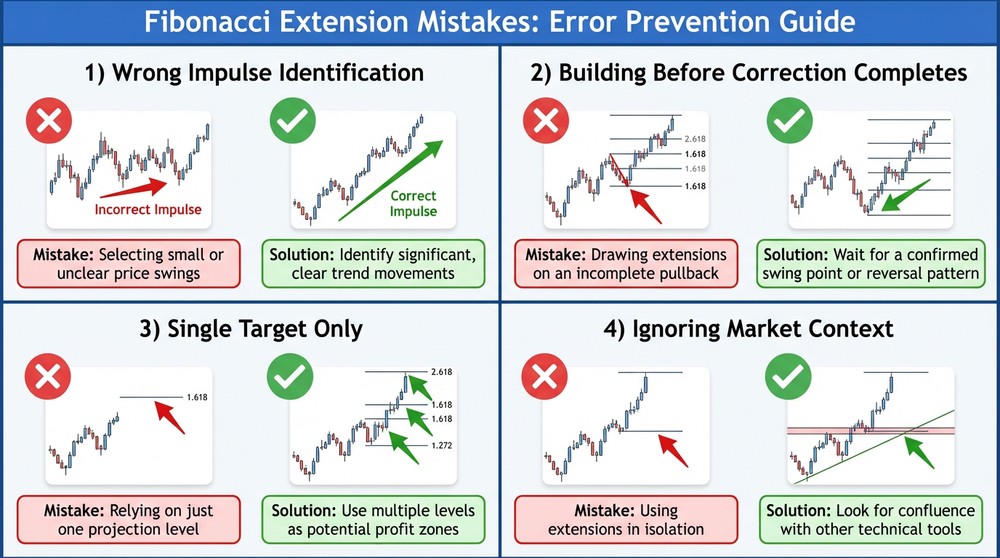
Common Mistakes When Using Extension
Even experienced traders make mistakes when working with Fibonacci Extension. Knowing typical errors will help you avoid them.
Mistake 1: Incorrect Impulse Identification
If you incorrectly identify the impulse move (points A and B), all calculations will be wrong. The impulse must be clear and significant, not a random price fluctuation.
How to avoid: Use obvious, significant highs and lows. If the movement looks unclear — wait for a clearer structure to form.
Mistake 2: Ignoring Market Context
Fibonacci Extension doesn't work in isolation. The 161.8% level can be broken if:
- Strong news or fundamental data is released
- Market is in a strong trend or parabolic growth phase
- Large players (whales) are aggressively moving the market
How to avoid: Always consider overall market context, news background, and volume behavior.
Mistake 3: Setting Target at Only One Level
Placing your entire take-profit at one extension level is a risky strategy. Price may not reach the target or may reverse sharply.
How to avoid: Use a partial profit-taking strategy at multiple levels (127.2%, 161.8%, 261.8%).
Mistake 4: Drawing Extension Before Correction Completes
You cannot draw extension until the correction is complete. Premature drawing will lead to constant level redrawing.
How to avoid: Wait for confirmation that the correction has ended (reversal pattern, correction trendline break, bounce from Fibonacci retracement level).
Professional Tips from the Pros
Professional traders using Fibonacci Extension follow several important principles:
- Don't chase maximum profit: Better to capture 70% of potential movement than lose everything
- Move stop to breakeven: After reaching the first extension level, always move your stop-loss to breakeven
- Use trailing stop: For the remaining position, apply a trailing stop to protect accumulated profit
- Keep a trading journal: Record which levels work best for specific assets
- Backtest on historical data: Before using in live trading, test extension on historical data of your chosen asset
Pro Rule: "Fibonacci levels are zones, not exact lines. Always leave room for error and don't expect pip-perfect accuracy from the market."
Lesson Summary
Fibonacci Extension is a powerful tool for determining profit targets that complements Fibonacci retracement and allows you to build a complete trading system.
Key takeaways from this lesson:
- Extension projects targets beyond the original impulse (127.2%, 161.8%, 261.8%)
- Drawn using three points: impulse start (A), impulse end (B), correction end (C)
- The 161.8% level is the primary target for most trends
- Use partial profit-taking at different levels
- Confluence with other technical levels strengthens target significance
- Always combine extension with other analysis tools
In the next lesson, we'll study Fibonacci Time Zones — a tool that helps forecast not only price levels, but also the time when significant market events may occur.