














Module 1: Fibonacci Levels Fundamentals
Fibonacci levels are one of the most popular and powerful technical analysis tools used by traders worldwide. Whether you're trading cryptocurrencies, stocks, or forex pairs, understanding these levels will give you a serious edge in identifying potential price reversal points.
In this lesson, we'll break down the fundamental basics of Fibonacci levels: what they are, why they work in financial markets, and what role they play in making trading decisions. This is essential knowledge without which you cannot effectively apply Fibonacci tools in practice.
What Are Fibonacci Levels in Trading
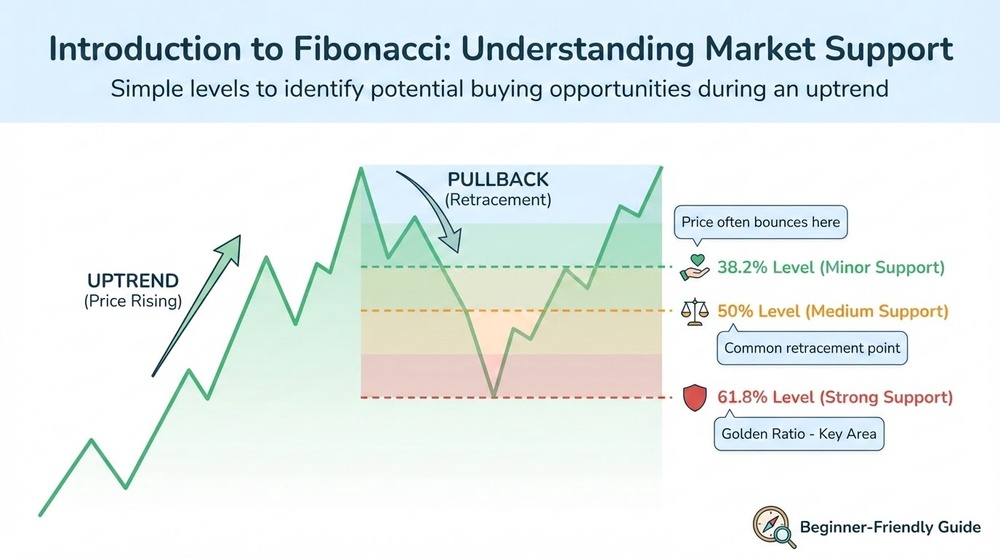
Fibonacci levels are horizontal lines on a price chart that indicate potential support and resistance zones. These levels are calculated based on a number sequence discovered by Italian mathematician Leonardo Fibonacci in the 13th century.
In the context of trading, Fibonacci levels help determine:
- Where price might stall during a correction
- Potential entry points into the market
- Zones for placing stop-losses and take-profits
- Probable price targets after a breakout
Key Concept: Fibonacci levels work not because they possess magical powers, but because a massive number of traders around the world watch the same levels and make decisions based on them. This creates a self-fulfilling prophecy.
Main Fibonacci Levels
Technical analysis uses several key levels, each with its own significance and strength:
| Level | Retracement Percentage | Significance | Application |
|---|---|---|---|
| 0.236 | 23.6% | Weak | Shallow pullbacks in strong trends |
| 0.382 | 38.2% | Moderate | First significant retracement zone |
| 0.500 | 50.0% | High | Psychologically important level |
| 0.618 | 61.8% | Very High | "Golden Ratio" — the key level |
| 0.786 | 78.6% | High | Deep retracement, last line of defense |
The Golden Ratio (0.618)
The 61.8% level is called the "golden ratio" or "golden proportion." This is the most important Fibonacci level, found everywhere in nature: from spiral seashells to human body proportions and galaxies. In trading, this level often acts as a powerful support or resistance zone.
Why Fibonacci Levels Work in Financial Markets
Many beginner traders are skeptical about Fibonacci levels, considering them somewhat esoteric. However, there are several solid reasons why these levels actually work:
1. Mass Market Psychology
Millions of traders worldwide use Fibonacci levels in their analysis. When price approaches the 61.8% level, a huge number of market participants start taking action:
- Some open positions expecting a bounce
- Others take profits
- Others place pending orders
This collective behavior creates real pressure on price, leading to reactions precisely at these levels.

2. Institutional Algorithms
Major hedge funds, banks, and trading firms use algorithmic systems, many of which incorporate Fibonacci levels into their logic. When algorithms with billions in capital react to these levels, it creates significant price movement.
3. Natural Price Movement Proportions
Markets move in waves: impulses alternate with corrections. Research shows that corrections often stop at levels close to Fibonacci ratios. This is related to the nature of market cycles and the balance between buyers and sellers.
Important to Understand: Fibonacci levels are not exact lines but rather zones of interest. Price rarely reverses exactly at a level — it usually tests the area around it.
Types of Fibonacci Tools
In practice, traders use several tools based on Fibonacci numbers. Each serves its own purpose:
Fibonacci Retracement
Identifies potential levels where a pullback may end and the trend may resume. The most popular tool.
Fibonacci Extension
Shows potential price targets after a correction completes.
Time Zones
Helps determine when a significant move or reversal might occur.
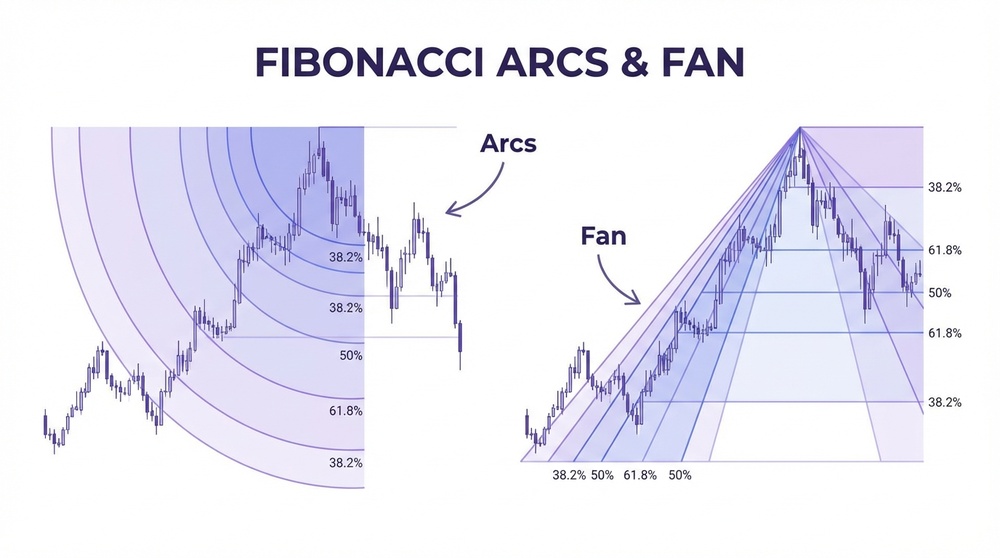
Fibonacci Fan and Arcs
Account for both price and time, showing dynamic support and resistance levels.
In the following lessons, we'll examine each of these tools in detail and learn how to apply them in practice.
Fibonacci Levels in Crypto Trading
Cryptocurrency markets are ideal for applying Fibonacci levels for several reasons:
- High volatility — crypto markets show clear impulse moves and deep corrections, making Fibonacci levels especially relevant
- Technical focus — most crypto traders actively use technical analysis, which amplifies the "self-fulfilling prophecy" effect
- 24/7 operation — the absence of opening gaps allows levels to work cleanly
- Global market — traders from around the world watch the same levels
Pro Tip
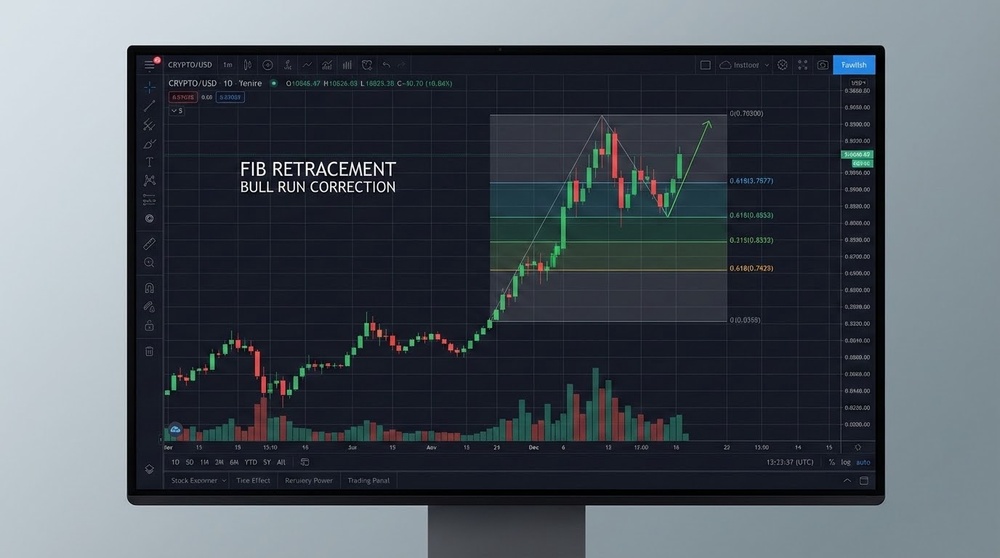
When trading cryptocurrencies, pay special attention to the 0.382, 0.5, and 0.618 levels. In a strong bull market, corrections often stop at 38.2%, while in weaker trends, price may retrace to 61.8% and deeper.
Advantages and Limitations of Fibonacci Levels
Like any technical analysis tool, Fibonacci levels have their strengths and weaknesses. Understanding these aspects will help you use them more effectively.
Advantages:
- Versatility — work on any market and timeframe
- Objectivity — levels are calculated mathematically, not subjectively
- Forward-looking — levels are visible in advance, before price reaches them
- Combinability — combine excellently with other analysis methods
- Ease of use — easy to plot on any trading platform
Limitations:
- Subjectivity in point selection — different traders may choose different start and end points for plotting
- Don't work in isolation — require confirmation from other indicators
- Zones, not exact lines — price may "overshoot" a level or reverse near it
- False signals — effectiveness decreases during low volatility or ranging periods
Golden Rule: Never make trading decisions based solely on Fibonacci levels. Use them in combination with volume analysis, candlestick patterns, support and resistance levels, and other indicators.
How Fibonacci Levels Fit Into a Trading Strategy
Fibonacci levels are not a trading system by themselves but a tool that enhances other analysis methods. Here's how professional traders integrate them into their workflow:
| Analysis Stage | Role of Fibonacci Levels |
|---|---|
| Trend Identification | Help visualize movement structure and correction depth |
| Finding Entry Points | Indicate potential zones for opening positions |
| Setting Stop-Loss | Placing protective orders beyond the nearest level |
| Determining Targets | Fibonacci extensions show potential take-profit levels |
| Position Management | Partial profit-taking at intermediate levels |
Confluence: When Fibonacci Levels Become Stronger
Confluence is a situation where multiple factors point to the same zone. Fibonacci levels become significantly stronger when they coincide with:
- Historical support and resistance levels
- Moving averages (especially MA 50, 100, 200)
- Round psychological levels (e.g., $50,000 for Bitcoin)
- Trendlines
- Fibonacci levels from different timeframes
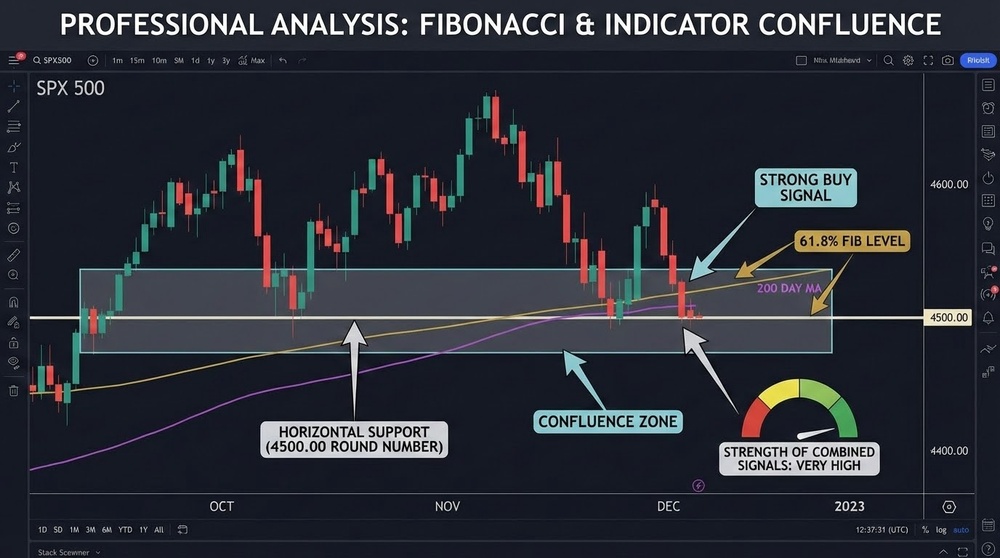
Confluence Example
Imagine the 61.8% Fibonacci level coincides with the 200-day moving average and a historical support level. Such a zone has a much higher chance of triggering a price reaction than a standalone Fibonacci level.
Common Misconceptions About Fibonacci Levels
Before you start applying Fibonacci levels in practice, it's important to dispel some myths:
Myth 1: "Fibonacci levels predict the future"
Reality: They only indicate probable reaction zones but don't guarantee a reversal.
Myth 2: "The more levels, the better"
Reality: Too many levels create noise and confusion. Focus on the key ones: 38.2%, 50%, 61.8%.
Myth 3: "Fibonacci levels only work on certain markets"
Reality: They work everywhere there's sufficient liquidity and participation from technical traders.
Myth 4: "You need to plot levels perfectly accurately"
Reality: Small deviations in point selection aren't critical. Understanding the big picture matters more.
Preparing for Practical Application
In the following lessons, we'll move from theory to practice. To absorb the material as effectively as possible, we recommend:
- Choose a trading platform — make sure it has Fibonacci tools (TradingView, Binance, MetaTrader, and others)
- Open a demo account — for safe practice without risking real funds
- Start observing — pay attention to how price reacts to the 38.2%, 50%, and 61.8% levels
- Keep a journal — record your observations and conclusions
Remember: Understanding theory is only the first step. True mastery comes with practice and analyzing your own trades. In the next lesson, we'll dive into the mathematics and history of Fibonacci numbers so you can better understand where these magical proportions came from.
Lesson Summary
Let's summarize what we've learned:
- Fibonacci levels are a tool for identifying potential support and resistance zones
- Main levels: 23.6%, 38.2%, 50%, 61.8%, and 78.6%
- The 61.8% level ("golden ratio") is the most significant
- Levels work due to mass psychology and algorithmic systems
- They're especially effective in volatile cryptocurrency markets
- Best results are achieved when combined with other analysis methods (confluence)
- These are zones of interest, not exact reversal lines
In the next lesson, we'll dive deeper into the mathematics and history of Fibonacci numbers, learn who Leonardo Fibonacci was, and why his discoveries from eight centuries ago remain relevant for modern traders.