















Module 7: Fibonacci Time Zones
After mastering Fibonacci retracement and extension, it's time to explore one of the most underrated tools in technical analysis — Fibonacci Time Zones. While previous tools helped identify price levels, time zones answer an equally important question: when exactly might a significant price movement occur?
Most traders focus exclusively on price levels, forgetting about the time dimension of the market. However, understanding time cycles can become your serious competitive advantage in cryptocurrency trading.
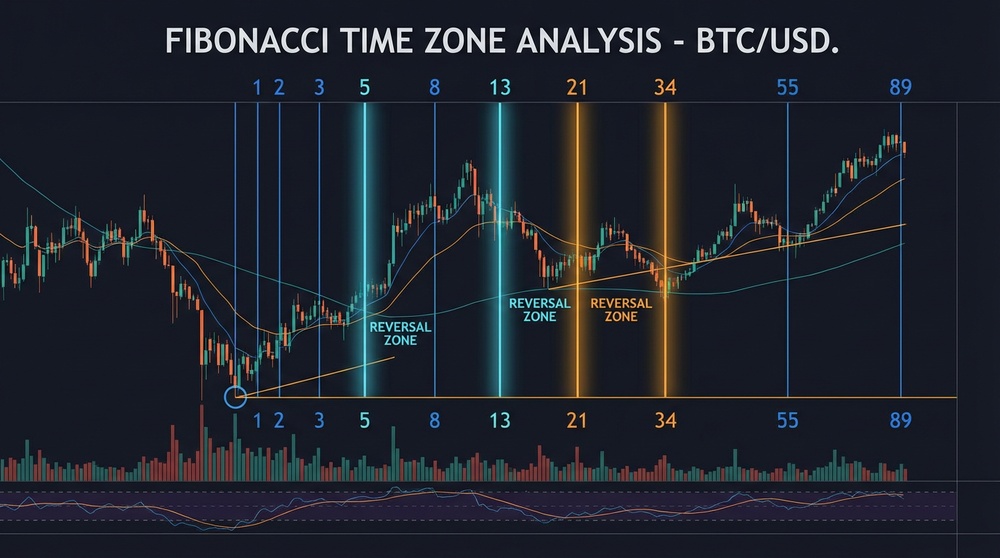
What Are Fibonacci Time Zones
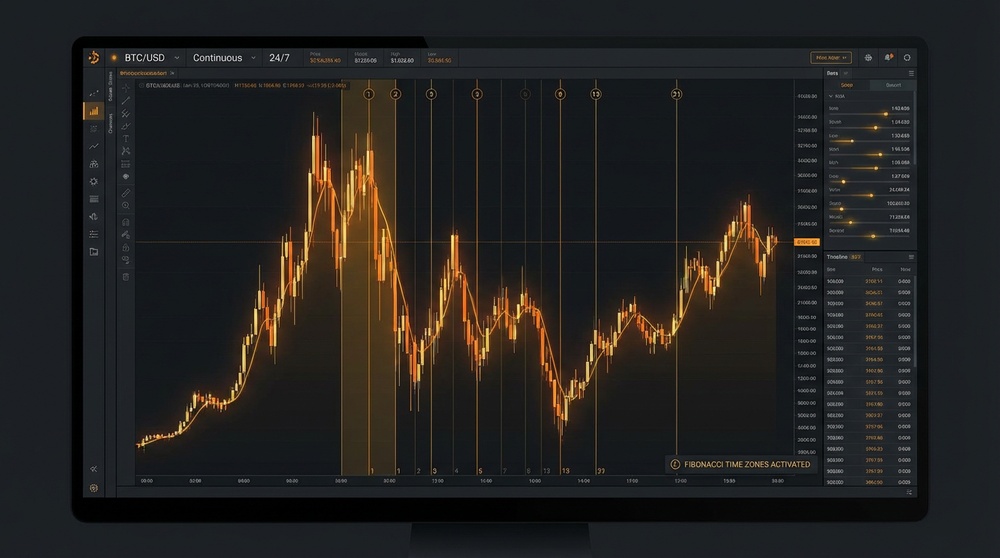
Fibonacci Time Zones are a technical analysis tool that uses numbers from the Fibonacci sequence to forecast moments in time when significant price movements or trend reversals may occur in the market.
Unlike horizontal retracement and extension levels, time zones are represented by vertical lines on the chart. These lines mark potential points in time when the market may change its direction.
Key Concept
Fibonacci Time Zones are based on the idea that markets move not only within certain price ranges but also follow specific time cycles. Understanding these cycles allows traders to forecast periods of increased volatility.
How Fibonacci Time Zones Work
Time zones are built based on the Fibonacci sequence: 1, 1, 2, 3, 5, 8, 13, 21, 34, 55, 89, and so on. Each vertical line is positioned at a distance corresponding to a Fibonacci number from the starting point.
How Time Zones Are Distributed
| Zone Number | Fibonacci Number | Distance from Reference Point | Practical Significance |
|---|---|---|---|
| 1 | 1 | 1 time unit | Initial fluctuations |
| 2 | 1 | 2 time units | Early market reaction |
| 3 | 2 | 3 time units | Trend formation |
| 4 | 3 | 5 time units | First significant reversal |
| 5 | 5 | 8 time units | Strengthening of new movement |
| 6 | 8 | 13 time units | Medium-term reversal |
| 7 | 13 | 21 time units | Important correction point |
| 8 | 21 | 34 time units | Long-term reversal |
Time unit is determined by the selected chart timeframe. On a daily chart, one unit equals one day; on an hourly chart — one hour; on a weekly chart — one week.
Building Time Zones on a Chart
Proper construction of time zones is key to obtaining accurate signals. There are several methods for setting starting points.
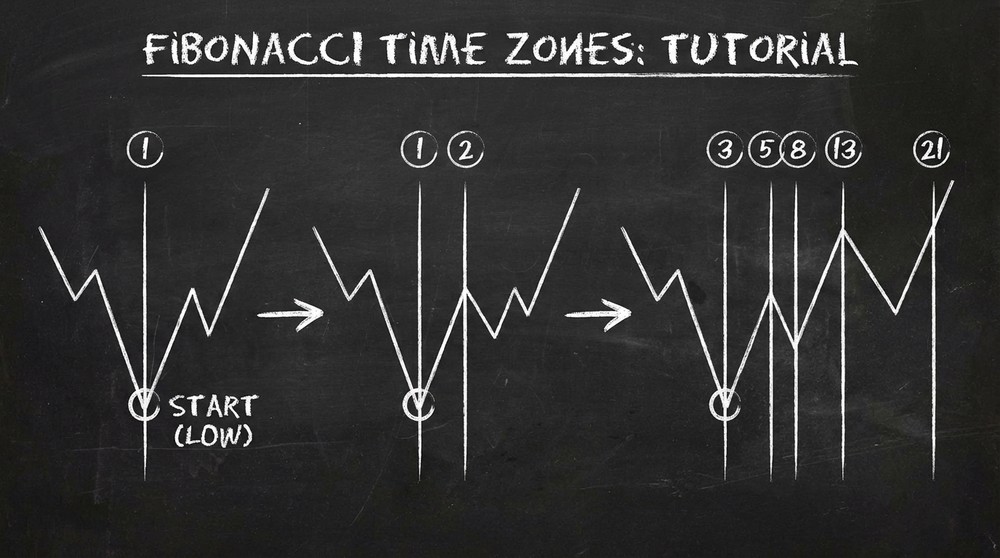
Method 1: From a Significant Extreme
The most common approach is setting the starting point at a significant local minimum or maximum:
- Identify a significant extreme — a reversal point from which a strong movement began
- Select the tool "Fibonacci Time Zones" on your trading platform
- Set the first point at the chosen extreme
- Extend the line to the next significant extreme in the opposite direction
- Confirm the construction — vertical lines will automatically distribute to the right
Method 2: From Two Consecutive Extremes
This method uses the distance between two points as the base time unit:
- Connect two consecutive lows or two consecutive highs
- The distance between them becomes the reference time unit
- Subsequent zones are marked according to Fibonacci numbers from this unit
Pro Tip: The more significant the extremes you choose for construction, the more reliable signals the time zones will generate. Look for points that clearly stand out on the chart and are confirmed by high trading volume.
Practical Construction Steps
Construction Algorithm
- Step 1: Select a timeframe that matches your trading style
- Step 2: Find a significant trend reversal (start of an impulse)
- Step 3: Identify the completion of the first impulse movement
- Step 4: Apply the time zones tool between these points
- Step 5: Analyze price behavior near each vertical line
Interpreting Time Zone Signals
Fibonacci Time Zones don't provide exact buy or sell signals. Instead, they indicate periods of increased probability of significant price movements.
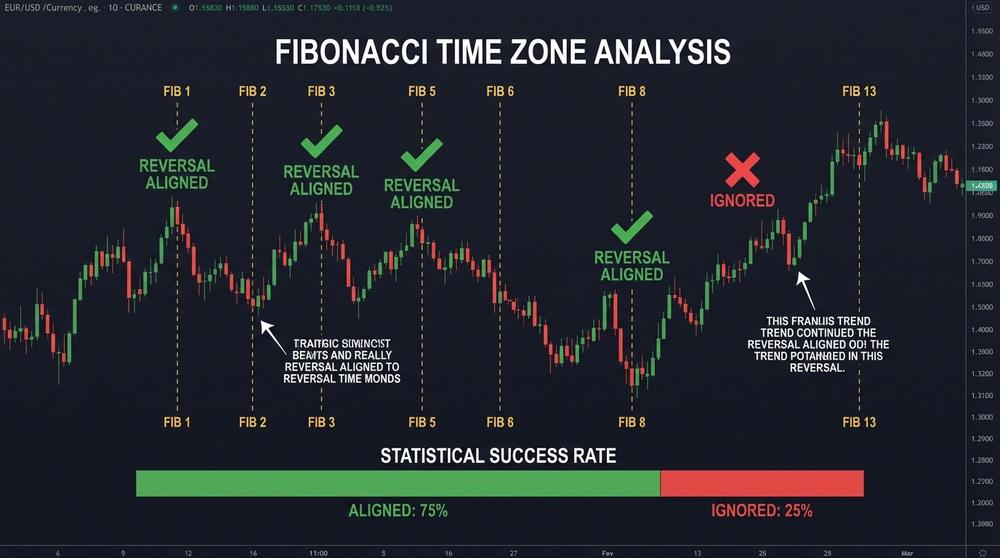
What to Expect at Time Zones
✓ Likely Events
- Current trend reversal
- Acceleration of existing movement
- Start of consolidation
- Breakout of key levels
- Volatility spike
✗ Incorrect Expectations
- Exact direction of movement
- Specific reversal price
- Guaranteed signal
- Definite magnitude of movement
- Clear-cut entry point
Interpretation Rules
Rule 1: Attention Zone, Not Action Point
A time zone is an area of heightened attention. When price approaches a vertical line, the trader should intensify market observation but not execute automatic trades.
Rule 2: Confirmation from Other Tools
A time zone signal is significantly strengthened when it coincides with:
- Fibonacci retracement or extension level
- Key support or resistance level
- Indicator signal (RSI, MACD, volume)
- Candlestick reversal pattern
Rule 3: Zone Clustering
If multiple time zones from different constructions cluster in the same time area, the probability of a significant event increases substantially.
Combining Time Zones with Price Levels
Time zones show maximum effectiveness when used together with Fibonacci price levels. This creates a two-dimensional analysis grid where the intersection of a time zone and price level forms a point of heightened significance.
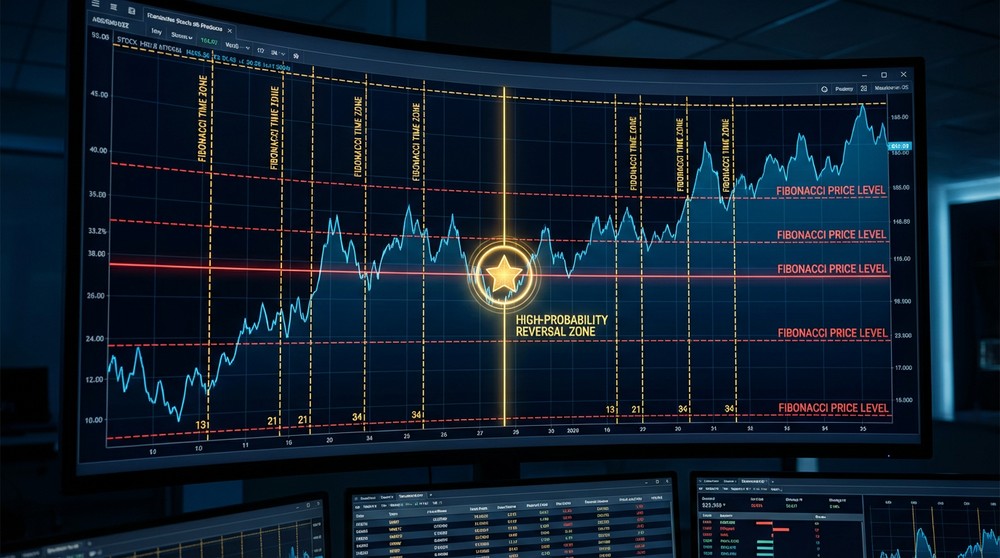
Creating Confluence
| Element 1 | Element 2 | Signal Strength | Recommended Actions |
|---|---|---|---|
| Time Zone | 61.8% Retracement Level | High | Active search for entry point |
| Time Zone | 161.8% Extension Level | High | Prepare for profit-taking |
| Time Zone | Horizontal Support Level | Medium | Wait for confirming signal |
| Time Zone | No additional factors | Weak | Observation only |
Practical Confluence Example
Imagine this scenario:
- A cryptocurrency is in an uptrend
- Price has pulled back to the 38.2% retracement level
- A Fibonacci time zone is expected to pass in two days
- At the same level, there's previous resistance that has become support
Such a coincidence of three factors (time zone + price level + structural support) creates a high-probability bounce zone. The trader can prepare an entry plan for a long position with a clear stop-loss below the 50% level.
Choosing the Right Timeframe for Time Zones
The effectiveness of time zones depends on choosing the right timeframe that matches your trading horizon.
Timeframe Recommendations
| Trading Style | Primary Timeframe | Secondary Timeframe | Typical Zone Horizon |
|---|---|---|---|
| Scalping | 5-15 minutes | 1 minute | Hours |
| Day Trading | 1-4 hours | 15-30 minutes | Days |
| Swing Trading | Daily | 4 hours | Weeks |
| Position Trading | Weekly | Daily | Months |
| Long-term Investing | Monthly | Weekly | Years |
Important: Time zones on higher timeframes carry greater significance. If zones on daily and weekly charts coincide — this is a powerful signal of a potential reversal.
Advantages and Limitations of the Tool
Advantages of Fibonacci Time Zones
- Unique analysis angle: complement price analysis with a time dimension
- Planning ahead: allow you to identify periods of heightened attention in advance
- Versatility: work on any markets and timeframes
- Objectivity: based on mathematical ratios, not subjective assessments
- Synergy: combine excellently with other Fibonacci tools
Limitations of Time Zones
- Direction uncertainty: show when, but not where price will go
- Construction subjectivity: different reference points yield different zones
- False signals: not every time zone leads to significant movement
- Requires confirmation: cannot be used as the sole decision-making factor
- Learning curve: requires practice for proper interpretation
Practical Tips for Using Time Zones
Tips for Effective Application
- Keep a journal: record how price reacted to each time zone
- Use multiple constructions: from different extremes for confirmation
- Consider market context: during strong trends, zones may mark acceleration rather than reversal
- Combine timeframes: check for zone coincidence across different time intervals
- Don't ignore fundamental analysis: important news can disrupt technical patterns
- Stay flexible: the market isn't obligated to react precisely to mathematical levels
Checklist Before Using a Signal
Before acting on a time zone, make sure:
- ☑ The zone is built from significant extremes
- ☑ There's confirmation from a Fibonacci price level
- ☑ Additional technical factors are present
- ☑ Market context aligns with the expected movement
- ☑ Trading volume confirms movement potential
- ☑ Risk management is defined before entering the position
Time Zones in the Context of the Cryptocurrency Market
The cryptocurrency market has its own characteristics that affect the application of time zones:
- 24/7 trading: the absence of trading sessions makes time zones "cleaner" — no gaps between days
- High volatility: reactions to time zones can be sharper and faster
- News influence: cryptocurrencies are sensitive to news that can override technical signals
- Young market: less historical data, but Fibonacci patterns still work
Conclusion
Fibonacci Time Zones are a powerful tool that adds a time dimension to your technical analysis. They don't replace price levels but complement them, creating a more complete picture of the market.
Key principles for working with time zones:
- Use them as attention zones, not precise signals
- Always seek confirmation from other tools
- Confluence of time and price levels — the most reliable signals
- Practice on historical data before applying in live trading
In the next lesson, we'll explore Fibonacci Arcs and Fans — tools that combine price and time analysis into unified visual constructs, opening new possibilities for market forecasting.
Practice Assignment: Open a chart of any cryptocurrency on the daily timeframe. Find the last significant trend reversal and build Fibonacci Time Zones from it. Analyze how price reacted to past time zones, and note where upcoming zones might coincide with price levels.