














Module 3: Types of Fibonacci Tools
The Complete Trader's Arsenal: Types of Fibonacci Tools
In previous lessons, we explored the mathematical foundations of the Fibonacci sequence and its remarkable connection to natural patterns. Now it's time to move into practice and study the specific tools that will help you apply this knowledge to real cryptocurrency charts.
Most traders are familiar with only one tool — Fibonacci retracement levels. However, this is just the tip of the iceberg. In reality, there's an entire family of tools, each solving different tasks and revealing various aspects of market dynamics. By mastering them all, you'll gain a powerful toolkit for comprehensive analysis of any asset.
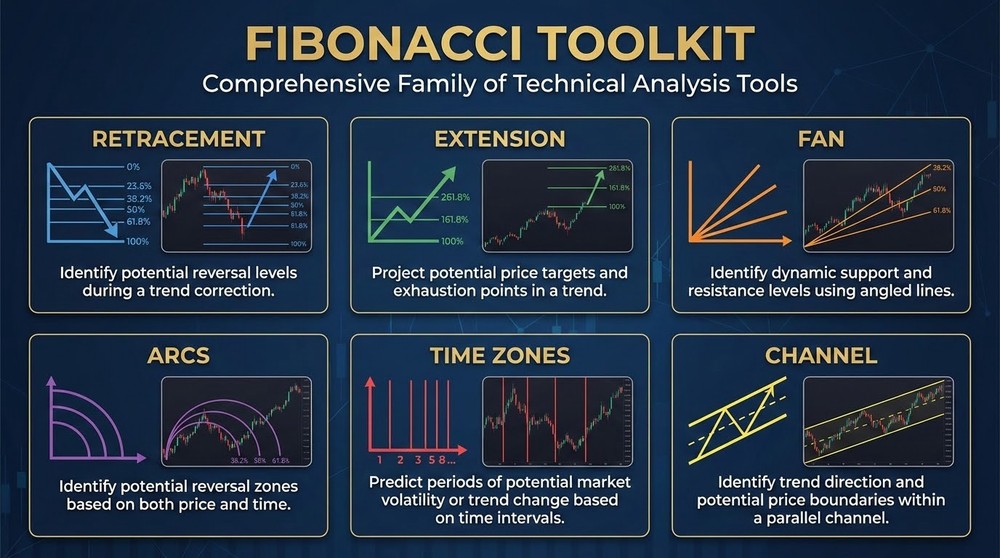
Important to understand: Each Fibonacci tool is not a standalone trading system, but a component of your analytical arsenal. True power emerges when you combine multiple tools to obtain more accurate signals.
Classification of Fibonacci Tools
All Fibonacci tools can be divided into three main categories depending on which aspect of the market they analyze:
📊 Price-Based Tools
Analyze vertical price movement and identify potential support, resistance, and target levels.
Include: Retracement, Extension, Projection
⏱️ Time-Based Tools
Analyze the horizontal axis of the chart and forecast timing of potential reversals or significant events.
Include: Time Zones
📐 Combined Tools
Merge price and time analysis, creating dynamic levels that change over time.
Include: Fan, Arcs, Channels
🎯 Auxiliary Tools
Specialized tools for specific tasks: identifying clusters, confirming signals.
Include: Clusters, Spiral
1. Fibonacci Retracement Levels
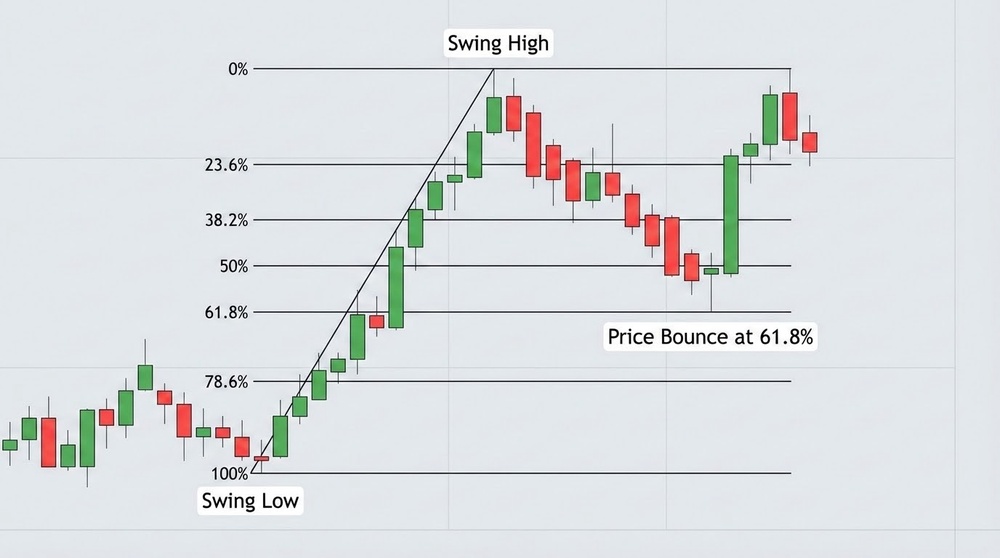
This is the most popular and widely used Fibonacci tool. Retracement levels help identify potential points where price may pause and reverse during a pullback against the main trend.
How the Tool Works
Retracement levels are drawn between two significant points — the start and end of a price move. The tool automatically plots horizontal lines at key percentage levels:
- 23.6% — minimal retracement, typical for strong trends
- 38.2% — moderate retracement, often seen in healthy trends
- 50% — psychological level (not an actual Fibonacci number)
- 61.8% — the "golden ratio," the most significant level
- 78.6% — deep retracement, signals possible trend reversal
When to Use Retracement
- Identifying entry points — buying on pullbacks in an uptrend
- Setting stop-losses — placing protective orders beyond levels
- Confirming reversals — a bounce from a level signals trend continuation
- Analyzing trend strength — retracement depth reveals strength or weakness of the move
Advantages and Limitations
| Advantages | Limitations |
|---|---|
| Easy to plot and interpret | Only works in trending markets |
| Available on all trading platforms | Doesn't indicate exact reversal timing |
| Effective on any timeframe | Requires correct identification of swing points |
| Combines well with other indicators | Multiple levels can create confusion |
2. Fibonacci Extension
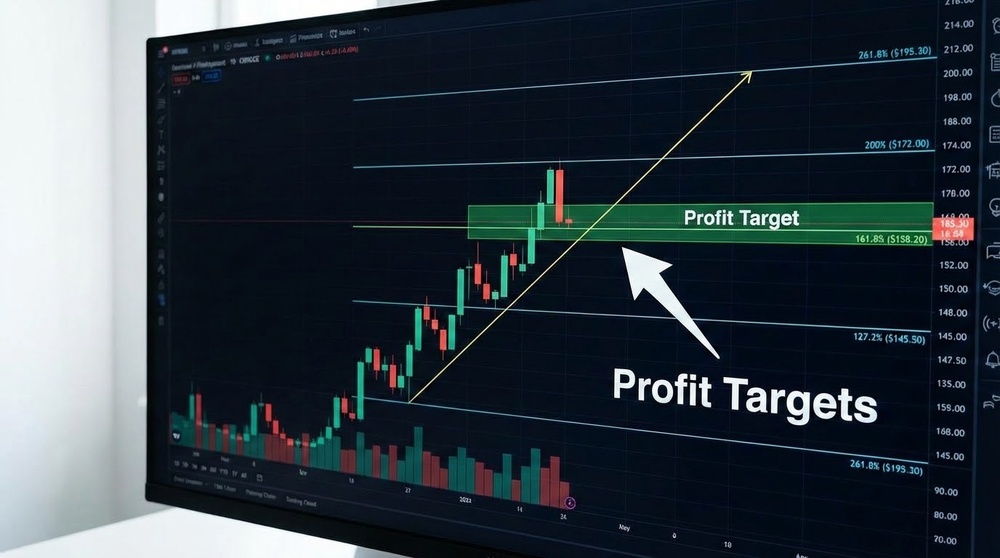
If retracement helps find entry points, then Fibonacci extension answers an equally important question: "Where should I take profits?" This tool projects potential price targets beyond the initial impulse.
Key Extension Levels
Extension uses the same Fibonacci ratios but applies them to project future targets:
- 100% — price has traveled a distance equal to the original impulse
- 127.2% — first standard profit-taking target
- 161.8% — the "golden" target, most frequently reached
- 200% — doubling of the initial move
- 261.8% — aggressive target for strong trends
- 423.6% — extreme target for powerful impulses
Methods for Plotting Extensions
There are two main methods for plotting Fibonacci extensions:
Two-Point Extension
Drawn from the start to the end of an impulse. Levels are projected from the endpoint. Simpler to use but less precise.
Three-Point Extension
Accounts for three points: impulse start, impulse end, and correction end. More accurate, used by professionals.
Pro Tip: The 161.8% level is considered the "golden" extension level. Statistically, price reaches this mark in most trending moves. Use it as your primary target when planning trades.
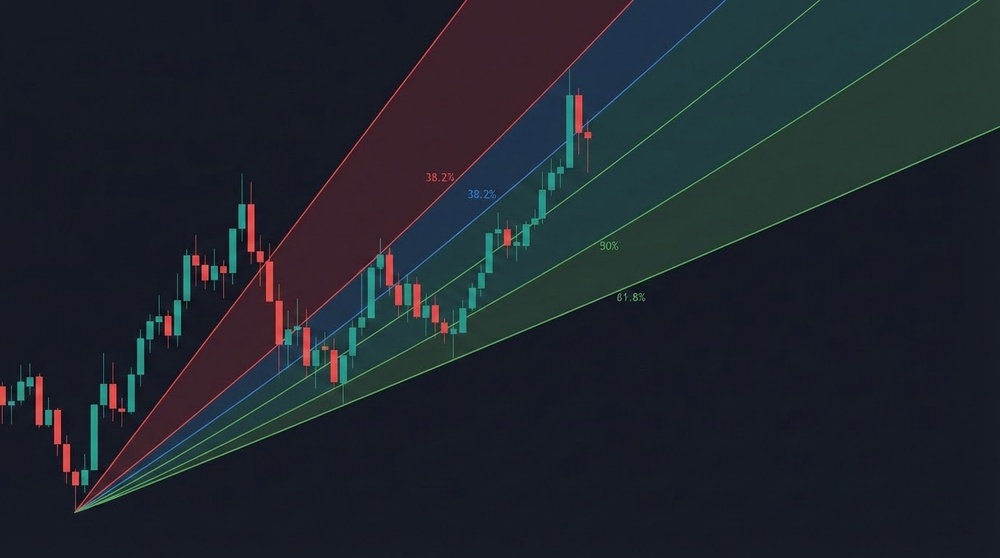
3. Fibonacci Fan
The Fibonacci Fan is a dynamic tool that creates diagonal support and resistance lines. Unlike horizontal retracement levels, fan lines change over time, making them particularly useful for analyzing long-term trends.
Construction Principle
The fan is drawn from a significant low to a significant high (or vice versa). Rays are drawn from the starting point through intersections of a vertical line from the endpoint with Fibonacci levels:
- 38.2% — first fan line, the shallowest
- 50.0% — middle line
- 61.8% — third line, the steepest
Application Features
Unique Capabilities of the Fan
- Dynamic levels — lines change position over time
- Trend strength identification — steeper angle indicates stronger trend
- Cascade analysis — breaking one line leads to movement toward the next
- Long-term forecasting — effective on daily and weekly charts
The fan is especially effective for identifying cascading support levels. When price breaks through one fan line, it often moves toward the next line. This creates a predictable movement structure.
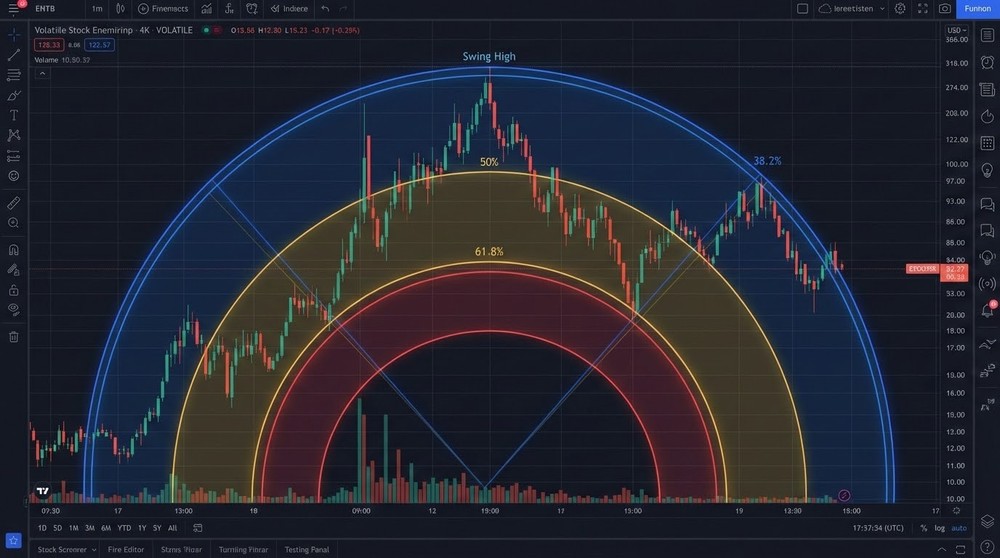
4. Fibonacci Arcs
Fibonacci Arcs are semicircles centered on the endpoint of a price move. This tool is unique because it considers not only price levels but also the time factor.
How Arcs Work
Arcs are constructed as follows:
- A significant price move is identified (from low to high or vice versa)
- Arcs are drawn from the endpoint with radii corresponding to 38.2%, 50%, and 61.8% levels
- Arcs intersect the price chart, creating curved support/resistance levels
Advantages of Arcs Over Linear Tools
| Characteristic | Retracement Levels | Fibonacci Arcs |
|---|---|---|
| Level shape | Horizontal lines | Curved (arcs) |
| Time consideration | Not considered | Built into the tool |
| Change over time | Static | Dynamically expand |
| Interpretation complexity | Low | Medium |
| Best timeframe | Any | Medium and long |
Important Note: The appearance of Fibonacci Arcs depends on chart scale. When changing scale, arcs may look different. For accurate analysis, use a fixed scale or enable the logarithmic scale option.
5. Fibonacci Time Zones
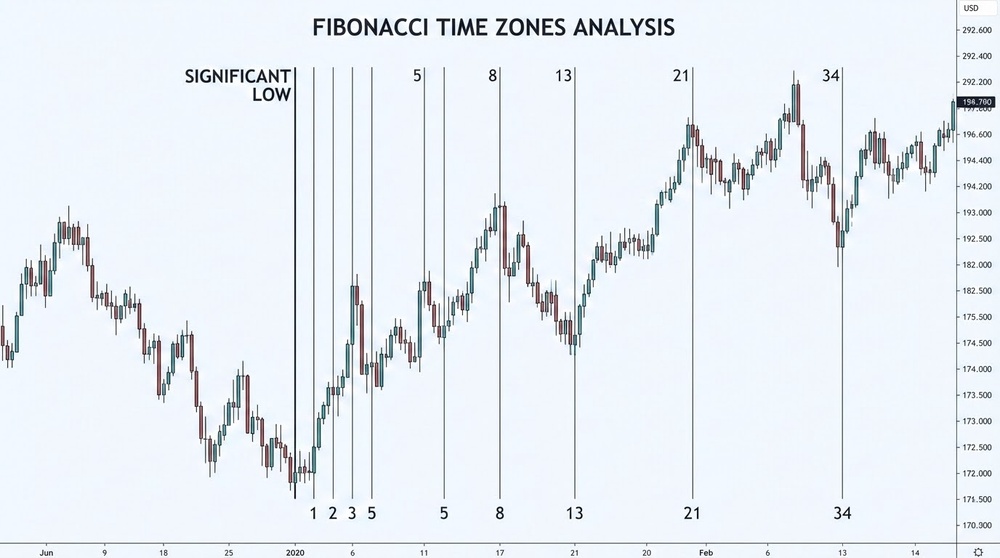
Fibonacci Time Zones are the only tool in the family that analyzes exclusively the time axis of the chart. It helps predict when significant changes in price dynamics may occur.
Working Principle
The tool places vertical lines at distances corresponding to Fibonacci numbers:
- 1, 2, 3, 5, 8, 13, 21, 34, 55, 89, 144... (in bars/candles from the starting point)
These lines mark potential moments when the market may change direction, accelerate movement, or enter a consolidation phase.
Practical Application
How to Use Time Zones
- Reference point — choose a significant extreme (high or low)
- Combination with price levels — overlaying on retracement strengthens the signal
- Signal confirmation — use as an additional filter
- Trade planning — prepare in advance for potential reversals
Time zones work best in combination with other tools. When a vertical time line coincides with a horizontal retracement level, the probability of reversal significantly increases.
6. Fibonacci Channel
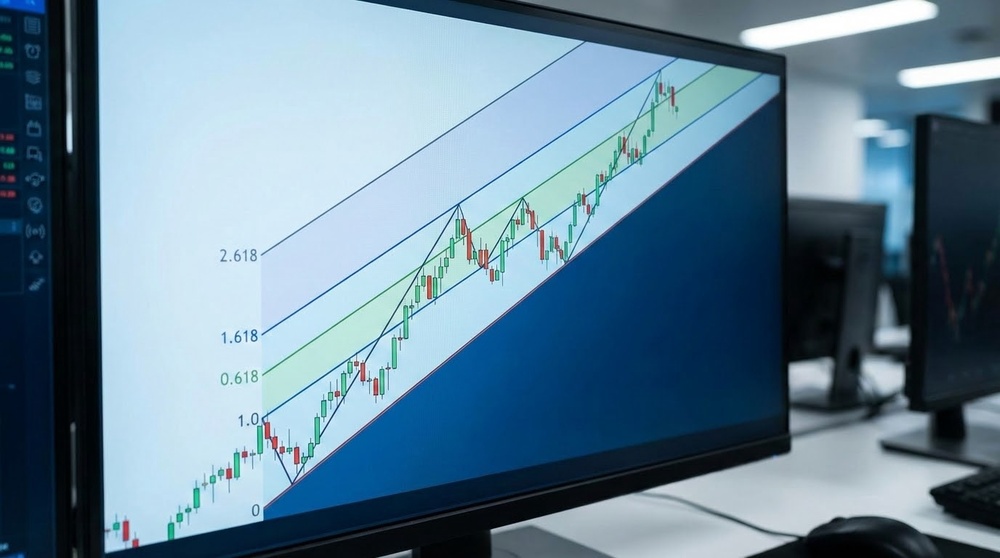
The Fibonacci Channel is a modification of the classic price channel where parallel lines are positioned at distances corresponding to Fibonacci ratios. The tool is particularly useful for trading in trending markets.
Channel Construction
To construct a Fibonacci Channel:
- Draw a baseline trendline through two or more extremes
- Specify the channel width (usually to the opposite extreme)
- The tool automatically plots parallel lines at 0.618, 1.0, 1.618, 2.618 levels, etc.
Trading Strategies with the Channel
Trading Within the Channel
Buying at the lower boundary (0 or 0.618) and selling at the upper (1.0 or 1.618). Suitable for sideways movement within a trend.
Breakout Trading
Entering a position on a breakout of the upper channel line with targets at extended levels (1.618, 2.618).
7. Additional Tools
Beyond the main six tools, there are several specialized tools that are used less frequently but can be useful in certain situations:
Fibonacci Clusters
Clusters are areas on the chart where multiple Fibonacci levels from different constructions converge in one zone. Such areas are considered particularly significant as they represent multiple confirmations of a level.
Fibonacci Spiral
The Fibonacci Spiral is an advanced tool based on a logarithmic spiral with a growth coefficient equal to the golden ratio. Rarely used due to interpretation complexity, but can yield interesting results on longer timeframes.
Fibonacci Projection
Projection is similar to extension but uses three points for construction and projects levels from the third point. This allows for more precise target identification after a correction completes.
Comparative Table of All Tools
For convenient tool selection, use the following comparison table:
| Tool | Analysis Type | Complexity | Best Application |
|---|---|---|---|
| Retracement | Price | ⭐ Low | Entry points, stop-losses |
| Extension | Price | ⭐⭐ Medium | Profit targets, take-profits |
| Fan | Combined | ⭐⭐ Medium | Dynamic support/resistance |
| Arcs | Combined | ⭐⭐⭐ High | Time + price, medium TFs |
| Time Zones | Time | ⭐⭐ Medium | Reversal timing forecast |
| Channel | Combined | ⭐⭐ Medium | Trend trading |
| Clusters | Combined | ⭐⭐⭐ High | Key zone confirmation |
How to Choose the Right Tool
Tool selection depends on several factors:
1. Your Trading Objective
- Looking for an entry point? → Use retracement
- Determining a target? → Use extension
- Analyzing a trend? → Use fan or channel
- Forecasting timing? → Use time zones
2. Market Conditions
- Strong trend → Extension, channel
- Correction within trend → Retracement levels
- Uncertainty → Time zones + retracement
- Long-term analysis → Arcs, fan
3. Your Experience Level
- Beginner → Start with retracement and extension
- Intermediate → Add fan and channel
- Advanced → Use all tools in combination
Recommendation for Beginners: Don't try to master all tools at once. Start with retracement levels — this is the foundation. After you learn to confidently identify entry points, move on to extension for determining targets. Add other tools gradually.
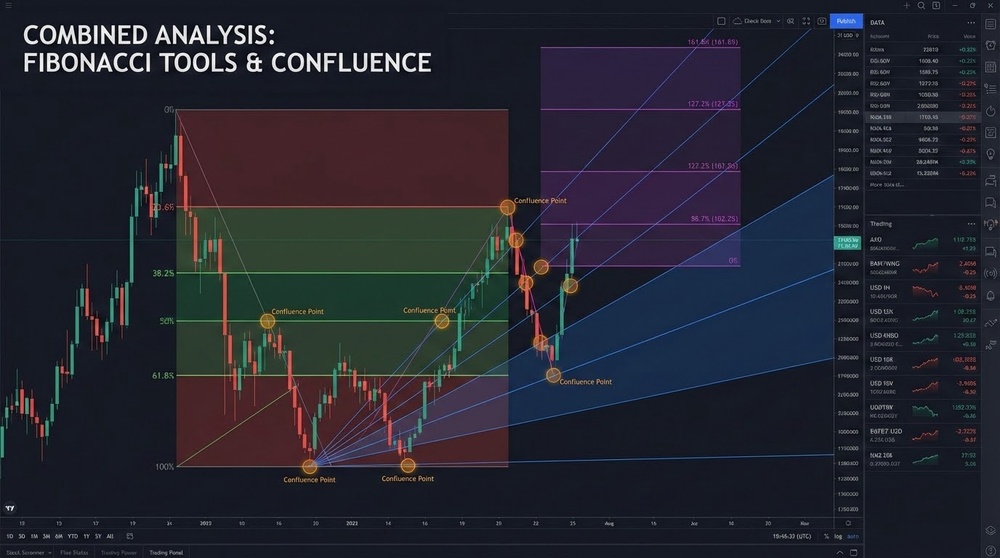
Combining Tools
The true power of Fibonacci tools is revealed through their combined use. Here are several effective combinations:
Effective Combinations
- Retracement + Extension — identifying entry point and target in one analysis
- Retracement + Time Zones — understanding where AND when to expect a reversal
- Fan + Channel — multi-level support/resistance structure
- Multiple Retracements — plotting from different waves to find clusters
Practical Recommendations
Let's conclude this lesson with practical tips that will help you effectively use Fibonacci tools:
- Always use significant swing points — construction quality directly depends on correct point selection
- Backtest on historical data — before trading, ensure levels worked in the past on this asset
- Don't overload the chart — 2-3 tools provide more information than 10 overlapping each other
- Combine with other methods — Fibonacci works better in conjunction with volume, candlestick patterns, indicators
- Consider context — levels on higher timeframes are more important than on lower ones
Conclusion
Fibonacci tools are a powerful arsenal for cryptocurrency technical analysis. Each tool has its strengths and areas of application:
- Retracement — your primary tool for finding entry points
- Extension — indispensable for determining targets
- Fan and Arcs — for dynamic analysis
- Time Zones — for timing forecasts
- Channel — for trend trading
In the following lessons, we'll examine each tool in detail, learning how to properly construct and apply them in real trading. We'll start with the most important — Fibonacci retracement levels.
Homework: Open a chart of any cryptocurrency and find the Fibonacci tools panel. Explore which tools are available on your platform. Try plotting a simple retracement from the last significant low to high — this will prepare you for the next lesson.