











Module 1: What Is Blockchain? Simple Explanation with Real-World Examples
Welcome to the world of cryptocurrency! If you're here — you've decided to understand the technology that has already transformed the financial world and continues to impact dozens of industries. Blockchain isn't just a buzzword — it's the foundation on which Bitcoin, Ethereum, and thousands of other cryptocurrencies are built.
In this lesson, we'll break down blockchain so that even someone with zero programming knowledge can understand it. No complex jargon without explanation — just clear analogies, real-life examples, and a solid structure. After reading this, you'll understand blockchain better than 90% of people around you.
💡 Why should you care? Without understanding blockchain, it's impossible to grasp cryptocurrencies, DeFi, NFTs, and Web3. It's like trying to drive a car without knowing it has an engine. Knowing the basics will give you an edge and protect you from scammers.
Blockchain in Simple Terms: Three Easy Analogies
Before diving into technical details, let's understand the core concept of blockchain through everyday examples.
Analogy 1: The Shared Class Notebook
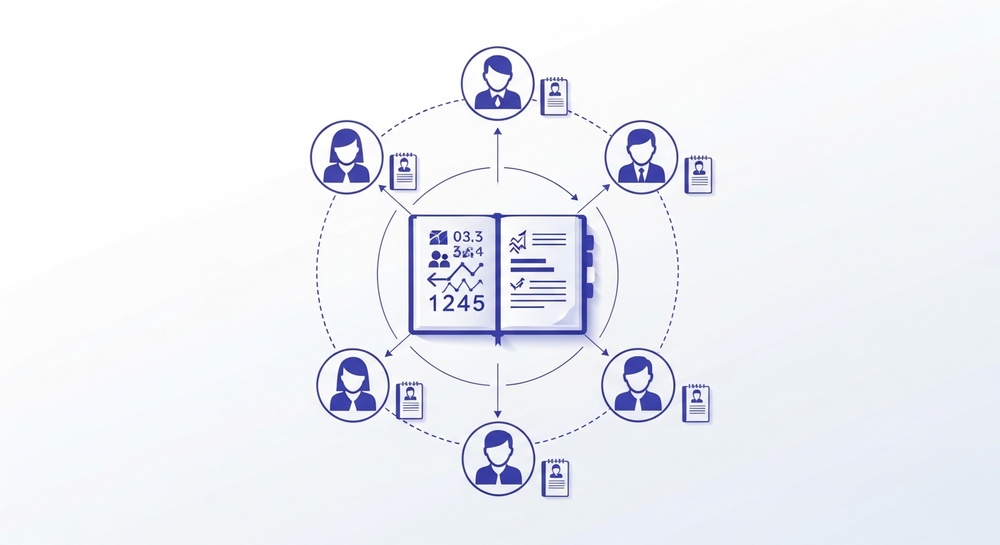
Imagine a school class where everyone keeps one shared notebook recording who owes whom money for lunches. Every student has an exact copy of this notebook. When John gives Mike $10:
- John announces loudly: "I gave Mike $10"
- All 30 students write this down in their notebooks
- Now everyone has the same record
- If John later says "I never gave anything" — 29 notebooks prove otherwise
This is blockchain — a distributed database where information is stored simultaneously by thousands of participants, and changing it alone is impossible.
Analogy 2: The Glass Safe in the Town Square
Now imagine a transparent safe standing in the central town square:
- Everyone can see what's inside
- Anyone can add something new
- But no one can take out or change what's already there
- Thousands of cameras record every action
Blockchain works the same way: all transactions are visible, everything is recorded forever, and no one can forge or delete them.
Analogy 3: A Chain of Train Cars
The word "blockchain" literally means "chain of blocks." Imagine a freight train:
- Each car is a block containing data (transactions)
- Cars are connected by strong couplings — these are cryptographic links
- To change the cargo in car #5, you'd need to uncouple all cars after it
- But the train keeps moving, and new cars are constantly being attached
- The farther a car is from the end, the harder it is to reach
This is exactly why old records in blockchain are virtually impossible to change — doing so would require rewriting all subsequent history, which demands colossal computing resources.

How Blockchain Works: Step-by-Step Explanation
Now let's break down what happens "under the hood" when you send cryptocurrency to someone.
Step 1: Creating a Transaction
Let's say you want to send 0.1 BTC to your friend. You open your crypto wallet, enter your friend's address and the amount, and click "Send." At this moment, a transaction is created — a digital record containing:
- Your address (sender)
- Your friend's address (recipient)
- Amount: 0.1 BTC
- Your digital signature (proof that it's really you)
- Timestamp
Step 2: Broadcasting to the Network
Your transaction is sent to the network and enters the mempool (memory pool) — a sort of "waiting room" for unconfirmed transactions. Thousands of computers (network nodes) receive information about your transfer.
What Is a Node?
A node is a computer connected to the blockchain network. It stores a copy of the entire transaction history and helps verify new operations. The more nodes — the more reliable and decentralized the network. The Bitcoin network has tens of thousands of nodes worldwide.
Step 3: Transaction Verification
Network nodes verify your transaction:
- ✅ Do you have enough funds?
- ✅ Is the digital signature correct?
- ✅ Are you trying to spend the same coins twice?
- ✅ Does the transaction comply with network rules?
If everything checks out, the transaction is considered valid and waits to be included in a block.
Step 4: Block Formation
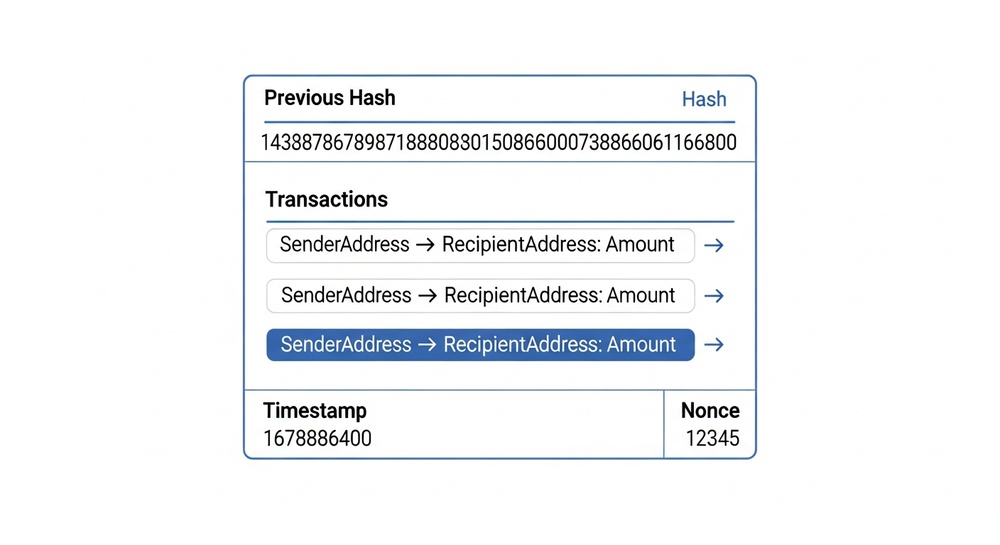
Special network participants — miners (in Bitcoin) or validators (in Ethereum and other networks) — gather several hundred or thousand transactions into one block. Each block contains:
- List of transactions
- Hash of the previous block — a unique "fingerprint" linking blocks into a chain
- Timestamp
- Special number (nonce) — for mining
- Merkle root — a compact representation of all transactions
Step 5: Adding the Block to the Chain
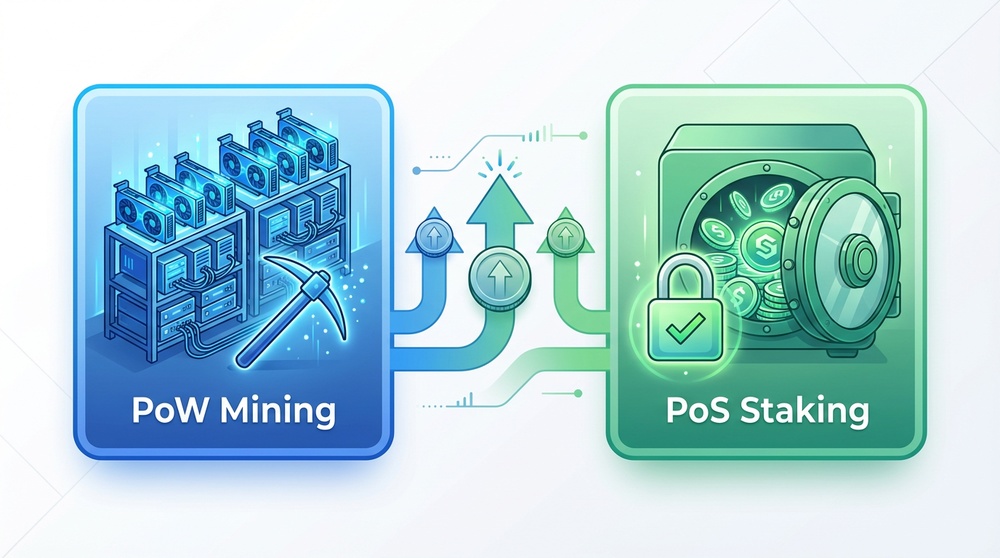
To add a block to the chain, one must solve a complex mathematical puzzle (in Proof of Work) or be selected to create a block (in Proof of Stake). More on this in the lesson about mining and staking.
When a block is added:
- All nodes update their copy of the blockchain
- Your transaction receives its first confirmation
- With each new block on top — more confirmations accumulate
- After 6 confirmations, a transaction is considered irreversible (in Bitcoin)
Step 6: Completion
Done! Your friend received 0.1 BTC. This transaction is now permanently recorded on the blockchain and visible to everyone. No one — not you, not your friend, not any government, not even Bitcoin's creator — can cancel or change it.
⏱️ How long does this take? In the Bitcoin network, blocks are created approximately every 10 minutes. In Ethereum — every 12 seconds. But for reliability, it's recommended to wait for several confirmations, which can take from a minute to an hour depending on the network.
Key Components of Blockchain
To understand blockchain more deeply, let's examine its main components.
1. Cryptographic Hashes
A hash is a unique digital fingerprint of data. Imagine a machine that takes any information (text, file, image) and outputs a fixed-length string:
- The word "Hello" →
3a5b9c7d... - The word "Hello!" →
f2e8a1b3...(added one character — the hash completely changed) - The entire "War and Peace" → also a string of the same length
Important properties of hashes:
- Irreversibility — it's impossible to recover the original data from a hash
- Uniqueness — two different data sets virtually never produce the same hash
- Sensitivity — the slightest change in data completely changes the hash
Thanks to these properties, blocks are securely linked: changing data in one block breaks the hashes of all subsequent blocks.
2. Digital Signatures
A digital signature proves that a transaction was created by the actual owner of the funds. It works based on public-key cryptography:
- Private key — a secret code known only to you. Used to sign transactions
- Public key — an open code that can be shown to anyone. Your network address is generated from it
When you sign a transaction with your private key, anyone can verify the signature using the public key and confirm it's really you. Meanwhile, the private key remains secret.
The Golden Rule of Cryptocurrency
Never share your private key or seed phrase with anyone! Whoever knows the private key has complete control over the funds. Lost key = lost access forever. Leaked key = stolen funds.
3. Consensus Mechanisms
How do thousands of computers agree on which version of history is correct? That's what consensus algorithms are for:
| Mechanism | How It Works | Examples |
|---|---|---|
| Proof of Work (PoW) | Miners compete to solve mathematical puzzles. Whoever solves it first adds the block and receives a reward | Bitcoin, Litecoin |
| Proof of Stake (PoS) | Validators "lock up" their coins as collateral. The larger the stake — the higher the chance to create a block | Ethereum, Cardano, Solana |
| Delegated PoS (DPoS) | Coin holders vote for delegates who create blocks on their behalf | EOS, TRON |
| Proof of Authority (PoA) | Only authorized nodes with known reputation create blocks | Private blockchains, testnets |
We'll discuss PoW and PoS in more detail in the lesson "What Is Mining and Staking."
4. Decentralization
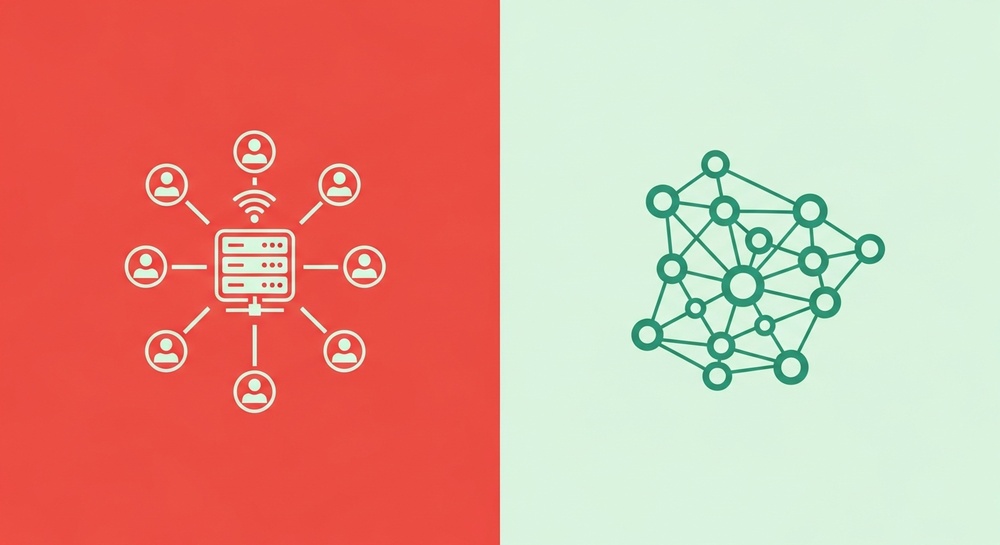
Decentralization means the absence of a single control center. In blockchain, there's no "main server" or "administrator." Thousands of equal nodes store identical copies of data.
Why this matters:
- Resilience — no single point of failure. Even if half the nodes go offline, the network continues operating
- Censorship resistance — no government or corporation can block transactions
- Transparency — all rules are open, all transactions are public
- Trustlessness — no need to trust a specific organization, just trust the math and code
Types of Blockchains
Not all blockchains are the same. Depending on who can participate in the network, there are three types:
🌍 Public Blockchains
Open to everyone. Anyone can read data, send transactions, and become a validator. Fully decentralized.
Examples: Bitcoin, Ethereum, Solana
🔒 Private Blockchains
Access by invitation only. Controlled by a single organization. Used for internal corporate tasks.
Examples: Hyperledger Fabric
🤝 Consortium Blockchains
Managed by a group of organizations. Partially decentralized. Suitable for industry solutions.
Examples: R3 Corda (banks), TradeLens (logistics)
🔗 Hybrid Blockchains
Combine public and private elements. Some data is open, some is confidential.
Examples: Dragonchain, XinFin
In this course, we focus on public blockchains because that's where cryptocurrencies, DeFi services, and NFTs operate.
Advantages of Blockchain: Why It's Revolutionary
Now that you understand how blockchain works, let's explore why this technology is called revolutionary.
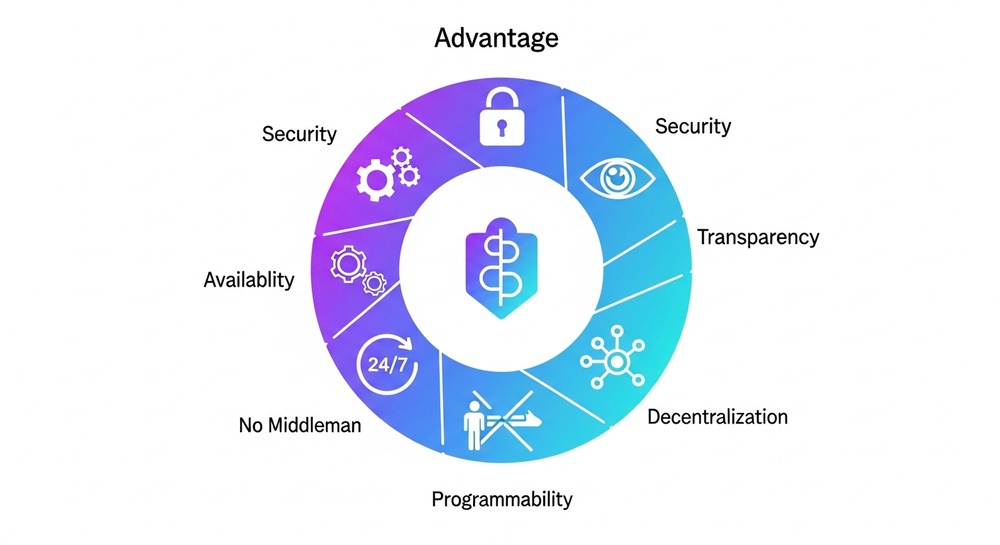
✅ Data Immutability
Records on the blockchain are virtually impossible to forge or delete. Each block is cryptographically linked to the previous one, and changing old data would require recalculating all subsequent blocks. In the Bitcoin network, this would require computing power exceeding all the world's supercomputers combined.
✅ Transparency
In public blockchains, all transactions are open. You can verify any transfer, check the balance of any address, and track the movement of funds. This creates an unprecedented level of accountability.
🔍 Try it yourself! Go to blockchain.com/explorer or etherscan.io and enter any known address. You'll see its complete transaction history.
✅ Security
Cryptography protects data at all levels:
- Digital signatures confirm transaction authorship
- Hashes ensure data integrity
- Distributed storage protects against hacking individual nodes
- Consensus mechanisms prevent fraud
✅ No Intermediaries
Traditional money transfers require banks, payment systems, and clearing houses. Each intermediary takes a fee and adds processing time. Blockchain allows you to send value directly — person to person, without third parties.
✅ Accessibility
Blockchain operates 24/7, 365 days a year. No weekends, no lunch breaks, no "scheduled maintenance." Anyone with internet access can participate in the network — regardless of country, social status, or credit history.
✅ Programmability
Modern blockchains (Ethereum and others) support smart contracts — programs that automatically execute when certain conditions are met. This opens enormous possibilities for automation: from decentralized finance to supply chain management.
Where Blockchain Is Used: Real-World Examples
Blockchain isn't just about cryptocurrencies. The technology finds applications in various fields.
💰 Finance and Cryptocurrencies
The most obvious application. Bitcoin created the possibility of digital money without banks. Ethereum expanded this into an entire ecosystem of decentralized finance (DeFi): lending, trading, insurance — all without intermediaries.
🎨 NFTs and Digital Art
NFTs (non-fungible tokens) allow you to prove ownership of digital objects: artwork, music, in-game items. Blockchain stores proof of authenticity and ownership history.
📦 Logistics and Supply Chains
Companies use blockchain to track goods from manufacturer to buyer. This helps fight counterfeits and increases trust in products.
🏥 Healthcare
Storing medical records on blockchain ensures patient data security and easy information exchange between clinics (with patient consent).
🗳️ Voting
Blockchain can make elections transparent and protected from fraud. Several countries are already experimenting with such systems.
📜 Document Management and Notarization
Recording documents on blockchain proves their existence at a specific point in time. This is useful for patents, copyrights, and contracts.
🎮 Gaming Industry
In-game items in blockchain games truly belong to players. They can be sold, traded, and used across different games.
Common Myths About Blockchain
There are many misconceptions about blockchain. Let's debunk the most popular ones.
❌ Myth 1: "Blockchain = Bitcoin"
Truth: Bitcoin is the first and most famous application of blockchain, but far from the only one. There are thousands of different blockchains with different purposes and capabilities.
❌ Myth 2: "Blockchain is completely anonymous"
Truth: Most public blockchains are pseudonymous, not anonymous. Transactions are tied to addresses, not names. But if the connection between an address and identity is established — the entire transaction history becomes visible. There are special "privacy" cryptocurrencies (Monero, Zcash), but even they don't guarantee 100% anonymity.
❌ Myth 3: "Blockchain can be hacked"
Truth: Hacking the blockchain itself is extremely difficult. Attacks happen at the application level: exchanges, wallets, smart contracts. Blockchain cryptography remains robust.
❌ Myth 4: "Blockchain is a bubble that will burst soon"
Truth: Cryptocurrency prices are indeed volatile, with booms and crashes. But blockchain technology continues to develop and be implemented in real business processes of the world's largest companies.
❌ Myth 5: "Blockchain solves all problems"
Truth: Blockchain is a tool for specific tasks. It's excellent where transparency, immutability, and absence of intermediaries are needed. But for many tasks, traditional databases are more efficient and cheaper.
Glossary of Lesson Terms
Let's reinforce the key concepts covered in this lesson:
| Term | Explanation |
|---|---|
| Blockchain | A distributed database consisting of a chain of linked blocks containing transactions |
| Block | A container with a group of transactions, linked to the previous block |
| Hash | A unique digital fingerprint of data with a fixed length |
| Node | A computer storing a copy of the blockchain and participating in transaction verification |
| Transaction | A record of value (cryptocurrency) transfer from one address to another |
| Private Key | A secret code for signing transactions and accessing funds |
| Public Key | An open code from which the wallet address is generated |
| Consensus | A mechanism for reaching agreement among network nodes about the blockchain state |
| Decentralization | Absence of a single control center, distribution of control among participants |
| Smart Contract | A program on the blockchain that automatically executes under certain conditions |
| Mempool | A queue of unconfirmed transactions waiting to be included in a block |
Practical Assignment
Theory without practice is quickly forgotten. Here are some actions to help reinforce the material:
Self-Check Tasks
- Explore the blockchain: Go to blockchair.com and find the latest block added to the Bitcoin network. See how many transactions it contains
- Explain to a friend: Try explaining blockchain to someone close to you using the class notebook analogy. If you can explain it clearly — you truly understand it
- Think about applications: Come up with three areas in your life or work where blockchain's transparency and immutability could be useful
Lesson Summary
Congratulations! You've completed the first and one of the most important lessons of the course. Let's summarize what you've learned:
- Blockchain is a distributed database where information is stored simultaneously by thousands of participants
- Data is organized into blocks linked in a chain using cryptographic hashes
- Key properties of blockchain: immutability, transparency, decentralization, security
- There are different types of blockchains: public, private, consortium
- The technology is used not only in cryptocurrencies but also in logistics, healthcare, gaming, and other fields
- Private key is the main secret that must never be shared with anyone
🎯 What's next? In the next lesson, we'll explore Bitcoin — the first and most famous cryptocurrency. We'll learn who created it, why it's called "digital gold," and what place it holds in the crypto world.
Blockchain is the foundation. Now that you understand the basics, learning about cryptocurrencies will be much easier. See you in the next lesson!