















Module 6: Combined Analysis: Candlesticks + Levels + Volume
Imagine a detective investigating a complex case. One witness gives testimony — that's good. Two witnesses confirm the story — that's better. Three independent sources saying the same thing — that's irrefutable evidence. This is exactly how combined analysis in trading works: when candlesticks, levels, and volume all point in the same direction, the probability of a successful trade increases dramatically.
In previous lessons, we studied individual candlestick patterns — Hammer, Engulfing, Three Soldiers, and others. These are powerful tools, but their true potential is only unlocked when combined with support and resistance levels and volume analysis. Today, we'll put all the pieces together and create a comprehensive analysis system used by professional traders in cryptocurrency markets.
Key Principle of This Lesson: One analysis tool is an opinion. Two tools form a hypothesis. Three confirming tools create a trading signal.
Why Isolated Candlestick Analysis Isn't Enough
Before diving into combined analysis, it's important to understand why using only candlestick patterns often leads to losses. Imagine you spot a perfect "Bullish Engulfing" pattern on a Bitcoin chart. Your first reaction is to immediately open a long position. But let's look deeper:
- Context of location: Where exactly on the chart did the pattern form? If it's in the middle of a downtrend without any support — the signal is weak
- Strength confirmation: Was the pattern accompanied by increased volume? If volume was minimal — there's no serious capital behind the move
- Historical context: How did price behave at this level before? If there were previous reversals here — the signal strengthens
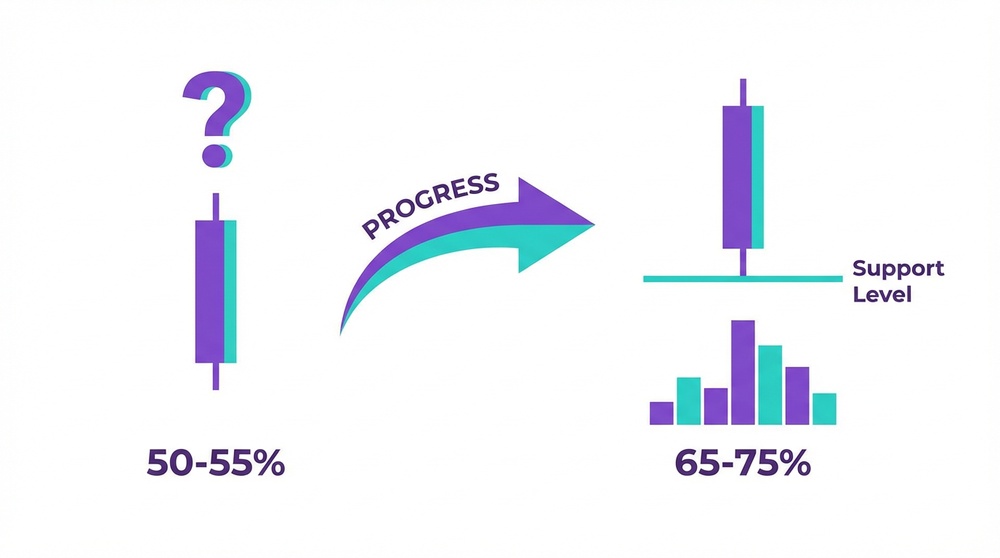
Statistics show that candlestick patterns without additional confirmation work in 50-55% of cases — only slightly better than flipping a coin. But when we add filters like levels and volume, accuracy increases to 65-75%. This difference is what separates profitable traders from losing ones.
Support and Resistance Levels: The Foundation of Analysis
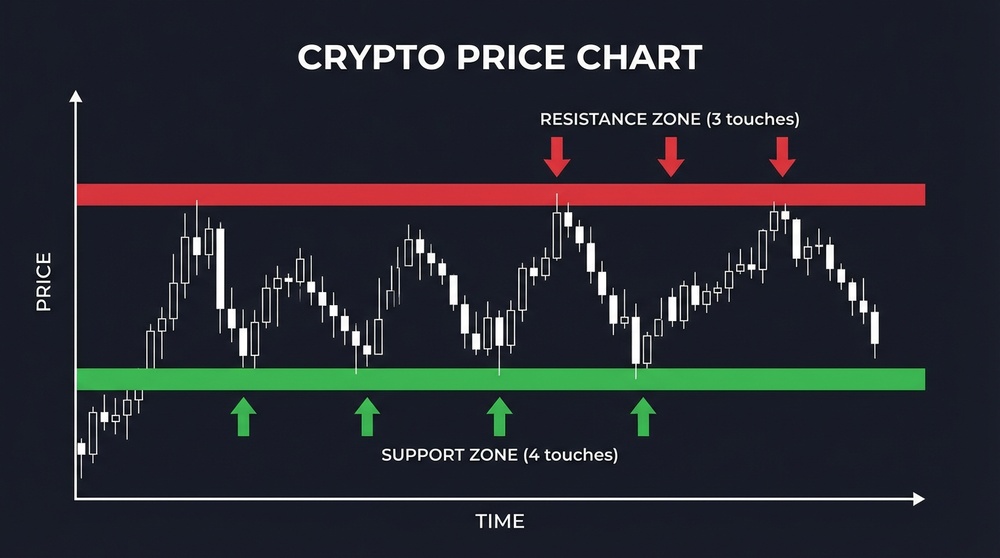
Support and resistance levels are price zones where historically significant order accumulation has occurred. They function as psychological and technical barriers from which price tends to bounce or break through with acceleration.
What Are Support and Resistance
🟢 Support Level
A price zone where buyers have historically shown interest. Price falls to this level and bounces upward. Buy orders are concentrated here, "supporting" the price.
🔴 Resistance Level
A price zone where sellers have historically taken profits. Price rises to this level and bounces downward. Sell orders are concentrated here, "resisting" further growth.
How to Properly Identify Key Levels
Many beginners make the mistake of drawing dozens of lines on their charts. As a result, they see levels everywhere, but none of them work. Professionals use a different approach — they look for zones of greatest significance.
Criteria for Strong Levels
- Number of touches: A level from which price has bounced 3+ times is significantly stronger than a level with one touch
- Duration of existence: Levels on higher timeframes (daily, weekly) are more important than those on lower timeframes
- Sharpness of reaction: The faster and stronger price reversed from a level, the more significant it is
- Volume at the level: High volume when touching a level confirms its significance
- Round numbers: Psychological levels ($50,000, $100,000) often act as support/resistance
Types of Levels and Their Strength
| Level Type | Description | Strength | Usage Example |
|---|---|---|---|
| Historical Highs/Lows | Extreme points on the chart, ATH/ATL | ⭐⭐⭐⭐⭐ | Global trend reversal points |
| Consolidation Zones | Areas where price traded in a range for extended periods | ⭐⭐⭐⭐ | Major accumulation/distribution |
| Broken Levels | Former resistance becomes support and vice versa | ⭐⭐⭐⭐ | Retest after breakout |
| Gaps | Price voids that the market tends to fill | ⭐⭐⭐ | Price movement targets |
| Psychological Levels | Round numbers: $10,000, $50,000, $100,000 | ⭐⭐⭐ | Additional reaction points |
| Intraday Levels | Local extremes on lower timeframes | ⭐⭐ | Precise position entry |
The Role Reversal Principle: Support Becomes Resistance
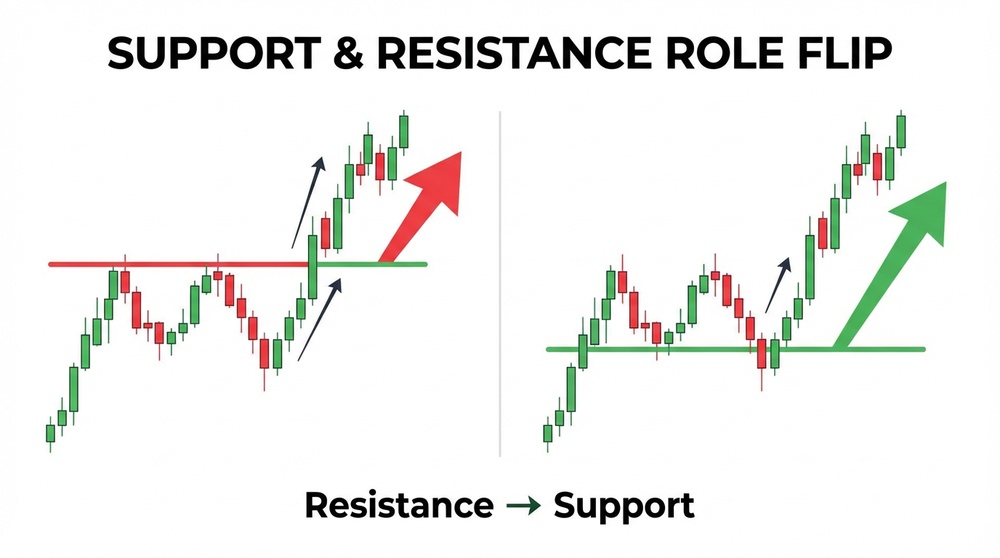
One of the most important concepts in technical analysis is level role reversal. When price breaks through a resistance level and consolidates above it, that level transforms into support. And vice versa — broken support becomes resistance.
Why does this work? Crowd psychology:
- Traders who missed the entry wait for a return to the level to buy cheaper
- Traders already in position are ready to add on pullbacks
- Large players place limit orders at these levels
This is why the so-called "retest" of a broken level often provides a better entry point than the breakout moment itself.
Volume Analysis: Seeing the Invisible
If price is the effect, then volume is the cause. Volume shows the amount of an asset that was bought and sold during a specific period. It's like an X-ray of the market: it allows you to look inside price movement and understand how sustainable it is.
Market Wisdom: "Price can lie, but volume always tells the truth." Price can be manipulated, but creating real volume requires real money.
Basic Principles of Volume Analysis
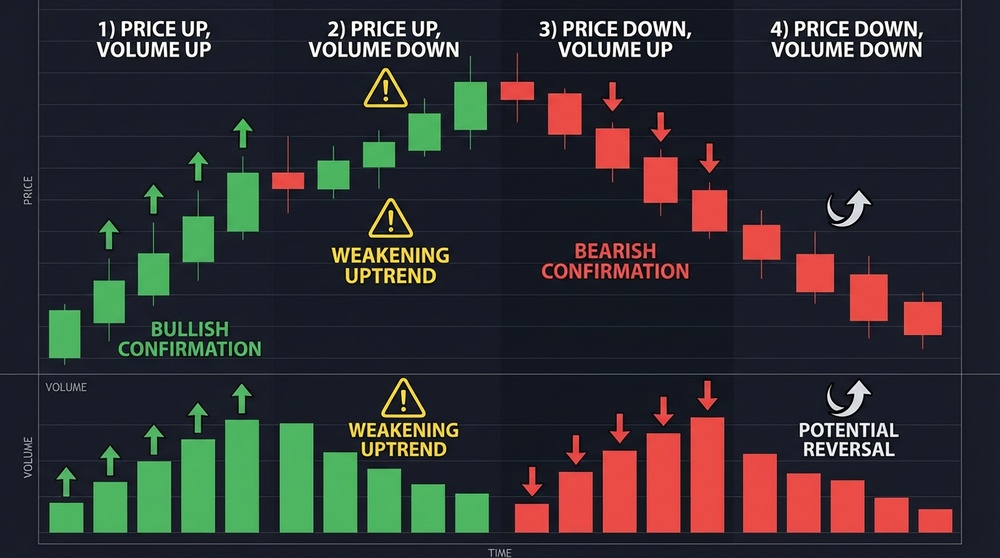
Four Golden Rules of Volume
- Rule 1: Rising price on rising volume — healthy trend, buyers control the market
- Rule 2: Rising price on falling volume — trend weakness, possible reversal
- Rule 3: Falling price on rising volume — strong selling pressure
- Rule 4: Falling price on falling volume — seller exhaustion, possible upward reversal
Types of Volume Analysis
| Volume Type | What It Shows | Interpretation |
|---|---|---|
| Volume Spike | Sharp increase in trading activity by 2-3x | Movement climax, possible reversal or start of strong trend |
| Declining Volume | Gradual decrease in trading activity | Current movement exhaustion, consolidation |
| Volume at Level | Increased activity when touching a level | Confirmation of level significance |
| Breakout Volume | Volume at the moment of level breakthrough | High volume — true breakout, low — false breakout |
| Pullback Volume | Volume during correction against the trend | Low pullback volume — trend is strong |
Volume Anomalies: What They Mean
Special attention should be paid to anomalous volumes — situations where volume sharply differs from the average value. These are signals of large player presence.
Abnormally High Volume on a Candle
- At trend highs: Likely buying climax, large players selling positions to the crowd
- At trend lows: Seller capitulation, large players buying panic selling
- On level breakout: Confirmation of true breakout
Abnormally Low Volume
- In consolidation zone: Market is "resting" before a move
- When approaching a level: Participant uncertainty, wait for reaction
- On breakout: High probability of false breakout
Synthesis: Combining Candlesticks, Levels, and Volume
Now we're ready to assemble all elements into a unified system. Combined analysis isn't just mechanical addition of three tools, but their synergy, where the whole is greater than the sum of its parts.
Combined Analysis Algorithm
Memorize this sequence — it will become your checklist before every trade:
Step-by-Step Analysis Algorithm
- Step 1: Determine the overall trend on a higher timeframe (daily/weekly)
- Step 2: Find key support and resistance levels
- Step 3: Wait for price to approach the level
- Step 4: Look for a reversal or continuation candlestick pattern
- Step 5: Check volume: does it confirm the pattern?
- Step 6: Evaluate the risk/reward ratio
- Step 7: Make a decision: entry, wait, or skip
Practical Combinations: From Theory to Practice
Let's examine specific scenarios you'll encounter on charts daily:
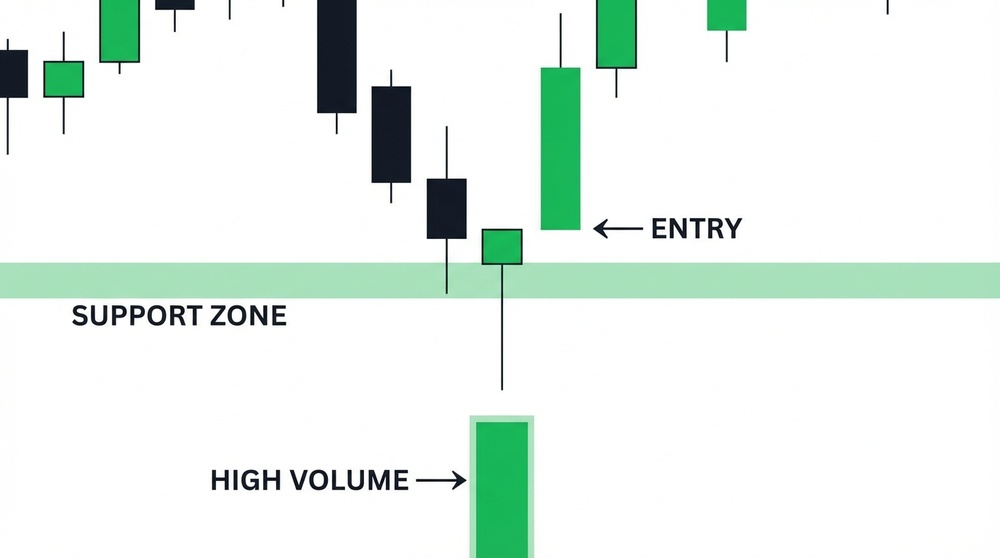
Scenario 1: Hammer at Support with Volume Spike
This is a classic combination for entering a long position (buy):
- ✅ Price approaches a strong support level
- ✅ A "Hammer" candle forms with a long lower wick
- ✅ Volume on the "Hammer" candle is 1.5-2x above average
- ✅ Next candle is bullish, confirming the reversal
Logic: Sellers attempted to break support, but buyers (as evidenced by high volume) aggressively defended the level. The long lower wick shows rejection of lower prices.
Scenario 2: Shooting Star at Resistance with Volume
Mirror situation for entering a short position (sell):
- ✅ Price approaches a strong resistance level
- ✅ A "Shooting Star" candle forms with a long upper wick
- ✅ Volume on the candle is significantly above average
- ✅ Next candle is bearish
Logic: Buyers attempted to break resistance but were pushed back by sellers. High volume confirms that selling was active. The long upper wick shows rejection of higher prices.
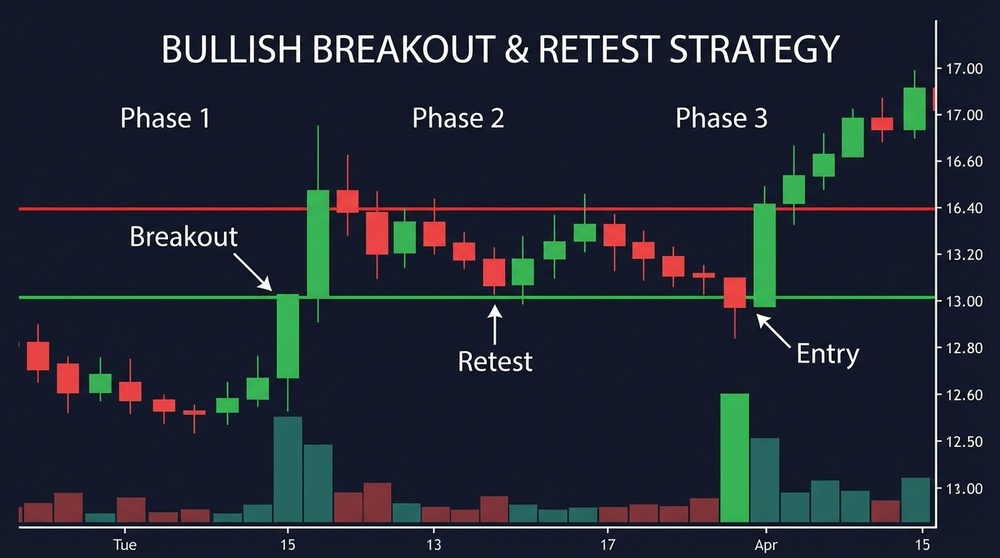
Scenario 3: Bullish Engulfing on Retest of Broken Level
One of the most reliable setups:
- ✅ Price breaks resistance upward with high volume
- ✅ A pullback occurs to the broken level (former resistance = new support)
- ✅ "Bullish Engulfing" forms at the level
- ✅ Volume on the engulfing candle is higher than on previous pullback candles
Logic: This is a classic retest. Those who missed the first entry on the breakout get a second chance. The candlestick pattern confirms buyers have returned. Volume shows their seriousness.
Scenario 4: Volume Divergence at Level
Advanced technique for recognizing trend exhaustion:
- ✅ Price forms a new high (or low)
- ✅ Volume is lower than at the previous high
- ✅ A resistance (or support) level is nearby
- ✅ A reversal candlestick pattern appears
Logic: If price makes new highs but volume is falling — it means fewer participants believe in continued growth. Level + pattern + divergence = powerful reversal signal.
Signal Matrix: Evaluating Combination Strength
Not all combinations are equal. Use this matrix to evaluate signal strength:
| Signal Components | Strength | Recommendation |
|---|---|---|
| Candlestick pattern only | ⭐ | Don't trade or use minimum size |
| Pattern + Level | ⭐⭐⭐ | Can consider entry with caution |
| Pattern + Volume | ⭐⭐ | Weak signal without level context |
| Pattern + Level + Volume | ⭐⭐⭐⭐ | Good signal for entry |
| Pattern + Level + Volume + Trend | ⭐⭐⭐⭐⭐ | Excellent signal, maximum size |
Practical Breakdown: Complete Chart Analysis
Let's walk through the complete analysis process using a real example. Imagine you're analyzing a Bitcoin chart:
Stage 1: Determining Context
Opening the daily chart, we see:
- Global trend is bullish (recent months show higher highs and higher lows)
- Locally, price is in a correction after strong growth
- The correction is approaching a zone that was previously resistance (now potential support)
Stage 2: Identifying Key Levels
We mark on the chart:
- Support 1: Zone of former resistance that was broken
- Support 2: Local low of the previous correction
- Resistance: Recent high before the correction began
Stage 3: Waiting for Pattern at Level
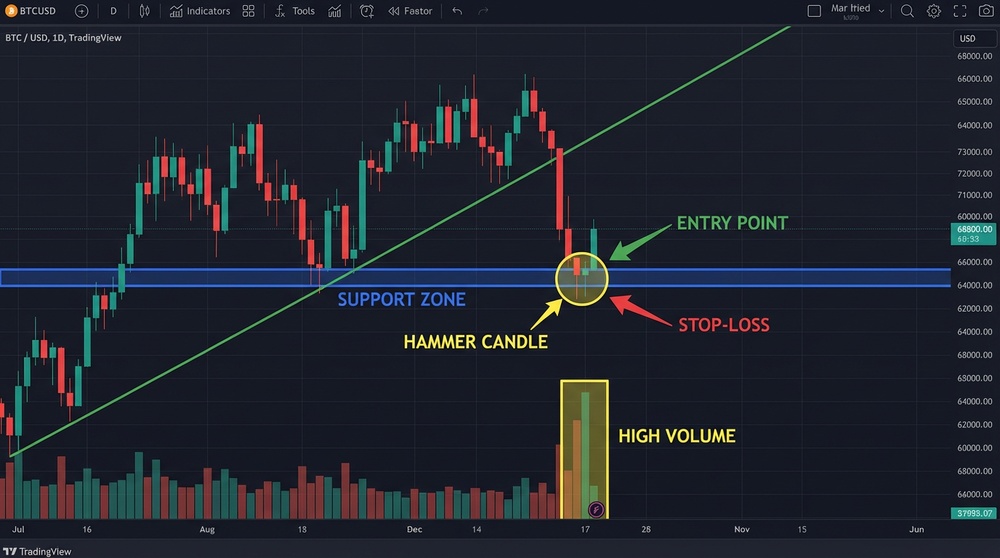
Price approaches Support 1. We wait. A candle with a long lower wick forms — a Hammer. The candle body sits exactly at the level.
Stage 4: Checking Volume
We look at the volume histogram. Volume on the Hammer candle is 2x higher than the 20-day average. This is confirmation! Someone large was actively buying at this level.
Stage 5: Final Decision
All three components aligned:
- ✅ Strong support level (former resistance)
- ✅ Reversal candlestick pattern (Hammer)
- ✅ High confirmation volume
- ✅ Overall uptrend (trading with the trend)
Decision: Enter long position. Stop-loss below the Hammer's wick. Target — previous high (resistance).
Common Mistakes in Combined Analysis
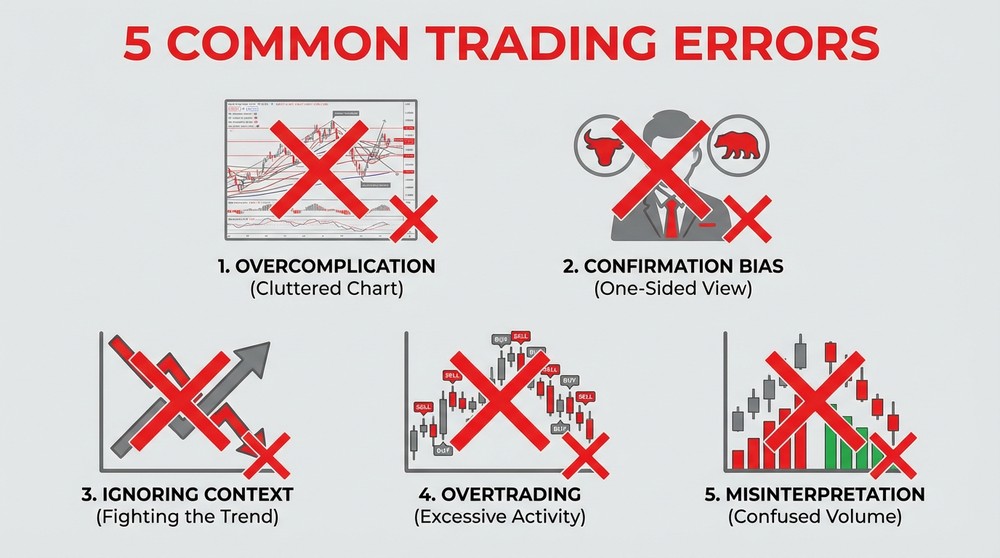
Knowledge isn't skill yet. Many traders understand the theory but make the same mistakes in practice. Study this list to avoid typical traps:
Mistake 1: Over-Complicating Analysis
Problem: Trader draws 20 levels, uses 10 indicators, and ultimately can't make a decision — signals contradict each other.
Solution: Limit yourself to 2-3 key levels. Use only candlesticks, levels, and volume. Simplicity is a sign of mastery.
Mistake 2: Seeking Confirmation of Your Opinion
Problem: Trader has already decided they want to buy and starts looking for reasons to do so, ignoring negative signals.
Solution: First analyze, then decide. Write down your analysis BEFORE entering a position.
Mistake 3: Ignoring Trend Context
Problem: Trader finds a perfect reversal pattern at support but doesn't account for the global downtrend.
Solution: Always start analysis from the higher timeframe. Trading with the trend is statistically more profitable.
Mistake 4: Trading Every Signal
Problem: Trader sees a suitable combination and immediately enters without evaluating risk/reward ratio.
Solution: Only enter trades with profit potential at least 2x the risk (R:R ≥ 1:2).
Mistake 5: Incorrect Volume Interpretation
Problem: Trader confuses high spot market volume with futures volume, or doesn't account for cryptocurrency market specifics.
Solution: Use volume from one exchange or an aggregated indicator. Compare current volume to average, not absolute values.
Trade Entry Checklist
Use this checklist before every trade. Print it or keep it visible:
Trade Entry Checklist (Long Position)
- Trend: Is the overall trend on higher TF bullish or neutral?
- Level: Is price at a significant support level?
- Pattern: Has a bullish candlestick pattern formed (Hammer, Engulfing, Morning Star)?
- Volume: Is the pattern confirmed by elevated volume?
- Stop-loss: Is there a logical place for a stop (below level/wick)?
- Target: Is nearest resistance at least 2R away?
- Risk: Does position size match risk management (1-2% of account)?
Trade Entry Checklist (Short Position)
- Trend: Is the overall trend on higher TF bearish or neutral?
- Level: Is price at a significant resistance level?
- Pattern: Has a bearish candlestick pattern formed (Shooting Star, Engulfing, Evening Star)?
- Volume: Is the pattern confirmed by elevated volume?
- Stop-loss: Is there a logical place for a stop (above level/wick)?
- Target: Is nearest support at least 2R away?
- Risk: Does position size match risk management?
Advanced Combined Analysis Techniques
For those who want to deepen their knowledge, let's examine several advanced concepts:
Level Cluster Analysis
When several different types of levels converge in one zone, its significance increases dramatically:
- Historical level + round number + Fibonacci level = support cluster
- Previous high + trendline + psychological level = resistance cluster
A candlestick pattern in a cluster zone has significantly higher probability of working out.
Volume Profile
An advanced tool showing volume distribution across price levels rather than time:
- POC (Point of Control): Level with maximum volume — the "fair price"
- Low volume zones: Price moves quickly through these areas
- High volume zones: Price is attracted to and lingers in these zones
Volume Delta Analysis
Delta = buy volume – sell volume. This indicator helps understand who dominates at each moment:
- Positive delta at support + bullish pattern = strong buy signal
- Negative delta at resistance + bearish pattern = strong sell signal
Practical Exercises
Theory without practice is dead. Complete these exercises to reinforce the material:
Exercise 1: Finding Levels
Open the daily chart of any top-10 cryptocurrency. Identify 3 key support levels and 3 resistance levels. Write down why each level is important (number of touches, role reversal, volume at level).
Exercise 2: Volume Analysis
Find 5 candles with abnormally high volume on the chart. Analyze what happened after each one. Was it a reversal, continuation, or climax?
Exercise 3: Combined Search
Review charts of 10 different cryptocurrencies. Find at least 3 situations where a candlestick pattern coincided with a level and was confirmed by volume. Mark them and track how price developed.
Exercise 4: Keeping a Journal
For one week, record all combinations you find (even if you don't trade). Note: pattern, level, volume, your expectation, actual result. Analyze the statistics.
Remember: Mastery comes through practice. Don't wait for the perfect moment to start — begin analyzing charts right now, even if only on paper.
Lesson Conclusion
Today you mastered combined analysis — a methodology that transforms separate tools into a unified trading system. Key takeaways:
- Candlestick patterns work better at key levels — don't trade patterns in chart "empty space"
- Volume confirms or refutes the signal — high volume = high probability
- Combining three tools creates synergy — accuracy is significantly higher than each individually
- Trend context is critically important — trading with the trend increases success probability
- Simplicity above all — don't overload your chart, look for obvious signals
In the next lesson, we'll dive into the psychology of candlestick patterns and learn to read crowd emotions directly on the chart. You'll discover how fear and greed form the very patterns we analyze, and how to use this knowledge to improve your results.
Keep practicing, and combined analysis will become second nature!