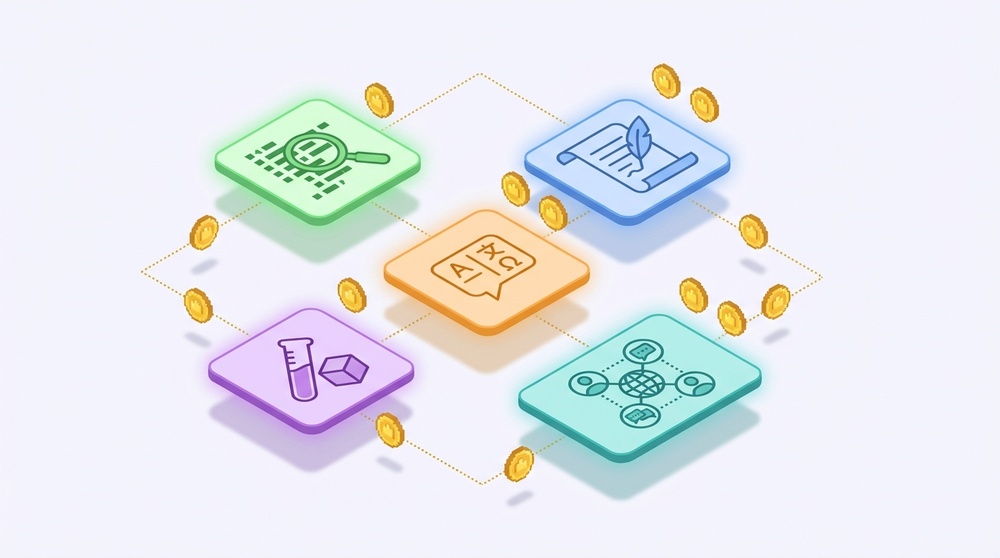













💡 Imagine this: Your ETH is working for you in multiple places at once—earning staking rewards, providing liquidity in DeFi, and accumulating points for future airdrops. All without buying more. This is the power of LST-Fi and LRT-Fi protocols. This is one of crypto's most underrated earning opportunities—read on to discover how accessible it truly is.
📋 Table of Contents
- What is LST and LST-Fi? Explained Simply
- LRT-Fi: The Next Level of Yield
- How It Works Under the Hood
- Key Platforms in the Ecosystem
- 5 Earning Strategies – From Simple to Advanced
- Risks and How to Manage Them
- Step-by-Step Starter Guide
- Strategy Comparison Table
- Why LST-Fi & LRT-Fi Matter Now
- Frequently Asked Questions
What is LST and LST-Fi? Explained Simply
Remember when staking Ethereum required locking up a minimum of 32 ETH—around $80,000—for months? This pain point gave rise to one of DeFi's key innovations: liquid staking.
The idea is brilliant in its elegance. You deposit any amount of ETH into a protocol and receive a tokenized receipt in return. This is the LST (Liquid Staking Token).
🔑 Simple Analogy: Imagine renting out an apartment through a property manager. You get a "rental income certificate" you can sell, borrow against, or use as collateral—all while still owning the property and collecting rent. LSTs work the same way. Your ETH is staked and working, while you hold a liquid, tradable token.
The most prominent LSTs today:
- stETH / wstETH — Lido Finance (largest, TVL >$20B)
- rETH — Rocket Pool (most decentralized)
- sfrxETH — Frax Finance (enhanced yield via dual-token model)
- cbETH — Coinbase (institutional option)
- osETH — StakeWise (non-custodial, flexible)
LST-Fi is the entire financial ecosystem built on top of these tokens. It's not just about holding stETH for ~4% APY. You can do much more:
🏦 Collateralized Lending
Use stETH or rETH as collateral on Aave, Morpho, or Spark to borrow stablecoins (USDC, DAI) without selling your ETH, while still earning staking rewards.
💹 Trading Future Yield
On protocols like Pendle Finance, split LSTs into Principal and Yield Tokens, unlocking new trading and yield strategies.
💧 Liquidity Provision
Provide LSTs in liquidity pools on Curve, Balancer, or Uniswap. Earn trading fees on top of staking rewards for dual income streams.

How ETH transforms into a multi-layered yield-generating asset via the LST-Fi ecosystem.
LRT-Fi: The Next Level of Yield
If LST is the ground floor, LRT-Fi is the penthouse. To understand the extra yield, you need to understand restaking.
In 2023, the EigenLayer team proposed a revolutionary idea: what if staked ETH could simultaneously secure not just Ethereum, but dozens of other protocols? This is restaking—reusing staked assets to secure additional networks.
Why Restaking is Revolutionary
Typically, new blockchain protocols spend years and millions building a validator network. EigenLayer lets them "rent" Ethereum's established, battle-tested security. Renting protocols pay rewards—and those rewards go to the restakers.
LRT (Liquid Restaking Token) is your receipt for restaking. Liquid Restaking Protocols take your ETH or stETH, restake it via EigenLayer, and issue an LRT token. Examples: eETH (ether.fi), rsETH (Kelp DAO), ezETH (Renzo), pufETH (Puffer Finance).
LRT-Fi is the ecosystem built on LRTs. The key difference? Potential yield is higher because assets generate multiple, independent income streams:
How It Works Under the Hood
Let's trace the full journey of your assets—critical to understand before investing.
The LST Strategy Path – 5 Steps
The LRT Path: An Extra Layer
Native Restaking (Direct)
Deposit ETH directly into EigenLayer. You earn EigenLayer points. Downside: locked ETH, no liquidity, no DeFi use.
Liquid Restaking via LRT ✅
Deposit ETH/stETH into an LRT protocol. It restakes via EigenLayer and issues an LRT token. You get liquidity + yield + points + DeFi options. The optimal choice.
What is an AVS? The Key to LRT-Fi
AVS (Actively Validated Services) are protocols that rent Ethereum's security via EigenLayer. Think oracles, cross-chain bridges, data layers. Each new AVS paying for security means more rewards for LRT holders.

How restaking works: one ETH securing multiple protocols.
Key Platforms in the Ecosystem
LST Protocols – The Foundation
| Protocol | LST Token | APY | TVL | Key Feature |
|---|---|---|---|---|
| Lido Finance | stETH / wstETH | ~3.5–4.5% | $20B+ | Largest, max liquidity, deep DeFi integration |
| Rocket Pool | rETH | ~3.2–4.2% | $3B+ | Most decentralized, permissionless node operators |
| Frax Finance | sfrxETH | ~4.5–5.5% | $500M+ | Enhanced yield via dual-token (frxETH + sfrxETH) |
| StakeWise | osETH | ~3.5–4% | $300M+ | Non-custodial, operator choice |
LRT Protocols – The Next Level
| Protocol | LRT Token | Base APY | Points | Key Feature |
|---|---|---|---|---|
| ether.fi | eETH / weETH | ~4–6% | Loyalty + EigenLayer | Largest LRT, already airdropped ETHFI |
| Kelp DAO | rsETH | ~4–7% | KEP + EigenLayer | Supports multiple LSTs (stETH, ETHx, sfrxETH) |
| Renzo Protocol | ezETH | ~4–6% | Renzo ezPoints + EigenLayer | Multichain: Arbitrum, Linea, BNB Chain |
| Puffer Finance | pufETH | ~4–5% | Puffer Points + EigenLayer | Anti-slashing tech for node operators |
LST-Fi / LRT-Fi Overlay – Where DeFi Magic Happens
📊 Pendle Finance
The central protocol. Splits any yield-bearing token into a Principal Token (PT) (fixed yield) and a Yield Token (YT) (rights to future yield). Unlocks unique strategies.
🏦 Morpho / Aave / Spark
Lending protocols that accept wstETH, rETH, weETH as collateral. Borrow stablecoins without selling your ETH, or create leveraged staking positions.
💧 Curve / Balancer
Specialized AMMs with stable pairs (stETH/ETH). Minimal impermanent loss. Earn trading fees + CRV/BAL rewards on top of staking yield.
🔄 Gearbox / DeFi Saver
Automation and leverage. Gearbox offers "credit accounts" for automated leveraged strategies. DeFi Saver monitors health factors and auto-rebalances near liquidation.
5 Earning Strategies: From Simple to Advanced
This is where it gets interesting. LST-Fi and LRT-Fi offer a spectrum of approaches for different risk profiles.
🟢 Strategy 1: Basic LST – "Set and Forget"
Profile: Minimal effort, steady passive income
The simplest entry. Convert ETH to stETH or wstETH and hold in your wallet. stETH rebases daily; wstETH appreciates. No further action needed. Ideal for long-term, low-risk exposure.
Path: ETH → Lido → receive stETH/wstETH → hold in wallet
Yield: 3.5–4.5% APY
Risk: Low (Lido smart contract risk, minimal de-peg risk)
For: Everyone, especially beginners.
🟡 Strategy 2: LST in Liquidity Pool – Dual Income
Add wstETH to a liquidity pool on Curve or Balancer. Earn on top of staking rewards:
- Trading fees from pool swaps
- Additional CRV/CVX rewards for liquidity providers
- Potential for boosted yields via veCRV
Total APY: 5–9% APY
Risk: Medium. Minimal impermanent loss for ETH/stETH pairs, but not zero.
For: Those comfortable with basic DeFi and willing to monitor positions.
🟡 Strategy 3: LRT + Pendle YT – Points Farming
💡 How Pendle YT Works: You buy the Yield Token (YT) for an asset like weETH. It's cheap but gives you rights to all future yield and points from that asset. Instead of 1x points with 1 weETH, you could get 10x points exposure for a fraction of the cost. This is a pre-TGE (token launch) strategy.
Yield: Mainly points for a potential airdrop. The YT itself depreciates; APY is negative.
Risk: High. Airdrop not guaranteed. Requires precise timing.
For: Those who understand Pendle and accept speculative risk.
🟡 Strategy 4: Pendle PT – Fixed High Yield
The opposite of YT. A Principal Token (PT) trades at a discount and grows to par at expiry, offering a fixed, predictable APY, often above market rates.
Example: PT-weETH expiring in 6 months at 0.95 weETH. You lock in ~10.5% APY fixed, regardless of market changes.
Yield: 8–15% APY (fixed, depends on asset/term)
Risk: Medium. Underlying LRT de-peg or Pendle contract risk.
For: Those wanting predictable, locked-in returns.
🔴 Strategy 5: Leverage Looping – Yield Amplification
For Experienced Users Only
Looping multiplies both yield and risk. A sharp de-peg or ETH drop can trigger liquidation. Use conservative LTV and auto-managers.
The core: use LST as collateral to borrow ETH, convert to more LST, re-collateralize, repeat.
Mechanics (2.5x leverage example):
- 1 ETH → Lido → 1 stETH (4% APY on 1 ETH)
- 1 stETH (collateral) → Aave → borrow 0.75 ETH
- 0.75 ETH → Lido → 0.75 stETH → collateral → borrow 0.56 ETH...
- Result: ~2.5 stETH exposure from 1 ETH initial capital.
- Yield: 4% × 2.5 = ~10% APY gross, minus ~1.5% borrowing cost = ~8.5% net APY.
Total APY: 8–20% APY, depending on leverage and rates.
Risk: High. Monitor health factor closely (keep >1.8 recommended).
For: Professionals with deep DeFi risk understanding.

Visualization of recursive leverage strategy with LSTs.
🔵 Bonus: The Combo Portfolio
A diversified approach for a $10,000 portfolio:
Sample Portfolio Structure
- 40% ($4,000) → weETH (ether.fi). Base position: ~4–6% APY + points.
- 25% ($2,500) → PT-weETH on Pendle. Fixed ~10–13% APY, predictable.
- 20% ($2,000) → YT-weETH on Pendle. Max points farming for potential airdrop.
- 15% ($1,500) → wstETH in Curve pool. Conservative, ~5–8% APY, low risk.
Estimated Total APY: 12–25% + potential airdrop.
Risks: The Honest Truth
Professional DeFi is about risk management first. Here are the key risks in LST/LRT-Fi:
Smart Contract Risk
Every protocol in your chain is a potential vulnerability. More protocols = higher aggregate risk. Mitigation: Use only well-audited protocols with bug bounties and insurance funds.
De-peg Risk
The price of stETH/weETH can deviate from ETH. In the 2022 "de-peg," stETH traded 5-7% below ETH. For leveraged positions, this can mean liquidation. Mitigation: Diversify LSTs/LRTs; monitor DEX prices.
Slashing Risk
Validators can be penalized (slashed). In LRT-Fi, one restaked ETH backs multiple services; slashing in one can affect your position. Mitigation: Choose protocols with anti-slashing insurance (e.g., Puffer) and diversified operators.
Liquidation Risk (Leverage)
In leveraged strategies, a sharp ETH drop or de-peg can trigger liquidation. Auto-liquidators act instantly. Mitigation: Maintain health factor >1.8, use auto-managers like DeFi Saver.
✅ Basic Risk Management Rules
1. Never invest more than you can afford to lose. DeFi carries unique risks.
2. Diversify across protocols. Don't keep all assets in one LST/LRT.
3. Start small to understand mechanics before scaling.
4. Monitor health factors on loans; keep >1.5 at minimum.
5. Use a hardware wallet for large positions—never keep large sums in a hot wallet.
6. Never build a strategy solely for an airdrop. Points are a bonus, not a guarantee.
Step-by-Step Starter Guide
Enough theory. Here's how to start, regardless of experience.
Step 1: Wallet Setup
- Install MetaMask or Rabby Wallet (Rabby shows transaction risks).
- Write down your seed phrase on paper. Never store it digitally.
- Add networks: Ethereum Mainnet (for large sums), Arbitrum/Base (for cheaper gas).
Step 2: Acquire ETH
- Buy ETH on a CEX, then withdraw to your wallet.
- Keep $50-100 in ETH for gas. Minimum recommended start: $500-1,000 on Mainnet, or $100-200 on L2s.
Step 3: Get LST (via Lido)
Step 4: Enter LST-Fi (Optional)
For your first foray, try Pendle PTs (fixed yield) or a Curve stETH pool. They're transparent and predictable.
Step 5: Choosing an LRT Protocol
When picking an LRT, evaluate:
- TVL & Audits: Larger, longer-audited protocols are generally safer.
- Points Realism: Is there a clear TGE roadmap? (e.g., ether.fi already airdropped).
- Multi-chain: Is the LRT available on L2s for cheaper gas?
- DeFi Integration: Is it accepted as collateral on Aave? Does it have a Pendle market?

A diversified DeFi portfolio with LST/LRT: multiple, independent income streams.
Strategy Comparison Table
| Strategy | Potential APY | Risk Level | Complexity | Min. Capital | Best For |
|---|---|---|---|---|---|
| Basic LST (stETH/wstETH) | 3.5–4.5% | Low | ★☆☆☆☆ | $50+ | Everyone (Start) |
| LST in Curve/Balancer | 5–9% | Low-Medium | ★★☆☆☆ | $200+ | Intermediate |
| Liquid Restaking (LRT) | 4–7% + Points | Medium | ★★☆☆☆ | $200+ | Intermediate |
| Pendle PT (Fixed APY) | 8–15% (Fixed) | Medium | ★★★☆☆ | $500+ | Advanced |
| Pendle YT (Points Farming) | Points → Airdrop | High | ★★★☆☆ | $300+ | Speculative |
| Leverage Loop (2-3x) | 8–20% | High | ★★★★☆ | $1,000+ | Professionals |
| Combo Portfolio | 12–25% + Airdrop | Medium-High | ★★★★★ | $3,000+ | Professionals |
Why LST-Fi & LRT-Fi Are More Than a Trend
This isn't a fleeting trend. It's a fundamental shift in how financial systems are built on Ethereum.
📈 Staking Growth is Inevitable
The share of staked ETH is on a steady climb. Liquid staking protocols hold over $30B TVL, proving resilience even in deep bear markets.
🔧 Technological Maturity
The Shapella upgrade enabled staking withdrawals, removing the "locked forever" risk. Top protocols have years of battle-tested, audited code.
🌐 L2 Expansion
wstETH, weETH, and others are now native on Arbitrum, Base, Scroll. This brings affordable gas and faster transactions to the ecosystem.
🏛️ Institutional Interest
Major funds and institutions are exploring LSTs as a regulated, yield-bearing entry point into DeFi, signaling a new wave of capital.
Ready to Earn with LST-Fi and LRT-Fi?
Explore current yields, compare protocols, and find a strategy that fits your profile. The liquid staking and restaking market operates 24/7—no holidays, no intermediaries.
Open Platform & StartFrequently Asked Questions
Disclaimer: This article is for educational purposes only and not financial, investment, or legal advice. Cryptocurrency and DeFi involve high risk, including total loss. Always conduct your own research (DYOR) and consult a professional. Past performance is no guarantee of future results.