













Imagine this: you're scanning the blockchain, spot a pattern no one else sees—and get paid for it. Or you help a new project test its product and get paid in tokens that 10x in value. Sound like a fantasy? This is the reality of on-chain analysis and bounty hunting—and thousands are earning from it daily, with zero upfront investment.

On-chain analytics and bounty hunting are two powerful Web3 earning tools.
📋 Table of Contents
What is On-Chain Analysis? Explained Simply
Imagine the blockchain as a giant, transparent wall. Every transaction, every token movement, every smart contract interaction is visible. On-chain analysis is the skill of reading this wall and drawing conclusions from it.
Unlike traditional finance, where data is hidden, the blockchain is public. You can see what the largest wallets are doing in real-time. Where are the "whales" moving funds? Which protocol just got a massive liquidity injection? What token are insiders accumulating weeks before a major listing?
Simple Analogy: An on-chain analyst is a detective, reading the public ledger to piece together the market's story. Their job is to find the signal in the noise before anyone else.
Why is this profitable? Information is money. Understanding fund flows before the market does gives you an edge. You can also sell your analysis: write reports, run paid channels, enter analyst competitions, or work directly for crypto projects.
What Does an On-Chain Analyst Study?
Whale Wallet Movements
Tracking transactions of major holders ("whales"). Their moves often precede major price movements.
Network Metrics
Active addresses, transaction volume, hash rate, fees—these metrics reveal the true health and demand for a network.
Exchange Flows
Large deposits to exchanges often signal selling pressure; large withdrawals suggest accumulation. A key indicator.
DeFi Metrics
Total Value Locked (TVL), liquidity pools, and protocol activity show where the smart money is flowing.
NFT & Token Distribution
How are tokens distributed? How many holders? This analysis reveals centralization and risk.
Smart Contract Activity
Growth in contract interactions signals a live project. A decline is a red flag. Analysis separates hype from reality.
Bounty Programs: What They Are & Why Projects Pay
Ever find a bug in an app and think, "I should get paid for this"? In crypto, you can. And it's not just for bugs.
A bounty program is when a crypto project offers rewards for completing specific, useful tasks. This could be finding a security flaw, writing an article, translating a document, testing a feature, or simply spreading the word on social media.
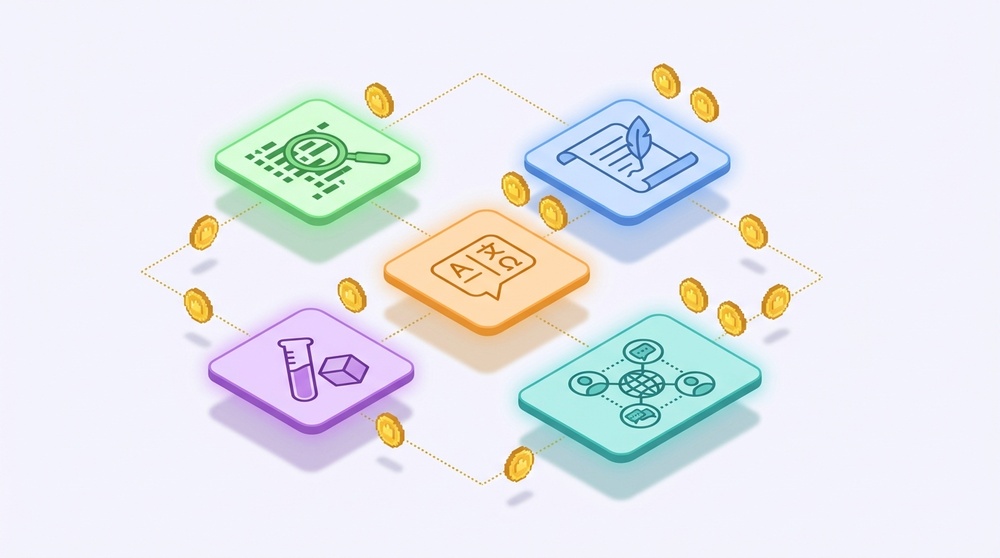
Bounty programs cover dozens of tasks—from technical to creative.
Why do projects do this? It's a win-win. It's cheaper and more effective to pay a community for real work than to hire agencies or large teams. Projects get work done; you get paid.
Why It Works
Blockchain projects, especially early-stage ones, desperately need organic growth, quality content, and rigorous testing. Bounty hunters fill this need and get paid in cash or tokens with high growth potential.
How to Earn with On-Chain Analysis
So you understand the data. How do you turn that into income?
1. Paid Newsletters & Channels
The direct path: build an audience and sell your insights. Many analysts run paid Telegram channels or Substack newsletters. Subscriptions can range from $20 to $200/month. With 500 paying subscribers, that's a significant income.
Key Insight
A paid channel requires time to build. Start with free, high-quality content to build trust and an audience, then monetize. It's not a get-rich-quick scheme, but it scales well.
2. Analytics Platform Competitions
Platforms like Dune Analytics host contests for analysts. Participants build dashboards and queries, with the best work earning cash prizes and recognition.
3. Working for Crypto Projects & DAOs
Many DAOs and crypto startups hire on-chain analysts for freelance or full-time roles. Tasks range from protocol monitoring to competitor analysis, paid in stablecoins or native tokens.
4. Protocol Grant Programs
Major protocols like Uniswap, Aave, and Optimism have grant programs. If you build a useful analytical tool or research for their ecosystem, you can receive grants from $5,000 to $50,000+.
5. Trading Based on Your Analysis
The most direct path: use your on-chain insights to make better trades. Spotting whale accumulation or major exchange outflows before the market reacts provides a real edge.
Ready to Start Practicing Now?
Sign up on a platform where you can work with real on-chain data, participate in bounty programs, and start earning from day one.
Start Earning Now →Bounty Types & Payouts
Bounty hunting isn't one thing—it's a spectrum. Here are the main types, with real reward ranges:
| Bounty Type | What You Do | Skill Level | Typical Reward |
|---|---|---|---|
| Bug Bounty | Find a vulnerability in a smart contract or app | High (coding skills) | $500 – $1,000,000+ |
| Testnet Hunting | Test a new protocol on a test network | Low-Medium | $50 – $5,000 in tokens |
| Content Bounty | Write articles, create videos, make posts | Low | $20 – $500 per piece |
| Translation/Localization | Translate docs, website, whitepaper | Low | $50 – $300 per project |
| Social Tasks | Follow, retweet, join Discord | Minimal | $1 – $30 in tokens |
| On-Chain Tasks | Make a swap, add liquidity, bridge assets | Medium | $20 – $2,000 in tokens |
| Analytics Bounty | Create dashboards, write reports | Medium-High | $100 – $10,000+ |
Pro Tip for Beginners: Start with testnet hunting and content bounties. They require minimal technical skill and are a great way to build a portfolio and reputation.
Testnet Hunting Explained
This is the most popular entry point. Projects launch test versions of their protocol and reward early users. You perform tasks on this test network and earn tokens upon the mainnet launch (a "retroactive airdrop").
The most famous example is Arbitrum. Active testnet participants received airdrops worth thousands of dollars. The cost? Only your time to test the product.

The testnet hunting process: from sign-up to reward.
Tools for On-Chain Analysis & Bounty Hunting
Every master needs their tools. Here's the essential kit—most have free tiers.
On-Chain Analysis Tools
Dune Analytics
Powerful platform for writing SQL queries against blockchain data. Build custom dashboards, track any metric. Free tier is great for starting.
Nansen
Professional tool with wallet labeling. See what "smart money" wallets are doing. Paid, but has a free demo.
Glassnode
Leader in on-chain metrics for Bitcoin and Ethereum. Publishes weekly reports; some data is free. Professional tier unlocks hundreds of metrics.
Etherscan / BscScan / Solscan
Free blockchain explorers. Study transactions, wallets, and smart contracts in detail. The "textbook" for any on-chain analyst.
DeFiLlama
Free aggregator for Total Value Locked (TVL) across all DeFi. Essential for seeing where capital is flowing.
Arkham Intelligence
Platform with wallet de-anonymization. Links addresses to real-world entities. Powerful for deep fund flow analysis.
Bounty Hunting Platforms
Earning Strategies: From Beginner to Pro
The path from novice to professional is a journey. Here's the roadmap.
Level 1: Beginner (First 1-2 Months)
First Steps:
- Set up a crypto wallet (MetaMask is the EVM standard).
- Master Etherscan: learn to read transactions and contracts.
- Complete 5-10 simple bounties on Galxe or Layer3.
- Participate in 2-3 active testnets.
- Follow top on-chain analysts on Twitter/X.
- Create a Dune Analytics account and study top dashboards.
Level 2: Intermediate (2-6 Months)
What to do:
- Learn basic SQL for Dune Analytics.
- Build your first custom dashboard.
- Systematically track 5-10 testnets at once.
- Enter analytics competitions.
- Publish your analysis on Twitter/Telegram to build an audience.
- Learn Solidity basics to understand smart contracts.
Level 3: Professional (6+ Months)
Professional Strategies:
- Submit a professional bug bounty report on Immunefi.
- Launch a paid analytics channel or newsletter.
- Apply for a grant from a major protocol (Uniswap, Optimism, Arbitrum).
- Offer your services as an analyst to a DAO or DeFi protocol.
- Build a custom on-chain monitoring tool.
- Participate in Web3 hackathons with an analytics project.
The "Testnet Portfolio" Strategy
One of the most effective approaches is to treat testnets like an investment portfolio. You don't know which project will have a major airdrop, so participate in 10-20 testnets simultaneously, spending minimal time on each.
Key Principle: Quality over quantity, but diversification is key to stability. It's better to do 50 meaningful actions across 10 projects than 500 mindless transactions in one.
Common Mistakes & How to Avoid Them
Most beginners lose time and money to the same pitfalls. Here's how to avoid them.
❌ Mistake 1: Farming Without Understanding
Spamming transactions without real interaction. Projects can spot "sybil" bot activity and will exclude you from airdrops.
✅ The Right Way:
Use the product like a real user. Test features, give feedback, join discussions. Quality interaction beats volume.
❌ Mistake 2: One Wallet for Everything
Using one address for all activities is risky. If compromised, you lose everything. It also makes tracking messy.
✅ The Right Way:
Use separate wallets for different projects and activities. Use a hardware wallet for significant holdings.
❌ Mistake 3: Ignoring Security
Signing random transactions, granting unlimited token approvals, storing seed phrases online.
✅ The Right Way:
Always read what you sign. Use revoke.cash to manage token approvals. Store seed phrases offline, on paper.
❌ Mistake 4: Chasing Hype
Jumping into every new project promising "million-dollar airdrops." Many are scams or have no real value.
✅ The Right Way:
Evaluate the project: Is there a real product? Who's backing it? On-chain analysis can separate the real from the hype.
❌ Mistake 5: Not Taking Profits
Holding airdropped tokens hoping for 100x. Many crash 70-90% after listing.
✅ The Right Way:
Sell at least a portion of your airdrop to secure profit. Let the rest ride for potential long-term gains.
Step-by-Step: Your First 30 Days
Theory is good, but action is better. Here's a concrete 30-day plan.
📅 Weeks 1-2: The Foundation
- Day 1: Install MetaMask, create a wallet, write down your seed phrase on paper.
- Days 2-3: Learn Etherscan. Find 5 transactions and understand what happened.
- Days 4-5: Sign up on Galxe and Layer3. Complete 3-5 simple tasks.
- Days 6-7: Create a Dune Analytics account. Study 3 popular dashboards.
- Days 8-10: Find 2-3 active testnets (check Twitter, Discord).
- Days 11-14: Start participating in those testnets. Document everything.
📅 Weeks 3-4: First Results
- Days 15-17: Complete 1-2 content bounties (article, video, thread).
- Days 18-20: Learn basic SQL (Mode Analytics, Khan Academy).
- Days 21-23: Build your first simple Dune dashboard.
- Days 24-26: Find a low-barrier Bug Bounty on Immunefi. Study the rules.
- Days 27-30: Review: How many testnets? Bounties completed? What worked?

A professional on-chain analyst uses multiple tools simultaneously.
How to Spot a Good Bounty or Testnet
Realistic Earning Potential
Beginner, 2-3 hours/day. Simple bounties, social tasks, basic testnets.
Intermediate, 4-5 hours/day. Analytics, multiple testnets, content.
Professional. Paid channels, grants, DAO work, major bug bounties.
Major airdrop or critical bug bounty. Rare, but possible with the right find.
Ready to Earn with On-Chain Analysis & Bounties?
Join the platform where thousands are already earning through Web3 activities. Bounty programs, testnets, analytics contests—all in one place.
FAQ: Frequently Asked Questions
Do I need technical skills to start?
Not to start. Social tasks, content bounties, and most testnets require no coding. Technical skills become crucial for bug bounties and advanced analytics.
Do I need money to start?
Minimally. Some testnets require a tiny amount for gas on the mainnet ($5-20). Most testnets use free test tokens. Many bounties require no money at all.
Is this legal?
Yes. Participating in bounty programs and analyzing public data is legal. Always report earnings according to your local tax laws.
How much time is required?
It scales. For basic earnings, 1-2 hours/day. For serious income, 4-6 hours. Many tasks can be batched or automated.
How do I find active bounties?
Follow project Twitter/Discord, use aggregators (Galxe, Layer3, Immunefi), and follow analysts who share opportunities.
How long for payouts?
Social tasks: instant. Testnets: weeks/months (until mainnet). Bug bounties: 1-4 weeks after verification.
The Bottom Line: Why This is a Smart Choice
In a world of get-rich-quick schemes, on-chain analysis and bounty hunting offer something better: a skill. A skill that grows with you, opens doors, and earns regardless of market cycles.
You can start today, with no capital, by simply learning the tools. In a month, you'll have experience. In three months, a portfolio. In a year, a new career path.
Disclaimer: This article is for educational purposes only and is not financial advice. Participation in bounty programs and on-chain activities carries risks, including technical risks and token volatility. Always Do Your Own Research (DYOR) before participating in any project.