













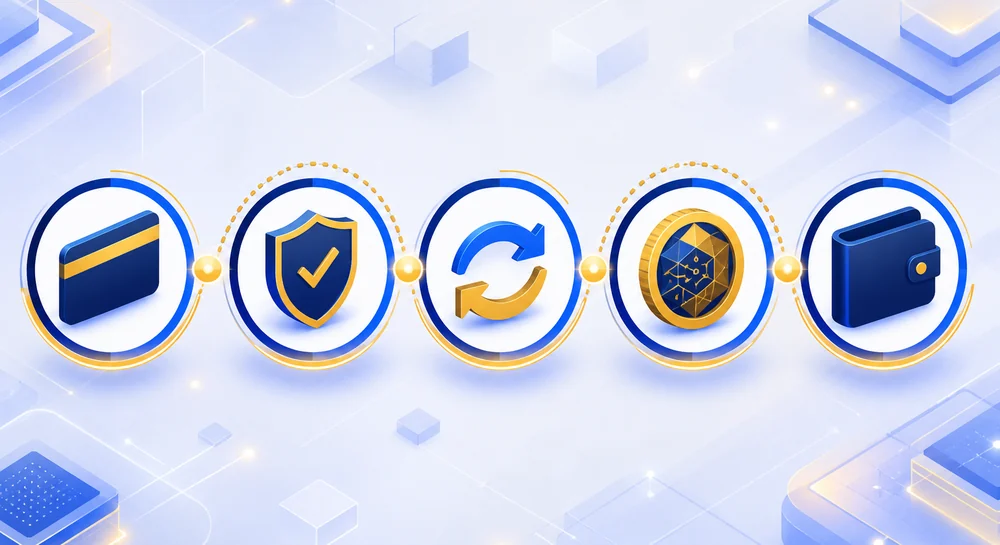
To buy your first cryptocurrency, you need three things: an exchange or swap service, a payment method (card, bank transfer, or P2P), and a place to store the coins you buy — a wallet. After that, the process comes down to a sequence of steps: registration, identity verification, funding your balance, making the purchase, and, optionally, transferring the coins from the exchange to your own wallet.
What you need to buy your first cryptocurrency
Three essential elements are required: an account on an exchange or swap service, a way to deposit funds (bank card, transfer, or a P2P transaction with another person), and a wallet where you can withdraw the coins after purchasing them. Everything else depends on the specific platform.
Let’s look at each element in more detail. An exchange is a platform where cryptocurrency buyers and sellers meet; it also usually provides a built-in wallet for storing purchased coins directly on the platform. This is convenient for getting started, but it is not suitable for long-term storage of large amounts — more on this in the section about wallets. The payment method depends on your country and the exchange: some platforms support direct card linking, others only accept bank transfers using account details, while others offer P2P, meaning a direct purchase from another user through an escrow intermediary. The storage location is either the same exchange wallet or a separate app or device that does not depend on the exchange.
The general sequence of actions is almost the same on any platform:
In practice, the entire process from registration to the first purchase takes anywhere from 20 minutes to several hours if verification is completed automatically. If the exchange reviews documents manually, the wait may take 1–2 days. It is worth allowing enough time in advance rather than starting the process an hour before you need the money for something else.
It is important to understand the difference between buying on an exchange and buying through P2P or a swap service: an exchange charges a trading fee and requires full verification, a swap service may be faster but usually offers a less favorable rate, while P2P lets you negotiate directly with the seller but requires careful attention to the counterparty’s reputation. Each option is covered in the relevant sections below.
You should also decide on the amount separately: for your first purchase, it is reasonable to limit yourself to an amount you could comfortably afford to lose — this is not an investment strategy, but a way to understand how the process works without unnecessary stress. See the section “How much is reasonable to invest in your first purchase” for more information.

How to choose an exchange for buying cryptocurrency
For a beginner, a large centralized exchange with a license or official registration in your jurisdiction, support for rubles or another local currency, and a clear mobile app is a suitable choice. The selection can then be narrowed down based on specific criteria: fees, payment methods, and liquidity for the coins you need.
Reputation is the first thing to consider. The exchange should have a multi-year operating history, public reporting on trading volumes, and openly available user reviews, including complaints on forums and social media — not only on the exchange’s own website. Guaranteed high returns, a lack of information about the legal entity, and a requirement to deposit money before registering an account should all be warning signs.
Regional availability is the second filter. Not all exchanges operate in every country: some restrict access at regulators’ request, while others withdraw from markets with a high level of legal risk. Before registering, check whether the exchange officially supports your country rather than relying on a VPN — bypassing geographic restrictions may result in your account being blocked along with the funds held in it.
Payment methods determine how quickly you can buy your first cryptocurrency. Some platforms accept bank cards directly, others only accept transfers using account details, and others specialize in P2P transactions. If your bank restricts transfers related to cryptocurrency, it is worth finding this out in advance rather than after a failed payment.
| Criterion | Centralized exchange | P2P platform | Swap service |
|---|---|---|---|
| Verification | Mandatory, full | Usually simplified | Often not required |
| Transaction speed | Instant (order) | 15 minutes to one hour | Several minutes |
| Rate | Market-based, transparent | Negotiated, may vary | Often worse than the market rate |
| Fees | 0.1–0.5% per transaction | Usually lower, but includes a spread | Built into the rate |
| Storage after purchase | Built-in wallet | Your own wallet is required | Usually direct withdrawal |
Fees consist of several parts: depositing funds (sometimes 0, sometimes 1–3% when paying by card), the transaction itself (usually 0.1–0.5% on major exchanges), and withdrawing coins to an external wallet (a fixed amount depending on the network). Exchanges should be compared by the total of these three fees, not just one of them — otherwise, it is easy to fall for a “free” purchase with an expensive withdrawal.
Liquidity affects the price at which your order will actually be executed. On major exchanges with high trading volumes, the purchase price is as close as possible to the market price, while on small platforms with low liquidity, the price may differ significantly from the one shown by rate aggregators, especially for less popular coins.
A centralized exchange (CEX) is an intermediary company that holds users’ funds in its own accounts and executes trades through its own order book. An alternative is decentralized exchanges (DEXs), where trades take place directly between wallets via smart contracts, without an intermediary or identity verification. DEXs are not suitable for a first cryptocurrency purchase with fiat currency: you cannot deposit rubles or dollars directly, only cryptocurrency you have already bought.
The final guideline for beginners: choose an exchange with a track record of several years, official support for your country and currency, a transparent fee structure on a dedicated page of its website, and a mobile app with a clear purchase interface. Exotic platforms offering maximum returns or minimum fees are best left for later, once you have enough experience to distinguish a genuine offer from marketing.
How to complete verification (KYC) on an exchange
Identity verification (KYC — know your customer) is required because crypto exchanges operate as financial institutions and are legally required to verify their customers’ identities to prevent money laundering and fraud. Without it, most major exchanges will not let you deposit or withdraw funds.
The process usually consists of several steps: uploading a photo of an identity document (passport, driver’s license, or ID card), taking a selfie or short video to match your face with the document, and sometimes confirming your residential address with a utility bill or bank statement. Verification levels are often divided into tiers: the basic level allows low purchase and withdrawal limits, while the full level removes most restrictions.
The speed depends on whether the exchange uses automated document recognition. On major platforms with a well-established system, verification takes from a couple of minutes to half an hour: the algorithm checks the document photo, selfie, and data from public databases. If the system is not confident in the result or the data does not match, the application is sent to a human moderator, and the process then takes one to three business days.
Common reason for rejection
Verification most often fails because of glare or cropped corners in the document photo, mismatched names in different application fields, or an attempt to verify using someone else’s or an expired document. Applications are also rejected if the selfie quality is too low for the algorithm to confidently match the face.
If verification does not pass the first time, check several things: whether the document photo was taken in good lighting without glare or shadows, whether all four corners and the full text are visible, whether the spelling of your name in Latin characters matches the registration form, and whether the document has expired. After making corrections, most exchanges allow you to try again without a limit on the number of attempts, but if rejections continue, contact support and attach screenshots of the error — this often speeds up manual review.
How to pass verification the first time
Photograph the document on a flat surface in daylight, without its cover or other objects in the frame. Take the selfie without glasses or headwear and with a neutral expression. Enter your name exactly as it appears in your international passport if the exchange is international.
If an exchange rejects the document several times in a row without a clear reason and support does not provide a substantive response, consider another platform — it is not always the user’s fault; sometimes a particular exchange’s verification system handles documents from a specific country poorly.
Which wallet is needed for storing cryptocurrency
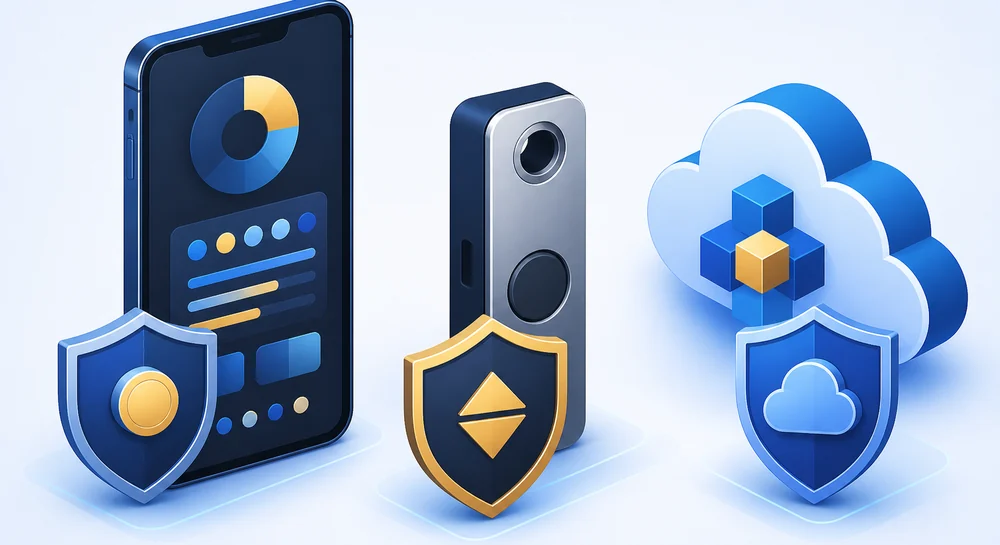
For a first purchase, the exchange’s built-in wallet is sufficient, but for an amount you would not be willing to lose if the platform were hacked, you need a separate wallet — hot (an app or browser extension) or cold (a separate device). The difference between them is where the private key is stored and whether it is connected to the internet.
Storing funds on an exchange means that the platform formally controls the coins: it holds the private keys, while your account only displays the balance. This is convenient — no setup is required, and the coins are immediately ready for sale or exchange. But if the exchange is hacked, blocked at a regulator’s request, or goes bankrupt, access to the coins may be lost — the history of cryptocurrency includes dozens of such cases involving major platforms.
A hot wallet is an app on a phone, a browser extension, or a computer program that stores the private key locally on your device, while the device itself is connected to the internet. It is convenient for everyday operations: transfers, payments, and interacting with DeFi services. The risk is that malware on the device or a phishing website could potentially gain access to the key.
A cold wallet is a separate physical device (a hardware wallet) or a sheet of paper with a seed phrase written on it, neither of which is directly connected to the internet. The private key never leaves the device, even when a transaction is confirmed — this makes cold storage practically immune to remote hacking. The downside is that it is less convenient for frequent operations and requires careful physical storage of the device itself.
| Parameter | Storage on an exchange | Hot wallet | Cold wallet |
|---|---|---|---|
| Who holds the private key | The exchange | You, on an online device | You, on an offline device |
| Risk of remote hacking | High (depends on the exchange) | Medium | Minimal |
| Convenience for frequent transactions | High | High | Low |
| Cost | Free | Free | From 4,000 to 15,000 rubles per device |
| Suitable for | Small amounts and active trading | Daily transfers and DeFi | Long-term storage of large amounts |
A seed phrase is a sequence of 12 or 24 ordinary words from which a wallet’s private key is mathematically generated. Essentially, it is a backup of access to all your coins: whoever has the seed phrase has full control over the funds, regardless of who physically holds the device. A private key is the technical representation of the same access as a long string of characters; the seed phrase was created to make it easier for people to remember or write it down without errors.
The main rule for storing a seed phrase
You must not photograph your seed phrase or store it in your phone’s notes, cloud storage, email, or messenger, and especially must not enter it on websites or dictate it to anyone, including “support.” Anyone who learns your seed phrase gains full and irreversible access to your coins—this cannot be restored or revoked.
A separate wallet is needed from the outset for two reasons. First, it allows you to withdraw your coins from an exchange immediately if something happens to it—you will not have to set up a wallet in a panic while the platform is already unavailable. Second, using a wallet from your very first small purchase is a skill that is easier to learn with an amount whose loss would be manageable than to figure it out for the first time when dealing with a large sum.

How to buy cryptocurrency with rubles or dollars: a step-by-step guide
The sequence is nearly the same on any exchange: add rubles or dollars to your balance, choose a trading pair (for example, USDT/RUB or BTC/USD), specify the amount and order type, and confirm the transaction. The entire process on a verified account takes 5 to 15 minutes.
How to add funds to your exchange balance
You can add funds to your balance using a bank card, a bank transfer, or the exchange’s own P2P section, if available. In the “Deposit” or “Add funds” section, select the currency (rubles, dollars, or a stablecoin such as USDT), specify the amount and method, and then follow the platform’s instructions—usually, this means going to a payment page or viewing the bank details for the transfer.
Card deposits are credited almost instantly, while a bank transfer can take anywhere from a few minutes to one business day, depending on the bank and amount. Large amounts may sometimes require additional verification by the sending bank, which may ask questions about the purpose of the transfer—this is normal compliance practice, not a sign of a problem.
How to choose a trading pair and place an order
A trading pair shows what you are exchanging for what: for example, the BTC/RUB pair means buying Bitcoin with rubles. On exchanges with a large selection of coins, the easiest way to find the pair you need is through the search bar in the trading section rather than by scrolling through the full list.
Next, choose the order type. A market order is executed instantly at the best currently available price—it is suitable when speed matters more than an exact price. A limit order is executed only when the market reaches the price you specify—it is suitable if you are willing to wait for a better rate, but there is no guarantee that the order will be executed at all.
How to confirm the transaction and check the result
After you click the buy button, the exchange displays a final window with the total amount, fee, and number of coins you will receive—this is the last step before the funds are charged. On most platforms, confirmation requires an additional security step: an SMS code, a push notification in the app, or a code from an authenticator app.
The coins you buy appear in your exchange balance almost immediately after a market order is executed. A limit order may remain “active” until the price reaches the specified level—you can cancel it at any time if the market moves in a direction you did not expect.
A stablecoin is a cryptocurrency whose price is pegged to a fiat currency, most often the US dollar (for example, USDT or USDC). Many beginners first buy a stablecoin with rubles and then exchange it for Bitcoin or another coin within the exchange—this is often cheaper in terms of fees than buying an uncommon coin directly with rubles.
If an order is not executed for a long time or a transaction remains in processing longer than usual, do not immediately try again—first check its status in the transaction history and, if it is unclear, contact support with the order number to avoid duplicating the payment.
What is a P2P purchase and how does it differ from an exchange purchase?
A P2P purchase is a transaction directly with another person who sells cryptocurrency for rubles or another currency, while the platform acts only as an escrow intermediary, holding the seller’s coins until payment is confirmed. Unlike a regular exchange purchase, the price and payment terms are set by the seller rather than by the exchange’s order book.
The mechanics are simple: the buyer chooses a seller’s listing with a suitable rate, amount, and payment method (bank transfer, card, sometimes cash), clicks “buy,” and the platform then locks the seller’s cryptocurrency for the duration of the transaction. The buyer transfers the money directly to the seller using the specified method and clicks “paid.” The seller confirms receipt of the money, and only then does the platform automatically transfer the locked coins to the buyer. If the seller does not confirm the payment on time, the buyer can open a dispute, and the platform’s support service gets involved in the conflict.
P2P is more convenient than a regular purchase in several cases: when the exchange does not support the required payment method directly, when a bank blocks direct transfers related to cryptocurrency while a P2P payment appears as an ordinary transfer between individuals, or when a more flexible rate is needed—some sellers offer rates below the market price to close the deal faster.
More payment methods, a flexible rate, availability where direct card purchases are not possible, and money sent directly to an individual rather than through the exchange’s banking gateway.
Takes longer, carries the risk of encountering an unscrupulous counterparty, and requires careful attention to transfer details and correspondence with the seller.
Escrow is a mechanism in which the seller’s coins are locked by the platform for the entire duration of the transaction and cannot be withdrawn unilaterally. This protects the buyer from a situation where the money has been transferred but the seller refuses to release the coins: if the payment has been confirmed with documentary evidence and the seller does not transfer the cryptocurrency, the platform’s support team has the right to force the transaction to be completed in the buyer’s favor.
What to look for when choosing a counterparty
Choose sellers with a high rate of completed transactions (usually 95–98% or higher) and a large number of completed trades, rather than focusing only on an attractive rate. Be wary of sellers with no history, requests to pay before confirmation through the platform, requests to transfer money to a third party’s card, or requests to put something unrelated to the actual reason for the transfer in the payment comment.
Another P2P security rule is to transfer money strictly from a card or account issued in your name, and never agree to transfers through third parties, even if the seller explains this as a technical necessity: such schemes are often used for money laundering, and the buyer will later have to deal with the bank that blocked the card for a suspicious transaction.
How much does it cost to buy cryptocurrency: fees and hidden expenses
The real cost of a purchase consists of three or four fees at once: for funding the balance, for the transaction itself, for withdrawing to an external wallet, and for the spread between the buying and selling prices. Each may seem negligible on its own, but together they can consume 3–7% of the amount of the first purchase.
The balance funding fee is the least noticeable and often the largest. Paying by card usually costs 1–3% of the amount, a bank transfer is more often free or costs a small fixed amount, while funding through P2P is formally free, but the seller’s rate may be 1–2% worse than the exchange rate.
The trading fee is the charge an exchange applies for executing an order, usually 0.1–0.5% of the amount on major platforms. Limit orders are often cheaper than market orders because exchanges incentivize users to add liquidity rather than take it immediately.
The withdrawal fee is a fixed amount in the coins of the selected network, rather than a percentage of the amount. That is why withdrawing a small amount can be disproportionately expensive: if the network fee is a fixed few dollars and you withdraw 20 dollars in cryptocurrency, the percentage loss will be enormous.
The spread is the difference between the price at which you can buy a coin and the price at which you can immediately sell the same coin. On liquid exchanges with high trading volumes, the spread is minimal and almost unnoticeable; on small platforms or in P2P listings, it can reach 1–3%, effectively becoming a hidden fee that is not shown as a separate line item.
| Fee type | Typical amount | How it appears |
|---|---|---|
| Card funding fee | 1–3% | Deducted immediately when the money is deposited |
| Bank transfer fee | 0% or a fixed amount | Often free, but slower |
| Trading fee (market order) | 0,1–0,5% | Deducted from the purchase amount |
| Trading fee (limit order) | 0,05–0,3% | Usually lower than for a market order |
| Wallet withdrawal fee | A fixed amount in the network’s coins | Does not depend on the transfer amount |
| P2P spread | 0,5–3% | Built into the seller’s rate and not listed separately |
A common mistake when comparing exchanges
Comparing platforms only by the percentage trading fee is a sure way to overpay: an exchange with the lowest trading fee may charge 3% for card funding or a high fixed withdrawal fee, making the total purchase cost higher than that of a competitor with a higher trading fee but free deposits and withdrawals.
To avoid overpaying, add up all fees applicable to your specific scenario: the funding method you will actually use, the order type you usually place, and the network through which you plan to withdraw the coins. Many exchanges publish a complete fee table on a separate page, so you should check it before your first transaction rather than rely on general marketing claims such as “low fees.”
It is also worth checking whether the exchange charges a hidden fee through an unfavorable conversion rate when funding in a currency different from the one specified in the trading pair. This sometimes happens when funding in rubles followed by automatic conversion into dollars within the platform—the conversion rate may differ from the official rate by 1–2%.
How much is it reasonable to invest in your first purchase
For a first purchase, it is reasonable to invest an amount whose complete loss you could withstand without serious consequences for your budget—usually an amount comparable to an inexpensive entertainment expense or subscription, rather than a salary or savings. The goal of the first purchase is to understand the mechanics, not to make money.
The minimum purchase amounts on most major exchanges are symbolic: you can often buy cryptocurrency for as little as 100–500 rubles or the equivalent of a few dollars. There are almost no technical lower limits, so you should set your own limit based on common sense rather than the platform minimum.
You should not invest borrowed money or your last funds for one simple reason: cryptocurrency is a volatile asset whose price can fall by 20–50% within a matter of days without warning. If the money was needed for rent, loan payments, or food, a price drop becomes not an abstract paper loss but a real problem that must be dealt with immediately, often by selling at the very bottom of the decline.
A sign that the amount was chosen incorrectly
If the thought of a 30% price drop causes panic or makes you want to check the price constantly, the amount chosen for your first purchase is too large. The right size for a first purchase is one you can calmly watch, even if it temporarily loses half its value.
A practical approach for beginners is to start with an amount that allows you to complete the entire cycle: making a purchase, transferring the funds to your own wallet, and possibly selling them back — and only then, after understanding the mechanics and assessing your reaction to price fluctuations, gradually increase the amount invested if the decision is conscious rather than emotional.
How to transfer purchased cryptocurrency from an exchange to your wallet
The transfer consists of four steps: copy the recipient address from your wallet, select exactly the same network in the exchange interface as the one used by the wallet, enter the amount, and confirm the withdrawal with a security code. For the first transfer, it is best to send a small test amount first rather than the entire balance at once.
How to choose the right network for a transfer
You need to choose the same network that your wallet address is configured for — for example, USDT can be transferred over the TRC-20, ERC-20, or BEP-20 networks, which are different technical networks with different fees and address formats, even though the coin is formally the same.
If the exchange interface does not clearly specify the network next to the address field during withdrawal, check the wallet settings or documentation before sending rather than guessing. Choosing the wrong network is the most common reason coins are lost during a first transfer made independently.
How to paste the recipient address without errors
Copy the address in full from the wallet app using the “copy” button rather than typing it out manually — crypto addresses consist of 26–42 or more characters, and a single typo makes the address either invalid or, worse, valid but belonging to someone else.
How long does it take to confirm a transfer
Confirmation depends on the load of the selected network and usually takes from a few minutes to an hour. The Bitcoin network typically requires 10–60 minutes for several block confirmations, networks such as TRON or BNB Chain confirm transfers within seconds to minutes, while Ethereum takes from one to several minutes during periods of normal activity and longer when the network is congested.
Why a test transfer is necessary
Sending a small amount first, for example, 5–10% of the total, costs one additional fee but fully protects you from losing the entire amount if there is an error in the address, network, or wallet settings. Once you have confirmed that the test amount has arrived, you can safely send the remainder along the same route.
If a transfer does not arrive within the usual confirmation time for the selected network, do not panic or resend it immediately — first check the transaction status using its hash in a public blockchain explorer, such as Etherscan for Ethereum or Blockchair for Bitcoin. It will show whether the transaction is stuck in the network queue or has already been confirmed but has not yet appeared in the wallet.
What can go wrong during your first purchase and how to avoid mistakes
Beginners most often lose money not because of a price decline but because of their own technical mistakes: transferring funds over the wrong network, using phishing websites, losing their seed phrase, buying emotionally, and trusting unverified exchangers. All these scenarios are predictable and can be easily prevented with simple checks before each step.
What happens if you send coins over the wrong network
In most cases, coins sent over a network unsupported by the recipient are lost permanently — the blockchain executes the transaction as valid, but the recipient’s wallet simply will not display the coins because it does not work with that network. Sometimes the coins can be recovered through the recipient exchange’s support service for a separate high fee, but this is never guaranteed.
How to identify a phishing exchange or wallet website
Phishing websites copy the interface of a genuine exchange almost exactly and differ only in their domain name — often by one or two letters or through a different domain extension. Access the exchange only through an address saved in your bookmarks after an initial manual check, not through links in emails, search ads, or messages in messengers, even if the sender appears to be official support.
| Error | Consequence | How to avoid it |
|---|---|---|
| Transfer over the wrong network | Coins are most often lost permanently | Check the network on the exchange and in the wallet before withdrawing |
| Following a phishing link | Theft of the password or account access | Log in only through a link saved in your bookmarks |
| Storing the seed phrase in the cloud | Complete loss of control over the wallet | Store it offline only, on paper or metal |
| Buying during a sharp price increase | Buying at the peak before a price pullback | Do not make decisions under the influence of hype |
| Exchanging through an unverified website | The money was transferred, but the coins were not received | Check reviews and the service's history in advance |
Why you should not buy cryptocurrency in a panic or during a hype cycle
A decision to buy made under the influence of a sharp price increase in the news or on social media is statistically more likely to be made near a local price peak — this is exactly when cryptocurrency is discussed the most, and exactly when a correction usually follows the hype. It is more sensible to decide on a purchase in advance and calmly, rather than when the price has already risen by 20–30% in a day.
How people lose money on unverified exchanges
Small exchange websites with no track record or reviews sometimes take the money for a transfer and simply do not send the cryptocurrency, citing a “technical issue” or “security review.” Such a website can be identified by the absence of independent reviews outside the site itself, the lack of official legal-entity contact details, and a requirement to pay the full amount before receiving any confirmation of the transaction.
What happens if you lose your seed phrase
If the seed phrase is lost and access to the wallet device or app is also unavailable (the phone is broken, the password is forgotten, or the app has been deleted), access to the coins cannot be restored either through wallet support or through the blockchain — no central authority that can issue a “new password” exists in a decentralized system. That is why you should write down the seed phrase by hand on paper in two copies and store them in different secure places, rather than rely on your memory or a single copy.
The minimum set of security habits
Check the website address before entering your password, enable two-factor authentication through an app rather than SMS alone, never enter your seed phrase on third-party websites, make a test transfer before a large one, and be suspicious of any offer to “double” your cryptocurrency or any “support agent” who messages you first in private.
Most of the mistakes listed above have one thing in common: they happen because of haste. The extra 5–10 minutes spent checking the address, website domain, or counterparty's reputation are almost never critical to a transaction, but they are what separates a trouble-free first purchase from a story about lost money.
How to check that a purchase and transfer were successful
A purchase on an exchange is confirmed by a changed balance in the wallet or portfolio section immediately after the order is executed, while a transfer to an external wallet is confirmed by the coins appearing in the wallet's incoming transactions and the transaction status showing “confirmed” in a public blockchain explorer.
Where to view transaction confirmation on an exchange
After a purchase, open the “Order History” or “Transaction History” section in your exchange account — it shows the status of each transaction: executed, canceled, or pending. An executed transaction shows the exact amount charged in the payment currency and the exact amount of coins received, including the fee.
How to check a transaction in a blockchain explorer
To check a transfer to a wallet, take the transaction hash (the unique identifier shown by the exchange or wallet after sending) and paste it into the search bar of a public explorer for the relevant network — for example, Etherscan for Ethereum and ERC-20 tokens, Blockchair or Blockstream for Bitcoin, and Tronscan for the TRON network.
The “confirmed” status means that the transaction has been included in a block and becomes theoretically harder to reverse with each subsequent block — in practice, after several confirmations, a transaction is considered final and irreversible. The “pending” status means that the transaction is still in the network's queue and awaiting inclusion in a block — this is normal and usually takes anywhere from seconds to an hour, depending on the network and its congestion.
If the transaction hash shows a “confirmed” status in the explorer but the coins are still not visible in the wallet interface, the problem is usually not with the transaction itself but with the wallet app failing to refresh the displayed balance — manually refresh the page or restart the app before assuming that the transfer did not arrive.
Do you have to pay taxes on cryptocurrency purchases
Purchasing cryptocurrency with fiat money does not usually create an immediate tax liability by itself — tax generally arises not at the time of purchase but at the time of a sale or exchange resulting in a positive difference between the purchase and sale prices. Rules vary by country, so you should check the specific rates and deadlines under the laws of your jurisdiction.
The general principle in most countries with developed regulation is that cryptocurrency is treated as property or an asset rather than currency. This means that the obligation to report income and pay tax usually arises when income is received — when coins are sold for more than their purchase price, one cryptocurrency is exchanged for another at a profit, goods or services are paid for with cryptocurrency at a rate higher than its acquisition price, and sometimes when staking or mining rewards are received.
Simply holding purchased cryptocurrency in a wallet, without selling or exchanging it, does not create a taxable event in most jurisdictions — an increase in the asset's value on paper is not taxed until the profit is realized, meaning the coins are sold or exchanged.
It is worth keeping a record of transactions from the very beginning for a simple reason: calculating taxable profit requires knowing the exact date and price of each purchase in order to correctly calculate the difference upon a subsequent sale. If one transaction is missed now, reconstructing the exact historical prices and amounts a year or two later will be significantly more difficult — especially if several exchanges or wallets were used.
Some exchanges provide built-in transaction reports or integration with specialized crypto tax calculation services that automatically calculate profit and loss for all transactions over a given period — this significantly simplifies reporting compared with manually calculating it from statements covering several years.
What to Do After Your First Purchase
After your first purchase, the logical next steps are to transfer the coins to a separate wallet for secure storage, start learning how the market works by devoting only a small, non-critical amount of attention to it, and deliberately avoid making any further decisions under the influence of emotions until new information has been calmly verified.
How to Set Up Backup Storage After a Purchase
If the purchase amount exceeds what you can afford to keep on an exchange, you should transfer the coins to a separate wallet, as described in the section on transfers, and immediately write down the seed phrase on paper in two copies stored in different places — for example, at home and with a trusted person or in a bank safe-deposit box. Backup storage is worth setting up once and correctly rather than putting it off until later.
Is It Worth Studying the Market Before the Next Purchase
Yes, with one caveat: studying the market should mean understanding how specific projects work, why a token is needed, and who uses it, rather than trying to predict price movements from charts. A beginner will benefit more from spending time understanding the difference between Bitcoin, Ethereum, and stablecoins than from studying candlestick technical analysis, which requires years of experience to produce consistent results.
Do You Need to Diversify Your Investments Immediately
Diversification — distributing money among several different assets instead of a single coin — reduces the risk that the failure of one specific project will wipe out all your investments, but it is not the top priority for a first purchase. It is more reasonable to first become comfortable with one or two well-known coins and expand your portfolio only when the mechanics of buying, storing, and transferring them are already clear in practice, not just in theory.
The Main Pitfall After a First Successful Trade
A rapid price increase immediately after a purchase often prompts people to sharply increase their investment or start trading frequently in pursuit of repeated success. This is a common mistake: a single successful result does not validate a strategy, and impulsive decisions based on one trade are statistically more likely to lead to losses than to repeated success.
Avoiding impulsive decisions is the most underrated habit among beginners. Before buying more, panic-selling during a downturn, or changing your entire strategy because of a single social media post, it is worth pausing for at least 24 hours and reconsidering the decision with a clear head. The cryptocurrency market operates around the clock and will not disappear during that time, whereas ill-considered decisions made in a matter of minutes often stay with a person for much longer.
A Sensible Plan for the First Few Months
Set up your wallet and backup storage, keep a simple record of your trades, learn about one new concept at a time — whether staking, DeFi, or smart contracts — and do not increase your investment until you have gone through at least one full cycle of price growth and decline without significant emotional stress.
Frequently Asked Questions About Buying Your First Cryptocurrency
Can You Buy Cryptocurrency Without Identity Verification
On large licensed exchanges, generally not: verification is mandatory for depositing and withdrawing funds. It is possible to make a small transaction completely without verification on some P2P platforms or through exchangers, but this option carries greater risks and is usually unavailable for large amounts.
What Is the Minimum Age for Buying Cryptocurrency
Practically all legal exchanges require users to be at least 18 years old, since identity verification involves an adult citizen’s passport and entering into an agreement with the platform, which is legally impossible for minors on most services.
Can You Buy Cryptocurrency Without a Bank Card
Yes, you can fund your balance by bank transfer using the provided details, through a P2P transaction with another person, or with electronic payment systems if the exchange supports them. Not having a card does not prevent you from buying — it simply limits the available payment methods.
What Happens to Your Money If an Exchange Closes or Is Blocked
If an exchange officially ceases operations, it usually gives clients a period to withdraw their funds — from several weeks to a couple of months. If the exchange is hacked or urgently blocked without warning, access to the coins stored there may be partially or completely lost — which is why you should not keep large amounts on an exchange balance any longer than necessary for a transaction.
Can You Cancel or Return Cryptocurrency After Buying It If You Change Your Mind
You can effectively reverse a purchase on an exchange by immediately selling the same coin, but the price may already have changed, and the price difference plus two fees will make the operation not free. An order that has already been executed cannot be canceled — you can only make a new, reverse transaction.
Do You Have to Buy a Whole Bitcoin or Another Cryptocurrency Immediately
No, almost all cryptocurrencies can be divided into very small fractions — for example, you can buy bitcoin in an amount equal to one hundred-thousandth or an even smaller fraction of a coin. You do not need to buy a whole coin, and for the vast majority of beginners it is impractical: the purchase amount is determined by your budget, not by the number of whole units.