













Cryptocurrency is money that exists only as entries in a shared database, and no one owns that database. There is no bank, company, or government that could shut it down, rewrite it, or block your account in it. It sounds strange, so let’s go through it step by step, without jargon.

In two sentences
Imagine a notebook that records who has how much money. Usually, there is only one such notebook, kept at a bank: the bank maintains it, the bank decides which entries are valid, and the bank can refuse to process your transfer.
Cryptocurrency works differently: a copy of the notebook is held simultaneously by tens of thousands of computers around the world. When you send money, the entry is added to all the copies at once, and from that moment it cannot be erased or forged—because doing so would require rewriting tens of thousands of copies simultaneously, while those copies constantly check one another.
The key difference in one sentence
In the banking system, you entrust your money to an organization on the strength of its word. With cryptocurrency, you do not need to trust anyone: the rules are written into the software and are the same for all participants, including its creators.
Where it came from
The idea of money without a bank was discussed by programmers for decades, and it always came up against one problem: how to stop someone from spending the same digital coin twice. An ordinary file can be copied endlessly, but money must not be copyable. Without centralized record-keeping, there was no solution.
In 2008, an author writing under the pseudonym Satoshi Nakamoto published a description of a system that solved this problem with a shared chain of blocks and a competition for the right to extend it. The network went live in early 2009. The author’s identity remains unknown to this day, and, strangely enough, that is part of how the system works: the project has no owner who could be forced to change something.
In its early years, cryptocurrency was a toy for enthusiasts. There is a well-known case of someone paying ten thousand bitcoins for two pizzas in 2010—at the time, they were worth next to nothing. The story is remembered not to mock the exchange rate, but as a reminder: something that looks useless today can sometimes become the beginning of an industry, while something that looks like an obvious success may not be. No one managed to predict this in advance.
Then networks emerged where not only transfers but also programs could be recorded on the chain. This changed the industry more profoundly than price growth, and almost everything you hear about today grew out of it: decentralized exchanges, loans without a bank, and digital items.
How cryptocurrency differs from money on a bank card
Money on a bank card is also entries in a database, not banknotes in a safe. In that sense, it is already “electronic.” The difference is not in the form, but in who controls the database and what that means for you.
| Property | Money in a bank | Cryptocurrency |
|---|---|---|
| Who maintains the records | One bank | Thousands of independent computers |
| Can the account be blocked | Yes, by decision of the bank or a court | No, access is available only to the key owner |
| Does it work at night and on weekends | International transfers—not always | Around the clock, including holidays |
| Can a transfer be reversed | Sometimes, through the bank | No, never |
| Who is responsible for safeguarding the funds | The bank; deposit insurance is available | You; there is no insurance |
| What is needed to open an account | Passport, agreement, and sometimes the bank’s refusal | Five minutes and an app, no documents |
Please note: this table has no “better” column. Every row works both ways. The inability to block an account is freedom, but also a lack of protection. The inability to reverse a transfer is reliable settlement, but also your personal responsibility for every typo in the address.
This is important to understand before your first purchase
There is no customer support service in cryptocurrency that can return your money. If you sent coins to the wrong address, lost access to your wallet, or handed your key to a scammer, there is nowhere to turn. Not because no one wants to help you, but because technically no one has the ability to do so.
How it works without a bank
The technology that everything rests on is called blockchain—literally, a “chain of blocks.” The name describes its structure exactly.
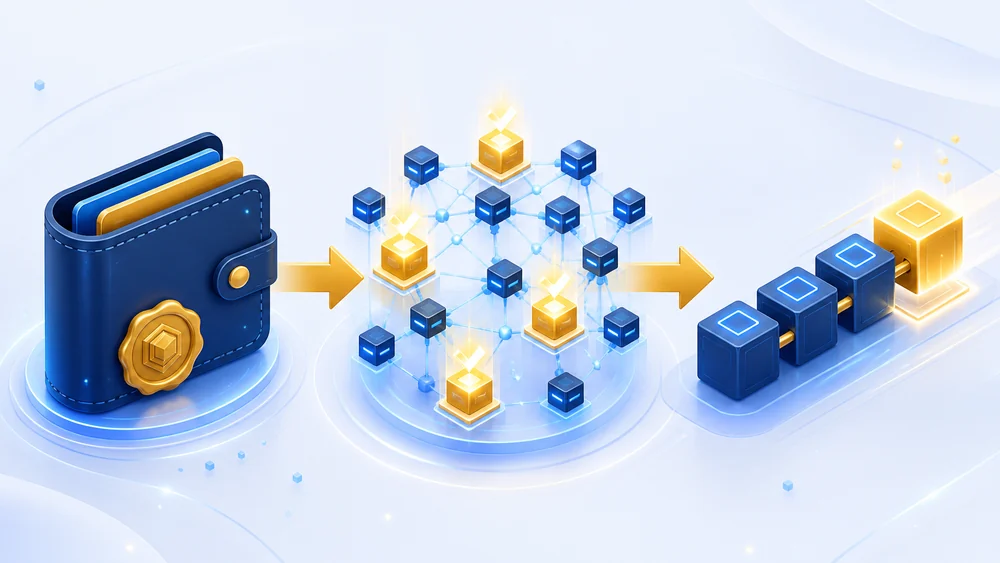
Step One: The Transaction
You tell the app: “Send 0.1 coins to this address.” The app signs this message with your private key—much like a signature on a document confirms that the document came from you. The difference is that, unlike a signature on paper, a cryptographic signature cannot be forged.
Step Two: Verification
The signed message spreads across the network. Every computer checks two things: that the signature is really yours and that your address really contains those funds. No other checks are performed—the network is not interested in whom you are paying or why.
Step Three: The Block
Verified transactions are assembled into a block—a batch of several thousand records. The block is closed and attached to the previous one. Each new block contains a “fingerprint” of the previous block, so an old record cannot be changed: the entire chain after it would break, and the network would notice immediately.
Why It Is Reliable
To forge a single record in Bitcoin, you would have to recalculate every block after it faster than the entire rest of the network combined. The cost of such an attack is measured in billions of dollars and requires more electricity than some countries consume. It is easier to earn honestly.
What Nodes Are and Why There Are So Many of Them
A computer that stores a complete copy of the chain and verifies other people’s transactions is called a node. Anyone can run a node on an ordinary computer—it requires no permission and is not licensed by anyone. That is precisely why the network cannot be switched off: there is no office, server, or master switch. If any part of the nodes goes offline, the others simply will not notice.
Nodes do not trust one another. Each one rechecks everything independently, according to the same rules for everyone, written into the software. If a node tries to accept an invalid transaction—for example, spending money that does not exist—the other nodes will reject its block, and the work will have been wasted.
What Consensus Is
The main task of a network without a central authority is to agree on which version of history is valid when two blocks appear almost simultaneously. The mechanism the network uses to resolve this is called consensus. The rule is simple: the valid chain is the longest one, with the greatest amount of work invested in it. The shorter branch is discarded, and its transactions return to the queue.
This leads to a practical consequence everyone encounters: after you send a transfer, it first appears as “unconfirmed” and then accumulates confirmations. One confirmation means the transaction has been included in a block. Several mean that subsequent blocks have been built on top of it, making it virtually impossible to reverse. Exchanges usually wait for three to six confirmations before crediting the funds—not out of spite, but for precisely this reason.
What Happens When You Click “Send”
Let’s go through one transfer second by second to dispel the sense of magic:
- The app assembles the transaction: from which address, to which address, how much, and what fee.
- The private key signs it directly on your device. The key is never sent anywhere—only the signature is sent.
- The transaction spreads across the network within seconds and enters the shared queue of pending transactions.
- Whoever assembles the next block takes transactions from the queue, prioritizing those with higher fees. That is why, in a congested network, a low-fee transfer can wait for hours.
- The block is closed and distributed to all nodes. Each one verifies it independently.
- The recipient sees the incoming funds. From this point on, they cannot be reversed in any way.
Why You Need to Know This
Understanding this chain of events answers most beginners’ questions: why a transfer is “stuck” (the fee is too low, so it is waiting in the queue), why an exchange does not credit it immediately (it is waiting for confirmations), and why you cannot “call and cancel” it (there is no one and nothing to physically cancel it).
Where Coins Come From
No one prints new coins—they appear as a reward for those who support the network. There are two methods, and they are fundamentally different.
Mining
Computers solve a computational problem; the winner assembles the next block and receives a reward. This is how Bitcoin works. It requires a lot of electricity—and that is the point: an attack becomes more expensive than useful work.
Staking
The right to assemble a block goes to whoever has locked their own coins in the network. An attempt to cheat results in their loss. This is how Ethereum works. It uses almost no electricity.
For most cryptocurrencies, the number of coins is limited by the software. Bitcoin has a cap of 21 million, and it cannot be increased: doing so would require the consent of an overwhelming majority of network participants, who would have nothing to gain from such a decision. That is why cryptocurrency is often compared to gold rather than ordinary money, which a central bank can print in unlimited quantities.
The Wallet and the Master Secret
The word “wallet” is misleading here. Coins do not sit in a wallet—they are recorded in a shared database. A wallet stores the key that proves the records belong to you.
A wallet has two parts:
- Address — a long string such as
bc1qxy2k.... You can and should give it to others: it is like an account number, and it is where they send you money. - Private Key — the secret that signs transfers. Whoever knows the key controls the money. Always, without exception.
In practice, you almost never see the private key directly. Instead, the app shows you a seed phrase — 12 or 24 ordinary words in a specific order. This phrase restores the entire wallet on any device, in any country.
Your seed phrase is your money
- Write it down on paper and put it somewhere you keep important documents.
- Do not photograph it or save it in your phone’s notes: phones break, get lost, and become infected with malware.
- Never send it to anyone. Genuine support for any service will never ask for it — only scammers do.
- Do not enter it on any website. A seed phrase should only be entered into the wallet app itself, and only when restoring the wallet.
Where to store it: four options and their cost
The question “where should I keep my coins?” actually means “who holds the key?” This determines both convenience and what happens if the platform is hacked or you make a mistake.
| Option | Who holds the key | When it is suitable | Main risk |
|---|---|---|---|
| Exchange account | The exchange | While you are trading or exchanging | Platform bankruptcy or account freeze |
| Phone app | You | Small amounts for everyday use | Malware, losing your phone, phishing |
| Browser extension | You | Working with services and applications | Fake websites and malicious extensions |
| Hardware wallet | You; the key is offline | Long-term savings | Losing the device without the seed phrase |
Hot and cold: what is the difference?
A wallet is called hot when its key is stored on an internet-connected device: an app, extension, or website. A cold wallet is one where the key never physically comes into contact with the network: a separate flash-drive-sized device that signs transactions internally and outputs only the completed signature.
The practice almost everyone eventually adopts is this: a hot wallet is like cash in your pocket, holding an amount you can afford to lose; a cold wallet is like a safe, holding most of your funds. A hardware wallet costs money, so it is usually purchased when your savings exceed its price by several dozen times.
Buy a hardware wallet only from the manufacturer
Devices with someone else’s seed phrase already recorded can be found on online marketplaces: the buyer transfers money to the wallet, and it disappears immediately. A genuine wallet always generates the phrase itself, in your presence, when it is first turned on. If a phrase is included in an envelope, the device has been compromised.
How to buy your first cryptocurrency
There are several ways, and they differ less in price than in how well they protect you.
Through an exchange
The most common route. Registration, identity verification with a document, funding your account, and making a purchase. The exchange rate is fair and close to the market rate, and the fee is small. The downside: the platform knows everything about you, and until you withdraw the coins to your own wallet, you do not truly own them.
Through an exchanger
Faster and sometimes without paperwork, but the exchange rate is noticeably worse, and the quality of exchange services varies. Reputation is especially important here: before your first transaction, look for reviews and start with a small amount.
Directly from another person
A so-called P2P transaction: you transfer money to the seller through a regular payment, and they send you cryptocurrency. Platforms for such transactions hold the seller’s coins in escrow until payment is confirmed — without this protection, the transaction becomes a lottery.
A process that saves you stress
- Start with a small amount — go through the entire process and see what everything looks like.
- Then withdraw to your own wallet — make sure the coins are actually yours.
- Only then move on to amounts that are significant to you.
How many cryptocurrencies exist
There are tens of thousands, and the vast majority are not worth your attention. It is easier to make sense of them by dividing them into groups based on their purpose.
| Group | What it is for | Examples |
|---|---|---|
| Digital gold | Preserve value over the long term and protect against inflation | Bitcoin |
| Platforms | Run programs and other coins on top of the network | Ethereum, Solana, TON |
| Stablecoins | Hold money on a crypto network without exchange-rate fluctuations | USDT, USDC |
| Utility tokens | Pay fees and receive discounts within a specific service | Exchange tokens |
| Everything else | Most often, nothing except hopes of growth | Thousands of names |
Stablecoins deserve a separate explanation because they surprise newcomers. They are cryptocurrencies whose exchange rate is pegged to the dollar: one USDT is always worth approximately one dollar. They let you use the benefits of a crypto network — fast transfers anywhere, around the clock, without a bank — without being exposed to exchange-rate fluctuations. Today, stablecoins account for most cryptocurrency transfers.
Bitcoin and Ethereum: two different ideas
These two names appear more often than any others, and they are constantly confused. The difference is not that “one is better than the other,” but that they serve different purposes.
Bitcoin
Designed as money and a store of value. It does one thing: reliably transfer coins. Its supply is limited, and its rules are changed extremely reluctantly — that is where its value lies.
Comparison: digital gold. You do not expect gold to perform functions; you expect it not to deteriorate.
Ethereum
Designed as a platform. Programs run on top of the network, which is why it hosts decentralized exchanges, lending services, digital items, and thousands of tokens.
Comparison: an operating system on which applications are installed.
What is a smart contract
It is a program that lives directly on the network and executes identically for all participants. The condition is written in advance, and no one, including its author, can interfere with how it runs.
A real-life example: swapping one coin for another without an exchange. You send one coin to a contract, and it returns another according to a predefined formula. There is no company between you—instead, there is code that anyone can inspect.
The downside
An error in a smart contract is just as irreversible as a transfer. If there is a vulnerability in the code, the money is gone, and there is no one to “roll back the update.” Major losses in the industry are more often caused by errors in contracts than by hacking the network itself.
What you can actually do with cryptocurrency
Let’s set advertising aside and look at what cryptocurrency is used for in practice.
Transfer money between countries
This is where it works best. A transfer arrives within minutes, costs a fixed amount regardless of the payment size, and does not depend on the bank’s business hours. Sending one thousand dollars and one million costs roughly the same—the same is not true of bank transfers.
Keep savings outside the banking system
You and only you have access to the money, from any country, with a single seed phrase. The downside: if you lose the phrase, the money disappears forever, and no one can recover it.
Invest for the long term
People buy cryptocurrency expecting it to grow over the years. This is a sensible strategy under one condition: invest only as much as you are prepared to lose in full. The price regularly falls by 50–80%, and this is not an anomaly but normal behavior for this market.
Earn interest
Staking and lending generate returns, but every percentage point of profit comes with risk: from a platform hack to a fall in the price of the coin itself. Promises of “20% a month with no risk” are always a scam, without a single exception.

Why there are so many networks and how they differ
Beginners are surprised that the same stablecoin can be sent “via Ethereum,” “via TRON,” or “via TON.” These are not different coins—they are different roads along which the same record travels.
Every network balances three properties: speed, low cost, and decentralization. No one has yet managed to improve all three at once, so each network chooses what to sacrifice.
| Network | Strength | What you pay for it | Where it fits |
|---|---|---|---|
| Bitcoin | Maximum reliability and a long track record | Slow, expensive under heavy load, and capable of doing little beyond transfers | Large sums, long-term storage |
| Ethereum | A huge ecosystem of applications and services | Fees rise during periods of high activity | Working with applications and tokens |
| Fast next-generation networks | Seconds and negligible fees | Fewer independent participants and a shorter track record | Frequent small transfers |
The most common way beginners lose money
The sender selected one network while the recipient was expecting another. The coins go to an address that belongs to no one on that network, and recovering them is usually impossible. Before every transfer, confirm the network with the recipient—it is one line in the interface, and it matters more than the amount.
Why “second layers” are needed
To avoid sacrificing the reliability of the main network, overlays were created: transactions are processed quickly and cheaply “on top,” while only the final result is recorded on the main chain. For the user, this looks like an ordinary wallet with very low fees. There is a trade-off as well—the money is held in the overlay, and withdrawing it to the main network takes time.
Three paths people take into crypto
It is useful to understand which one you are taking: it determines what you actually need to learn.
A practical task
You need to receive a payment from abroad or send money to relatives. Such a person does not need courses or trading — a stablecoin, a single wallet, and an understanding of fees are enough. This is the shortest and safest route.
Savings
A person wants to keep part of their savings outside the banking system. Only two topics matter here: how to store keys securely and how not to buy everything at the peak. Speed and trendy projects are irrelevant.
Earnings
The most popular and riskiest entry point. Here, you will have to study the subject seriously — and it is still worth starting with the first two points: without understanding storage and fees, any profit can easily turn into a loss.
Most beginners make the mistake of starting with the third path and skipping the first two. The result is someone who knows how to open trades but does not know how to store keys — and sooner or later loses everything not in the market, but through carelessness.
How much a transfer costs and how quickly it goes through
The fee is paid not to a bank, but to the network — to those who process transactions. The amount depends on the network and its current load, not on the transfer amount.
Specific fee figures are deliberately not provided here: they can change severalfold over the course of a week. The wallet app always shows the fee before sending — look at it rather than at articles on the internet. The general rule is: the more congested the network, the more expensive the transfer, and the more attractive next-generation networks become.
Practical advice
The same stablecoin usually exists on several networks at once. When transferring USDT, you choose the network — and the difference in fees between them can be a hundredfold. Important: the sender and recipient must choose the same network, or the funds will be lost.
Where cryptocurrency is used every day
In the news, cryptocurrency is about charts and fortunes. In everyday life, it more often solves mundane tasks, and those are precisely what explain why the technology has not disappeared in fifteen years.
Paying remote employees
The company is in one country, the developer in another. A bank transfer takes several days, loses a percentage to conversion, and sometimes gets returned without explanation. A stablecoin transfer arrives within minutes and costs a small fixed fee. For freelancers, this has long been routine.
Countries with high inflation
Where local currency loses tens of percent of its value each year, people move their savings into stablecoins simply because buying dollars through a bank is difficult or impossible. This is not an investment or speculation — it is an attempt to preserve what they have earned.
Sending money to relatives
The classic scenario: someone works abroad and sends money home. Traditional systems charge a noticeable percentage and require a visit to a branch. Cryptocurrency eliminates both, but requires the recipient to know how to use it — and that is the main obstacle.
Supporting creators and projects
Traditional payment systems handle small cross-border amounts poorly: the fee defeats the purpose. Here, a transfer of a couple of dollars remains a transfer of a couple of dollars.
All these cases have one thing in common: cryptocurrency succeeds where the traditional financial system is slow, expensive, or unavailable altogether. Where a bank does the job, cryptocurrency is unnecessary — and that is fine.
Security hygiene: nine rules
Most cryptocurrency losses are not caused by a network hack, but by the owner's carelessness. These rules cover almost all common cases.
The three-second check
Before every transaction, ask yourself one question: “Am I being rushed right now?” If the answer is “yes,” stop and reread what is happening. Urgency is a common element of nearly all scams because a thinking person can recognize them.
The main risks that advertising keeps quiet
An honest discussion of risks is not fearmongering. Every risk listed here is real, and each one happens to people regularly.
The price falls—and sharply
A 50% price drop over several months is a routine event. Cryptocurrency is not suitable for money you will need within the next year—for housing, medical treatment, or your children’s education.
There is no way to undo a mistake
Send funds to the wrong address or choose the wrong network, and the money is gone forever. That is why the first transfer to a new address is always made for a small amount; only after confirming it has arrived should you send the rest.
Scammers operate at scale
Cryptocurrency is an ideal environment for fraud: transfers are irreversible, and victims often have little understanding of what is happening. The most common schemes include “support” asking for a seed phrase, a fake exchange website with an address differing by one letter, an “investment project” promising guaranteed returns, and a messaging-app acquaintance who leads you to a “profitable platform” a week later.
Psychology does more harm than the market
There is one risk that is rarely discussed: your own reactions. The market operates around the clock, the price is visible on your phone at any second, and this creates a constant temptation to do something. People buy when everything is rising and they feel they are missing out, and sell when everything is falling and they fear it will get worse. In the end, they buy high and sell low—exactly the opposite of what they intended.
A simple measure works: make the decision in advance and write it down. How much you will invest, for how long, and under what conditions you will exit. Once the decision is written down, any price movement is already part of the planned scenario, not a reason to panic at three in the morning.
The platform may disappear
While your coins are on an exchange, they belong to the exchange, not to you: it holds the key. The industry’s history includes several major bankruptcies after which customers received nothing. Hence the rule: keep amounts you would hate to lose in your own wallet.
Not your keys, not your coins—the industry’s best-known saying, and it did not appear out of nowhere.
First-month mistakes
Most beginners repeat these mistakes, and they cost real money. The good news is that each one can be prevented by a single habit.
Keeping everything on an exchange
It seems convenient: everything is in one app, and you cannot lose anything. But the platform holds the key, and its problems automatically become your problems. The habit to adopt: withdraw amounts you would hate to lose to your own wallet immediately after buying.
Sending the entire amount to a new address at once
One mix-up over the network or a typo, and the money is gone. The habit to adopt: make the first transfer to any new address as small as possible, even if it costs an extra fee.
Storing the seed phrase on your phone
Notes, the gallery, the cloud, a message to “yourself”—all of these are accessible to malware and anyone who gets hold of your phone. The habit to adopt: paper and a place where you keep your important documents.
Buying on emotion
A coin has risen 40% in a day, and it seems you need to get in quickly. Usually, the rise has already happened by that point—and you are buying from people who are exiting. The habit to adopt: make the decision in advance and with a clear head, not in reaction to the news.
Following links from messages
Fake exchange and wallet websites differ by one letter in the address and look perfect. The habit to adopt: access them only through a bookmark you created yourself, and never through a link from a chat or email.
Investing borrowed money or money you need
A loan, money set aside for medical treatment, rent money—categorically no. The price may fall by half and remain low for years. The habit to adopt: invest only an amount whose loss would not change your life.
How to read the figures shown everywhere
On any price-tracking website, you will see several figures. Understanding what they mean protects you from manipulation.
| Metric | What it means | What it tells you |
|---|---|---|
| Price | How much one coin costs right now | Almost meaningless on its own: what matters is not the price, but its change and the volume |
| Market capitalization | The price multiplied by the number of coins in circulation | The project's size. A coin costing a kopek with a huge supply is not “cheap” |
| Trading volume | How much was traded over 24 hours | How easy it is to buy and sell. With low volume, you may not find a buyer |
| Bitcoin dominance | What share of the total market it accounts for | Where the money is moving: into safer or riskier assets |
The cheap-price trap
“The coin costs less than a cent; if it rises to a dollar, I’ll make a hundred times my money” is a typical mistake. If a trillion such coins have been issued, a rise to one dollar would imply a market capitalization larger than the entire global economy. Look at market capitalization, not the price of a single coin.
Five misconceptions that hold beginners back
“Cryptocurrency is completely anonymous”
Quite the opposite: every Bitcoin transfer is visible to anyone who wants to see it, forever. Only the address is anonymous — until it is linked to your name. Exchanges require identification documents, and after that the link is established.
“It’s too late, everything has already risen”
People have been saying this since 2013. It does not mean the rise will continue — it means that no one can predict where the price will move, including the authors of confident forecasts.
“You need a lot of money”
Coins can be divided into very small units. Bitcoin, for example, can be divided into one hundred million units. You can start with the cost of a meal, and for a first introduction, that is more sensible than starting with a large amount.
“It’s complicated; I won’t understand it”
Buying and transferring cryptocurrency is no more difficult than using a banking app. What seems difficult is not the action itself, but the terminology surrounding it.
“The government will ban it, and everything will disappear”
Regulation does vary from country to country and affects how conveniently cryptocurrency can be exchanged for fiat money. But the network itself cannot be switched off: it has no central point that can be shut down.

How to tell a real project from a hollow one
Of the tens of thousands of coins, the overwhelming majority solve no real problem. A check takes fifteen minutes and saves you far more time and money.
A rule worth remembering verbatim
The more insistently you are promised returns and the more pressure you are put under, the more likely it is that you are talking to a scammer. A genuine opportunity does not disappear in two hours.
Glossary: terms you will encounter on your very first day
Most of the difficulties beginners face are not about the substance, but about unfamiliar words. Here are the ones you cannot do without.
Blockchain
A shared record database arranged in linked blocks. The past cannot be changed.
Transaction
A single transfer operation. Once included in a block, it becomes irreversible.
Address
A string to which coins are sent. Safe to show others.
Private key
A secret that gives you the right to control the funds. Never show it to anyone.
Seed phrase
12 or 24 words used to restore the entire wallet.
Network fee
A fee for processing a transfer. It depends on network congestion, not the amount.
Confirmation
A block added to the chain on top of your transaction. The more confirmations there are, the more reliable it is.
Stablecoin
A coin whose exchange rate is pegged to the dollar. Used for holding and payments.
Token
A coin issued on top of another network rather than having its own.
Exchange
A trading platform. While the coins are there, the keys belong to it, not to you.
Volatility
The range of price fluctuations. It is very high for cryptocurrencies.
Cold storage
A key kept on a device without internet access. A way to store your savings.
Frequently asked questions
Can I lose everything?
Yes, in three ways: the price falls, you lose access to your wallet, or you are scammed. The first risk is reduced by investing only money you can afford to lose. The second, by keeping a paper copy of your seed phrase. The third, by making a habit of not rushing and never sending anything to anyone.
What happens if I forget my seed phrase?
The funds will remain on the network forever, but no one, including you, will be able to access them. There is no recovery process—this is not a flaw, but a consequence of the same design that prevents outsiders from getting to your coins.
Do I have to buy a whole coin?
No. Coins can be divided into very small fractions, and buying “half a bitcoin” or “one hundredth” is entirely normal. Focus on the amount in rubles or dollars, not the number of coins.
Do I need to pay taxes?
The rules depend on the country and change over time. The general principle is almost the same everywhere: income from a sale is considered income and must be declared. For a precise answer, consult your local laws or an accountant — an online article is no substitute for professional advice here.
Is cryptocurrency legal?
In most countries, owning cryptocurrency is legal, while using it for payments is regulated differently from one country to another. Check your country’s rules: they change more often than articles are updated.
What to expect — and not expect — from cryptocurrency
There are plenty of promises in both directions: some say it will replace money, while others call it a bubble about to burst. The reasonable position lies somewhere in the middle, and it is less exciting than either extreme.
What you can expect
- Borderless transfers. This works today, reliably and predictably. No future tense needed: you can send money to another country in minutes, right now.
- Holding funds outside the banking system. Access with a single phrase, from anywhere in the world, without anyone’s permission. This is already a reality too.
- Transparency. Anyone can verify any transfer on a public network. This is a valuable feature for charities and public budgets.
What you should not expect
- Replacing ordinary money in shops. For now, people do not pay for bread with cryptocurrency, and they are unlikely to start anytime soon: this requires a stable exchange rate, and there is none.
- Guaranteed growth. Past growth promises nothing. People who bought at the peak in 2021 waited years for prices to return to their previous levels.
- An easy life without responsibility. The freedom to manage your money also means taking full responsibility for it. Many people find banks more convenient — and that is a perfectly normal choice.
How to approach the topic sensibly
Cryptocurrency is a tool, like online banking or email: useful where it solves a problem and useless where it does not. People who come for the tool are more likely to be satisfied than those who come looking to get rich quickly.
Where to start: a short plan
If, after everything you have read, you want to give it a try, here is a safe order of actions. It is designed for your first week and does not require an investment you would later regret.
The main thing to remember
Cryptocurrency is a tool, not a way to get rich. It solves two problems particularly well: sending money anywhere without an intermediary and holding it so that only you have access. Everything else — including price growth — is guaranteed by no one, ever.
And here is the last thing worth saying plainly. Cryptocurrency does not require you to become an expert. For most people, it is enough to understand three things: coins exist in a shared ledger, not in an app; the seed phrase gives access to them, and losing it means losing the money; and a completed transfer cannot be reversed. Everything else consists of details that you can learn gradually as needed, without rushing and without relying on other people’s advice.
The next logical step is to understand how Bitcoin works specifically, how it differs from other coins, and how to choose your first wallet without falling for a fake. Both topics are covered in neighboring articles in this section.
This material is for educational purposes only and is not investment advice. Cryptocurrency transactions involve the risk of losing your entire investment.