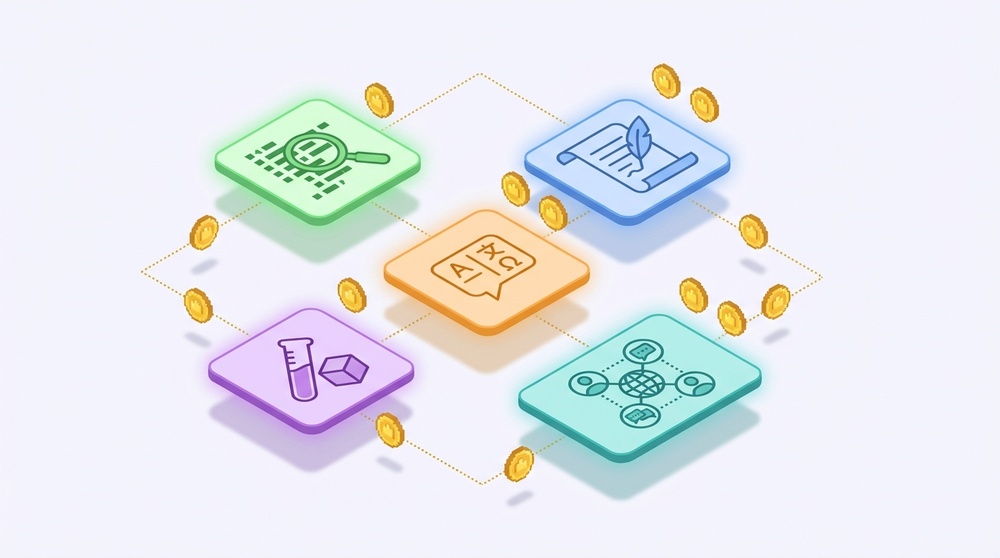












Imagine earning cryptocurrency while you sleep. Your router, hard drive, or GPU works silently in the background. No traditional mining rigs, no 24/7 chart monitoring. Just plug in your device and let it work for you. This is DePIN — one of the fastest-growing sectors in Web3 that most people haven't discovered yet.
Table of Contents
- What is DePIN — Simple Explanation
- How It Works: Internal Mechanics
- Types of DePIN Projects and How to Earn
- Top DePIN Projects: Detailed Breakdown
- Realistic Earnings Potential
- How to Start: Step-by-Step Guide
- Required Equipment
- Risks and Mitigation Strategies
- Taxes and Legal Considerations
- Frequently Asked Questions (FAQ)
What is DePIN — Simple Explanation
Remember when Uber and Airbnb emerged? They didn't build hotels or buy cars — they created platforms letting ordinary people monetize existing assets. DePIN operates on the same logic, but in the Web3 and physical infrastructure space.
DePIN (Decentralized Physical Infrastructure Networks) are networks where individuals provide physical resources — internet bandwidth, computing power, data storage, geolocation signals — and receive crypto rewards.
Simply put: corporations spend billions building server farms and cell towers. DePIN offers an alternative — assemble the same infrastructure from user devices, distributing rewards among all network participants.
You become part of the internet infrastructure — and get paid for it.
Why DePIN is Real Economics, Not Hype
This isn't another "token from thin air." Every DePIN project addresses real demand for physical resources — network bandwidth, 3D rendering power, or file storage space.
How It Works: Internal Mechanics
Let's break down a concrete example. A company wants to build global IoT coverage (smart meters, GPS trackers, sensors). Traditional path: spend $5 billion on cell towers. DePIN path: incentivize thousands of people to install small hotspots at home, paying them tokens for each data packet transmitted.
Step 1: Resource Provider
You connect a device (hotspot, hard drive, GPU) to the network and begin providing resources to other participants or corporate clients.
Step 2: Smart Contract
The blockchain automatically records how much resource you provided, verifies quality, and distributes rewards without intermediaries.
Step 3: Token Rewards
You receive native network tokens — hold them (stake), sell on exchanges, or reinvest in additional hardware.
The key advantage: the protocol doesn't lie. Smart contracts transparently record every transaction. You always see exactly what you're earning and why.
Types of DePIN Projects and How to Earn
DePIN isn't one project type — it's an entire ecosystem. Here's each category so you can choose what fits your setup.
1. Wireless Networks
The most popular category. You install a small hotspot device (router-sized) and provide network coverage in your area. Other devices — IoT gadgets, smartphones, sensors — use your coverage and pay tokens that go to you.
Best for:
Urban residents in densely populated areas. More devices using your coverage means higher earnings. Ideal for those with stable internet connections.
2. Decentralized Storage
You allocate free space on your hard drive and rent it to the network. User files are encrypted, split into pieces, and distributed across nodes — including yours. You earn tokens proportional to storage volume and duration.
Important:
User data is encrypted before reaching your disk. You cannot physically read others' files — it's mathematically protected privacy, not a vulnerability.
3. Decentralized Compute Networks
Own a GPU? You're sitting on gold. Networks like Render Network or io.net let you rent GPU power to studios, AI developers, and 3D artists. Demand for GPU compute is exploding alongside AI development.
Why GPUs are gold right now:
Training one claude-opus-4-6 model requires thousands of GPU hours. Companies pay for every compute hour. Decentralized networks give them cheaper access while providing you steady income.
4. Sensor and Geolocation Networks
Projects like FOAM or Hivemapper pay for location data, dashcam mapping, or weather sensor installation. This data is worth billions to autonomous vehicle companies and logistics firms.
5. Decentralized VPN and Bandwidth
Projects like Mysterium Network or Grass let you sell unused internet bandwidth. Other users route traffic through your connection, and you earn tokens. Minimal hardware requirements — any PC or even smartphone works.
Top DePIN Projects: Detailed Breakdown
Here are the most reliable, time-tested projects. All have real corporate clients, working infrastructure, and transparent tokenomics.
| Project | Resource Type | Blockchain | Entry Barrier | Profitability |
|---|---|---|---|---|
| Helium (HNT) | IoT/5G Coverage | Solana | $300–$500 | Location-dependent |
| Filecoin (FIL) | Data Storage | Filecoin | $500–$2,000 | 15–40% APY |
| Render Network (RNDR) | GPU Rendering | Solana | GPU from $300 | $0.5–$5 per GPU hour |
| Storj (STORJ) | Data Storage | Ethereum | $50 (HDD) | $1.5 per TB/month |
| io.net (IO) | AI GPU Clusters | Solana | GPU from $200 | Up to $500/month per GPU |
| Grass | Bandwidth | Solana | Free (browser) | Tokens for traffic |
| Hivemapper (HONEY) | Mapping | Solana | $400 (dashcam) | $50–$300/month |
| Mysterium Network | VPN/Bandwidth | Polygon | Free (PC/Raspberry Pi) | $5–$50/month |
Helium Network — DePIN Pioneer
Helium is arguably the world's best-known DePIN project. The network creates global coverage for IoT devices: smart locks, GPS trackers, water level sensors, and hundreds of other gadgets. You install a hotspot (small antenna) and earn HNT tokens for each data packet routed through your node.
Helium Pros
- Established project since 2013
- Over 400,000 hotspots worldwide
- Real corporate clients
- Passive income after setup
- Solana migration improved scalability
Helium Cons
- Earnings heavily location-dependent
- Competition with nearby hotspots
- Initial hardware investment
- HNT price volatility
Render Network — GPU for Creators and AI
Render Network connects artists, studios, and AI developers needing GPU power with graphics card owners. You connect your GPU, set your price per hour — the system automatically finds clients. Used by major studios for 3D animation rendering and neural network training.
Render Network is one of few DePIN projects where demand outpaces supply. The generative AI boom created massive GPU shortages.
Storj — Cloud Storage Without Corporations
Storj is S3-compatible cloud storage running on ordinary users' hard drives. Companies use Storj as an AWS S3 alternative — cheaper and without centralized control. You allocate disk space, run a node — and earn $1.5 per terabyte stored monthly plus additional traffic rewards.
With 10 TB (realistic for budget NAS), that's steady $15–20 monthly passive income. Small? Yes. But zero effort after setup, and scales with volume.
Realistic Earnings Potential
Let's be honest. DePIN isn't a get-rich-quick scheme. It's real business with real investments and real returns. Here are concrete numbers by scenario.
Three DePIN Earning Scenarios
Minimal Start
Investment: $50–200
Projects: Grass, Mysterium Network
Hardware: PC or Raspberry Pi
Income: $5–50/month
Intermediate Level
Investment: $300–800
Projects: Helium, Storj, Hivemapper
Hardware: Hotspot + HDD
Income: $50–300/month
Advanced Level
Investment: $1,000–5,000
Projects: Render, io.net, Filecoin
Hardware: GPU + NAS Server
Income: $300–1,500/month
Honest Warning About Profitability
These figures are guidelines, not guarantees. Real income depends on: current token price, geography (population density, local competition), internet quality and hardware specs, overall crypto market conditions. In bear markets, token prices drop and USD income falls. Always calculate potential returns in USD, not just tokens.
Biggest Income Factors
Income Growth Factors
- Densely populated location
- Stable internet (100+ Mbps)
- Early entry into new projects
- Diversification across multiple DePINs
- Token staking for compound returns
Income Reduction Factors
- Many competitors in your area
- Unstable internet or power
- Crypto bear markets
- Outdated hardware
- High electricity costs
How to Start: Step-by-Step Guide
Ready to start but don't know how? Here's a clear action plan — from project selection to receiving first tokens.
Required Equipment
The main beginner question: "What do I actually need to buy?" Answer depends on your chosen DePIN type. Here's the breakdown by category.
For Wireless Networks (Helium and Similar)
Hotspot Device
Bobcat Miner, RAK Hotspot, SenseCAP M1. Price: $200–500. The main device — specialized mini-computer with LoRa antenna.
Antenna and Cable
For better coverage, external antenna 5.8 dBi or higher recommended. Price: $30–80. Proper antenna can double earnings.
Internet Connection
10 Mbps minimum, preferably 50+. Stability matters more than speed. Device consumes about 5–10 watts.
For Data Storage (Storj, Filecoin)
You need a computer or NAS server with sufficient free space. Minimum entry for Storj — 500 GB free space. Filecoin has stricter requirements: minimum 8 TB and decent server specs.
| Project | Min. Volume | RAM | CPU | Internet |
|---|---|---|---|---|
| Storj | 500 GB | 2 GB | Any | 5 Mbps |
| Filecoin | 8 TB | 128 GB | 8+ cores | 1 Gbps |
| Sia/Skynet | 1 TB | 8 GB | 4+ cores | 25 Mbps |
For GPU Computing (Render, io.net)
Here it's all about GPU power. Newer, more powerful cards mean higher earnings. Projects accept NVIDIA RTX 4000 series and up (for io.net) or any GPU with sufficient VRAM (for Render).
Risks and Mitigation Strategies
It would be dishonest to discuss only benefits. DePIN is real business with real risks. Here's what you need to know.
Risk 1: Token Volatility
DePIN tokens can drop 70–90% in bear markets. Your hardware keeps working, but USD income plummets.
Risk 2: Local Competition
If many nodes appear in your area, your income drops. Especially relevant for Helium.
Risk 3: Technical Failures
Hardware breaks, internet disconnects, servers crash. Every hour of downtime is lost income.
Risk 4: Project Risk
Not all DePIN projects will survive. Some may shut down, change tokenomics, or turn out to be scams.
Risk 5: Electricity Costs
GPUs and servers consume significant power. In countries with high tariffs, this can "eat" all profits.
Risk 6: Regulatory Risk
Crypto legislation changes. In some countries, DePIN income may require declaration.
Taxes and Legal Considerations
The topic most beginners ignore — and shouldn't. In most jurisdictions, DePIN income is taxable. How exactly depends on your location.
In the US, EU, UK, and most countries, crypto income must be declared as personal income. Rates and mechanisms vary by jurisdiction and current legislation.
Proper Record Keeping
- Record date and amount of every reward received
- Note token price in USD at time of receipt
- Use specialized crypto tax software (Koinly, CoinTracker)
- Separate equipment costs (potential deduction) from operational expenses
- For significant amounts — consult tax professionals
Good News:
In many jurisdictions, equipment costs, internet, and electricity can be counted as expenses reducing taxable base. This means actual tax burden may be significantly lower than initially apparent.
DePIN vs. Other Crypto Passive Income Methods
Why DePIN instead of staking or lending? Let's compare honestly.
| Parameter | DePIN | Staking | Lending | Mining (PoW) |
|---|---|---|---|---|
| Entry Barrier | From $50 | From $100 | From $100 | From $2,000 |
| Passivity | High (after setup) | Maximum | Maximum | Medium |
| Yield | 15–120% APY | 4–20% APY | 3–15% APY | Market-dependent |
| Capital Loss Risk | Medium | Medium | Medium-High | High |
| Market Dependence | Partial | High | High | Critical |
| Real Product | Yes (physical resource) | No | No | Partial |
DePIN's main advantage over pure crypto instruments — your income is tied to real demand for physical resources, not just token price. Even if markets crash, companies still need data storage, GPU power, and internet coverage.
Frequently Asked Questions (FAQ)
Do I need technical knowledge to start?
For simple projects (Grass, Mysterium) — no. Just install the app. Storj or Filecoin require command line skills. Filecoin requires serious technical competence or willingness to learn.
Can I participate in multiple DePINs simultaneously?
Yes, and it's recommended for diversification. One computer can simultaneously run Storj node and Mysterium node if resources allow.
How fast does hardware pay for itself?
Depends on project and location. Average: Helium hotspot in good location — 6–18 months. Storj node with 10 TB — 2–4 years (but hardware keeps working). GPU for Render — 12–24 months.
Is storing others' data on my disk safe?
Yes. Data is encrypted client-side before upload. You cannot physically read file contents. You store encrypted fragments meaningless without the key.
What happens to hardware if a project shuts down?
Hardware remains yours. Hotspots can be used in other networks or sold. HDDs and GPUs are standard hardware always finding use elsewhere.
Do I need a static IP address?
For most projects — no. Helium and Storj work with dynamic IP. For Filecoin static IP is preferred but not mandatory. Check specific project documentation.
More Questions
Most DePIN projects are technically accessible from any country. However, some may have withdrawal restrictions through certain exchanges. Use DEX (decentralized exchanges) for token swaps.
Three strategies: 1) Sell regularly (take profits), 2) Stake in protocol for additional yield, 3) Hold long-term for price appreciation. Optimal — combine all three.
Conclusion: Is DePIN Worth Entering
DePIN isn't another hype project or "get rich quick" scheme. It's real economic model solving real problems: expensive centralized infrastructure, corporate monopolies on data and computing, lack of rewards for end users providing network infrastructure.
If you're ready to invest time learning mechanics, choose the right project, and exercise patience — DePIN can become one of the most intuitive and protected passive income sources in crypto.
Three Key Takeaways
- DePIN is physical business, not speculation. Your income is backed by real resource demand, not just token price.
- Entry barrier is accessible to everyone. Start literally by installing a browser extension (Grass) or small hard drive (Storj).
- Your main asset is time and information. The earlier you learn mechanics and choose a project — the fewer competitors in your area and higher potential income.
This material is for informational and educational purposes only. Investments in cryptocurrency and DePIN projects carry high risk, including possible total loss of invested capital. Past performance does not guarantee future results. Always conduct your own research (DYOR) and consult financial professionals before making investment decisions.