














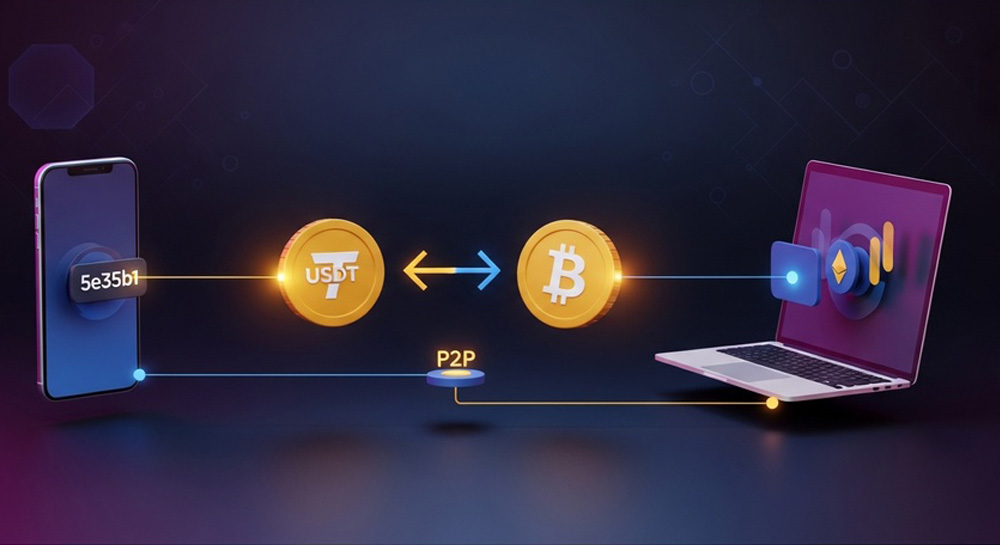
P2P arbitrage is a profit-making strategy based on exploiting price differences of the same cryptocurrency across different platforms, countries, or payment methods. You buy an asset cheaper in one place and sell it at a higher price elsewhere, locking in profit on each transaction. This isn't passive income — it requires your time and attention, but in return, you get a controlled process with clear earning mechanics.
📋 Table of Contents
💡 What is P2P Arbitrage in Simple Terms
Imagine you could buy a dollar for 90 cents at one exchange and immediately sell it for 93 cents at another. That 3-cent difference is your profit. P2P arbitrage works on the same principle, except instead of regular currencies, you use cryptocurrencies, and instead of traditional exchanges, you use P2P platforms on crypto exchanges.
P2P (Peer-to-Peer) is a trading format where transactions occur directly between users, without the exchange acting as an intermediary. The exchange only provides the platform and acts as a security guarantor through an escrow system.
The key advantage of P2P arbitrage over classic exchange arbitrage is that you don't need to hold funds on multiple exchanges and make rapid transfers between them. Everything happens within one or several P2P platforms using fiat currencies and bank transfers.
🎯 Core Method
Finding price imbalances between buyers and sellers on P2P markets and using them to extract profit
💰 Income Source
Price differences arise from variations in supply/demand, geography, payment methods, and transaction speed
⏱️ Time Per Trade
One complete arbitrage cycle takes from 10 minutes to several hours depending on the chosen spread
⚙️ How It Works: The Profit Mechanics
To understand where the profit comes from in P2P arbitrage, you need to understand the nature of price differences in the cryptocurrency market.
Why Do Price Differences Occur?
🌍 Geographic Factor
Demand for cryptocurrency varies across countries. In regions with unstable economies or limited access to banking services, people are willing to pay a premium for the ability to buy crypto.
💳 Payment Methods
Some payment methods are more convenient or secure than others. Buyers often pay 1-3% extra for instant transfers through popular payment systems.
⏰ Time Arbitrage
Rates constantly change, and price updates from different merchants happen at different speeds. This creates temporary windows of opportunity.
📊 Liquidity
In less liquid markets or unpopular trading pairs, the spread between buying and selling is significantly higher, increasing potential profit.
Basic Arbitrage Trade Structure
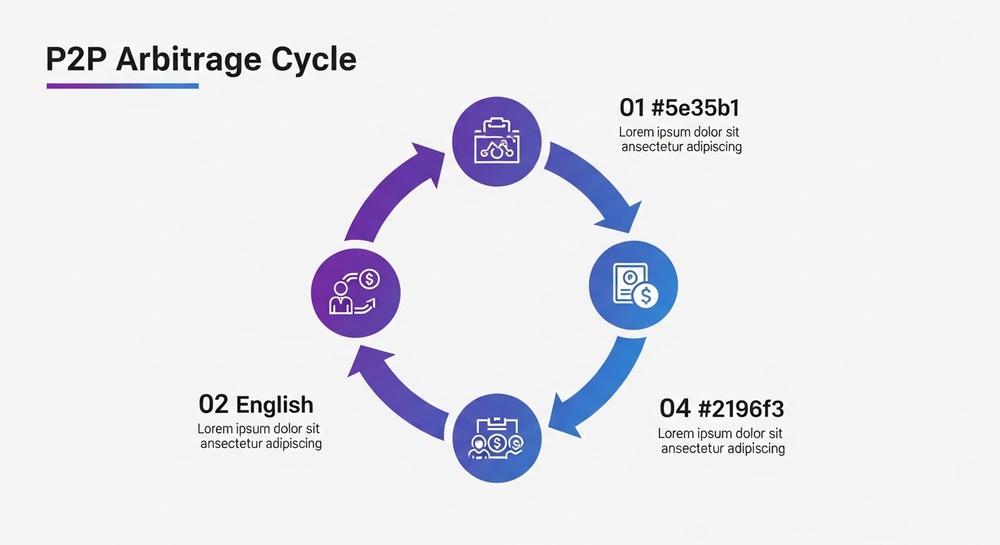
📈 Classic P2P Arbitrage Cycle
💡 Profit Calculation Example
You found a spread where you can buy USDT for $0.98 and sell for $1.01. With a $10,000 turnover, you buy approximately 10,204 USDT and sell them for $10,306. Net profit before fees — $306 or about 3.06% per trade.
📊 Types of P2P Arbitrage
There are several main types of P2P arbitrage, each with its own characteristics, complexity level, and profit potential.
Intra-Exchange Arbitrage (Classic)
🔄 How It Works
You find price differences between buy and sell orders within a single P2P platform. You buy crypto from one user and sell to another at a markup.
Inter-Exchange Arbitrage
🌐 How It Works
You exploit price differences on P2P sections of different exchanges. For example, buy USDT on Bybit and sell on Binance where the price is higher.
International (Geographic) Arbitrage
🗺️ How It Works
You exploit price differences across countries. Cryptocurrency can cost more in countries with currency restrictions or high inflation.
Payment Method Arbitrage
💳 How It Works
You exploit price differences when paying with different methods. Bank transfers are usually cheaper, while payments via e-wallets or cards are more expensive.
Triangular Arbitrage
🔺 How It Works
A chain of three or more conversions: for example, USD → USDT → BTC → USD. Due to quote inefficiencies, the final amount in dollars exceeds the initial one.
| Arbitrage Type | Profit Potential | Complexity | Starting Capital | Trade Time |
|---|---|---|---|---|
| Intra-Exchange | 0.5-2% | Low | From $100 | 10-30 min |
| Inter-Exchange | 2-5% | Medium | From $500 | 30-60 min |
| International | 5-15%+ | High | From $1,000 | 1-24 hours |
| Payment Methods | 1-3% | Low | From $200 | 15-45 min |
| Triangular | 1-4% | High | From $500 | 5-20 min |
📝 Step-by-Step Guide for Beginners
This section is a practical guide for those who want to start earning from P2P arbitrage from scratch. Follow the steps sequentially, without skipping preparation stages.
🚀 Stage 1: Preparation
Step 1.1: Choose Your Exchanges
Start with the largest P2P platforms with high liquidity and reliable protection systems. At the initial stage, 2-3 exchanges are sufficient.
Step 1.2: Complete Verification (KYC)
Verified accounts have higher limits and inspire more trust from counterparties. The process takes from a few minutes to 1-2 days.
Step 1.3: Prepare Payment Instruments
- Bank cards from several banks
- Accounts in payment systems (PayPal, Wise, Revolut, etc.)
- Instant payment services (Zelle, Venmo, etc.)
- If possible — foreign bank cards
Step 1.4: Determine Starting Capital
Recommended minimum for a comfortable start is $300-500. This allows you to work with most listings and not lose a significant portion of profit on fees.
🔍 Stage 2: Finding Spreads
Step 2.1: Market Monitoring
Open the P2P section of the exchange and study current listings. Pay attention to:
- Buy and sell rates for USDT in your currency
- Trade limits (minimum/maximum volume)
- Available payment methods
- Rating and number of trades of merchants
Step 2.2: Calculating Potential Profit
The formula is simple: (Sell Price - Buy Price) / Buy Price × 100% = Spread
Account for all fees: exchange fees (usually 0%), payment system fees (0.5-2%), taxes if necessary.
Step 2.3: Testing the Spread
Before working with large amounts, test the spread with minimum volume. Make sure both counterparties are active and trades go through quickly.
💱 Stage 3: Executing the Trade
Step 3.1: Buying Cryptocurrency
- Select the listing with the best buy price
- Create an order for the desired amount
- Wait for the seller to confirm crypto availability (it will be frozen in escrow)
- Complete payment using the specified method
- Mark payment as complete in the system and wait to receive crypto
Step 3.2: Selling Cryptocurrency
- Find a buyer with the best sell price
- Respond to a listing or create your own
- Your crypto will be frozen in escrow
- Wait for payment from the buyer
- Verify receipt of funds and confirm the trade
⚠️ Critically Important!
NEVER confirm receipt of funds before they actually arrive in your account. Check your balance in your banking app, not from screenshots sent by the buyer.
💰 Profit Maximization Strategies
Experienced arbitrageurs use several strategies to increase profitability and reduce time costs.
Strategy 1: Working as a Merchant
👨💼 Strategy Overview
Instead of responding to others' listings, you create your own. This gives you control over pricing and allows you to work on more favorable terms.
- Buy listing: set a price below market, sellers come to you
- Sell listing: set a price above market, buyers come to you
Strategy 2: Time Arbitrage
⏰ Strategy Overview
Market activity and spreads change throughout the day. Use these patterns:
- Morning (EST): low activity, potentially better rates
- Day/evening: high competition, but more liquidity
- Night/weekends: fewer merchants, wider spreads
Strategy 3: Multi-Currency Spreads
💱 Strategy Overview
Don't limit yourself to one currency pair. Track opportunities in different currencies:
- USD ↔ USDT (base market)
- EUR ↔ USDT (Euro)
- GBP ↔ USDT (British Pound)
- TRY ↔ USDT (Turkish Lira)
- INR ↔ USDT (Indian Rupee)
Strategy 4: Combining with Exchangers
🔄 Strategy Overview
Classic crypto exchangers sometimes offer rates different from P2P. Monitor exchanger aggregators and compare their rates with the P2P market.
🎯 P2P Arbitrage Success Formula
Profitability = (Spread - Fees) × Number of Trades × Turnover
To increase profit, work on each multiplier:
- Look for spreads with larger margins
- Minimize fees (choice of payment methods)
- Increase speed and number of trades
- Gradually scale your trading capital
🏦 Best Platforms for P2P Arbitrage
Choosing the right platforms is critically important for successful arbitrage. Key criteria: liquidity, number of payment methods, fees, and reliability.
| Platform | Liquidity | Payment Methods | Maker Fee | Verification |
|---|---|---|---|---|
| Binance P2P | Very High | 100+ | 0% | Required |
| Bybit P2P | High | 50+ | 0% | Required |
| OKX P2P | High | 60+ | 0% | Required |
| HTX (Huobi) P2P | Medium | 40+ | 0% | Required |
| KuCoin P2P | Medium | 30+ | 0% | Basic possible |
| MEXC P2P | Medium | 25+ | 0% | Required |
💡 Recommendation for Beginners
Start with Binance P2P — it's the most liquid platform with the largest number of merchants and payment methods. After mastering the basic principles, add Bybit and OKX for inter-exchange arbitrage.

⚠️ P2P Arbitrage Risks and How to Avoid Them
P2P arbitrage is not passive income. It's active work that carries certain risks. Understanding these risks and knowing how to minimize them is the key to stable earnings.
🚨 Risk #1: Counterparty Fraud
Description: Fake payment screenshots, bank transfer reversals after receiving crypto, social engineering.
Protection:
- Always verify actual receipt of funds in your banking app
- Don't trust screenshots and SMS — they're easily faked
- Only work with verified merchants with good history
- Don't communicate outside the platform chat — this may void your escrow protection
⚡ Risk #2: Rate Volatility
Description: While you're conducting a trade, the cryptocurrency rate may change, eating into your profit or causing a loss.
Protection:
- Work with stablecoins (USDT, USDC) — they're minimally volatile
- Reduce time between buying and selling
- Avoid arbitrage during strong market movements
- Don't hold crypto "waiting for a better rate" — that's speculation, not arbitrage
🏦 Risk #3: Bank Account Freezes
Description: Frequent transfers between different people may attract bank attention and lead to account freezes under anti-money laundering regulations.
Protection:
- Use multiple cards from different banks, distributing turnover
- Avoid "suspicious" patterns: identical amounts, round-the-clock transfers
- Keep all trade confirmations in case of bank inquiries
- Consider registering as a business to legitimize your activity
- Don't exceed limits that require mandatory reporting
🔒 Risk #4: Exchange Fund Freezes
Description: The exchange may freeze your funds if fraud or rule violations are suspected.
Protection:
- Carefully study P2P trading rules on each platform
- Don't keep all funds on one exchange
- Respond to appeals and support requests as quickly as possible
- Keep chat history and save payment proofs
📉 Risk #5: Spread Closure
Description: Profitable spreads don't last long. When other arbitrageurs find them, the spread narrows and the opportunity disappears.
Protection:
- Constantly search for new spreads — this is part of the job
- Diversify: work with multiple spreads simultaneously
- Don't get attached to one strategy — the market changes
- Use monitoring tools for quick opportunity detection
📊 P2P Arbitrage Risk Matrix
| Risk | Probability | Impact | Manageability |
|---|---|---|---|
| Fraud | Medium | High | High |
| Volatility | Low* | Medium | High |
| Account Freeze | Medium | High | Medium |
| Exchange Freeze | Low | High | Medium |
| Spread Closure | High | Low | Low |
* When working with stablecoins
🛠️ Arbitrage Tools
The right tools significantly simplify work and help find profitable spreads faster than competitors.
Monitoring and Analytics
📊 P2P Rate Screeners
Services that aggregate prices from different P2P platforms in real-time and show potential spreads. Examples: P2P.Army, ArbitrageScanner, and similar tools.
📈 Exchanger Aggregators
BestChange, Exnode, and similar services for comparing crypto exchanger rates with the P2P market.
🤖 Telegram Bots
Bots for rate monitoring and alerts about profitable spread opportunities. Many arbitrageurs create their own bots.
📱 Exchange Mobile Apps
Official apps with push notifications about new trades and rate changes.
Financial Tools
Record Keeping and Documentation
📒 What to Track
- Date and time of each trade
- Platform, counterparty, rate
- Amounts in fiat and crypto
- Fees (exchange, bank)
- Final profit/loss
- Screenshots of chats and confirmations
❌ Common Beginner Mistakes
Learning from others' mistakes is the best way to avoid your own. Here are the most common problems that beginning arbitrageurs face.
❌ Trading Without Testing
Jumping in with large amounts without testing the spread on minimum volume. Result — losses due to hidden fees or inactive counterparties.
❌ Ignoring Fees
Not accounting for all fees: bank transfers, currency conversions, withdrawals. As a result, a "profitable" spread turns out to be a loss.
❌ Trusting Screenshots
Confirming receipt of funds based on a screenshot from the buyer without verifying actual money arrival in the bank.
❌ Working with Unverified Merchants
Choosing counterparties only by price, ignoring rating, number of trades, and reviews.
❌ Lack of Diversification
Using one spread, one bank, one exchange. Any problem means losing the ability to work.
❌ Emotional Decisions
Trying to "recover" after a losing trade by increasing volumes and risking even more.
🎓 The Main Rule of Arbitrage
If a trade seems too good to be true — it probably is. An abnormally high spread often means fraud or hidden risks.
❓ Frequently Asked Questions
How much can you realistically earn from P2P arbitrage?
Profitability varies greatly depending on capital, working hours, and chosen strategies. Beginning arbitrageurs typically earn 5-15% per month on their working capital. Experienced merchants with large capital can achieve 30-50% and higher. However, it's important to understand: this is active income requiring constant attention.
Do I need to pay taxes on arbitrage profits?
Yes, arbitrage income is subject to taxation. In the US, this falls under capital gains tax. It's recommended to consult with a tax professional and keep records of all transactions. Many professional arbitrageurs register as businesses or report as self-employed.
Can P2P arbitrage be automated?
Partially — yes. You can automate rate monitoring and spread hunting using bots and scripts. However, P2P trades themselves require manual payment confirmation, which excludes full automation. Exchanges also fight bots and may block accounts for suspicious activity.
How much time do I need to dedicate to arbitrage?
Depends on your goals. For "pocket money" earnings, 1-2 hours per day is enough. For serious income, you'll need 4-8 hours of daily work. Some arbitrageurs work at night or on weekends when competition is lower.
What should I do if a counterparty doesn't respond or is scamming?
Don't panic. As long as funds are in escrow, they're protected. Use the appeal function on the platform, provide all evidence (chat screenshots, payment confirmations). Support will review the dispute and make a decision. This is exactly why it's important to keep all correspondence in the official platform chat.
What's the minimum capital needed to start?
Technically, you can start with $50-100, but fees and limits will make work inefficient. Recommended minimum is $300-500 for a comfortable start. Optimal is $1,000+, which allows you to work with most merchants and scale faster.
🚀 Ready to Start Earning with P2P Arbitrage?
P2P arbitrage is a real way to earn money, accessible to everyone. It doesn't require deep technical knowledge or huge starting capital. But it does require discipline, attention to detail, and willingness to learn from your mistakes. Start small, study all the risks, test strategies — and over time, you can turn this into a stable income source.
Disclaimer: This article is for informational purposes only and does not constitute financial advice. Cryptocurrency operations carry risks, including complete loss of funds. Before starting to trade, assess your financial capabilities and consult with a specialist. Make sure your activities comply with the laws of your jurisdiction.